LOCAL GROUP / GALAXY DOSSIER

Andromeda

Our nearest major galactic neighbor

EXPLORE THE INSTRUMENTS
Artist’s reconstruction of Andromeda
BARRED SPIRAL GALAXYARTIST’S RECONSTRUCTION

Light between galaxies ↗

03
MILKY WAYANDROMEDALIGHT IN TRANSIT →
2.5 million yearsLIGHT TRAVEL TIME

Stellar scale ↗

04
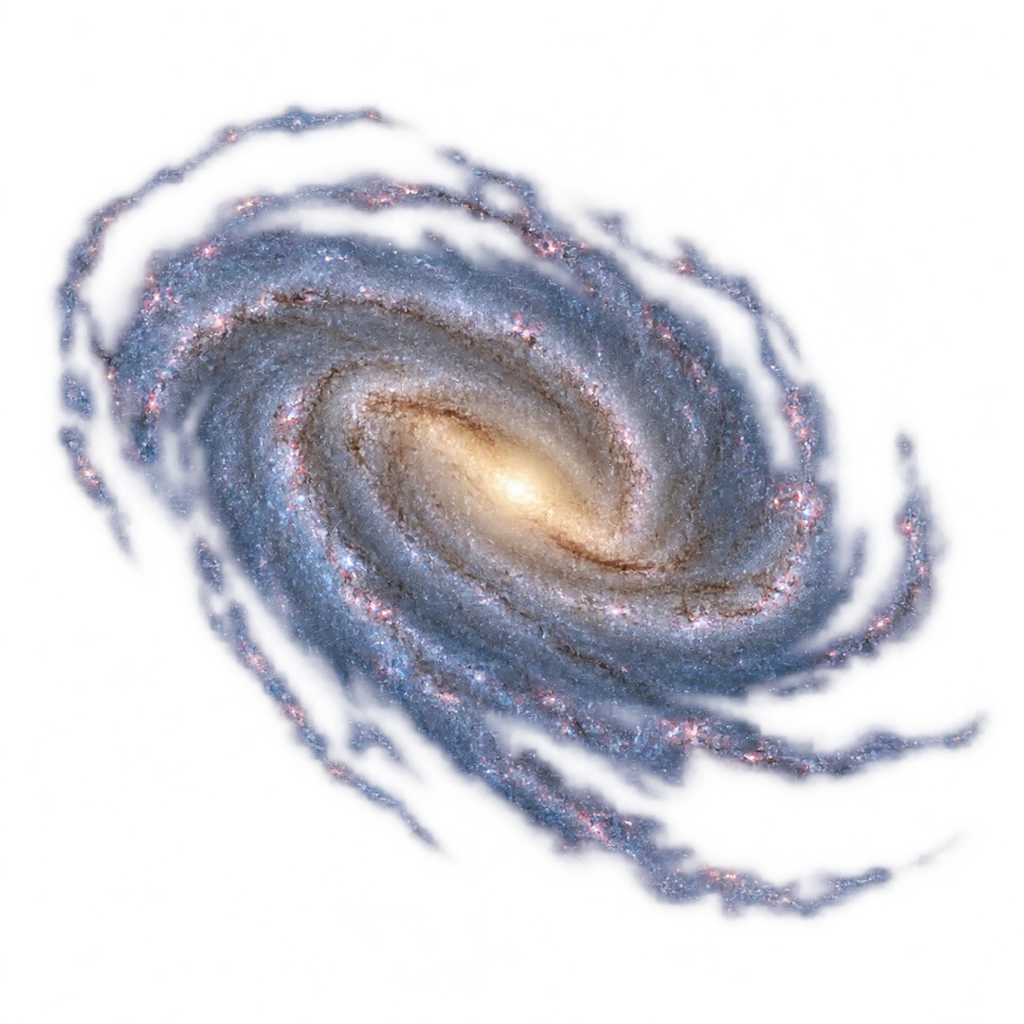
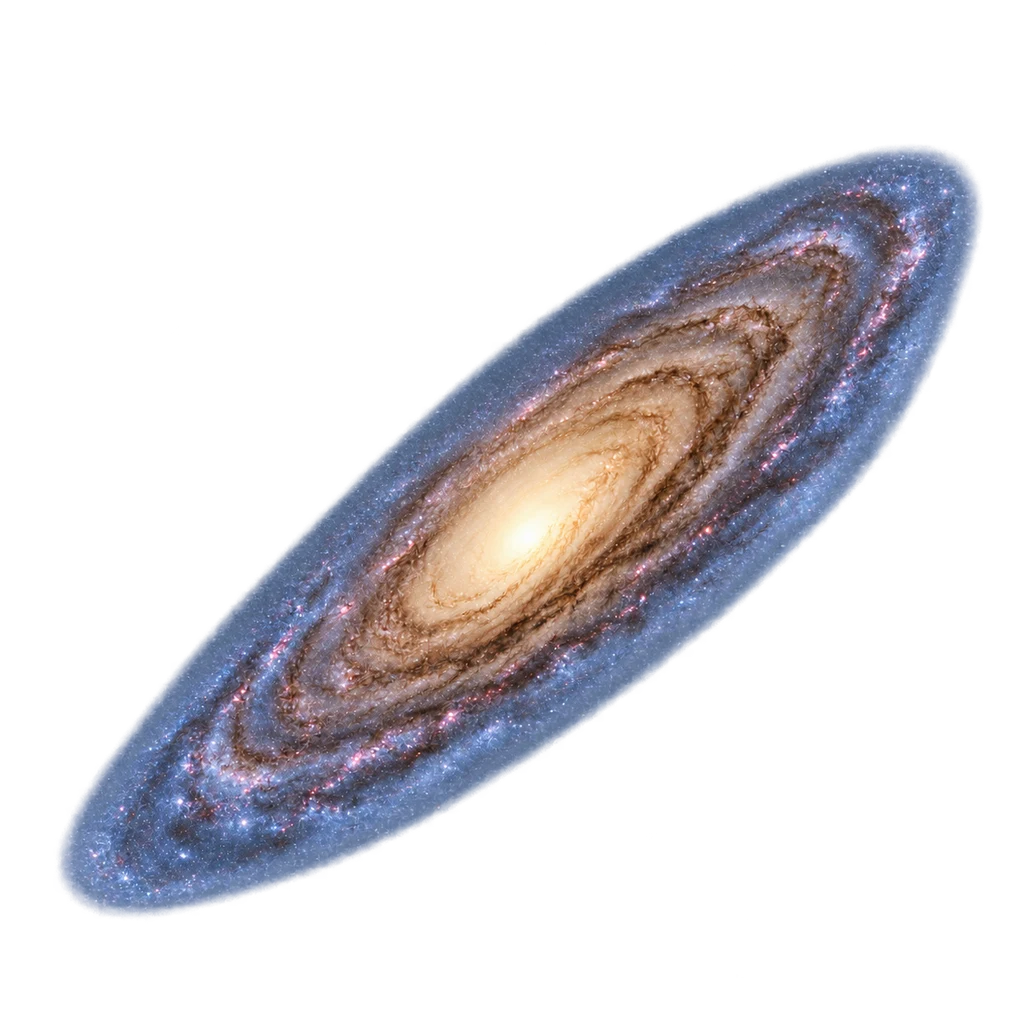
MILKY WAYANDROMEDA≈ 100,000 ly≈ 260,000 lySTELLAR EXTENT · SHARED DIAMETER SCALE
SELECT A LAYER · SCHEMATIC
ANDROMEDA

Instrument detail

Artist’s reconstruction of Andromeda

Another island of stars.

A luminous spiral beyond our own: Andromeda reveals a vast stellar disk, dark dust lanes and a family of smaller galaxies in the Local Group.

Research-informed artistic reconstruction. Shape, colour and viewing angle are illustrative.

Our nearest major galactic neighbor

Andromeda, also catalogued as Messier 31 or M31, is about 2.5 million light-years from us. The light reaching us today began its journey roughly 2.5 million years ago. It is the nearest large galaxy; smaller satellite galaxies lie much closer to the Milky Way.

The moving dashes represent light travelling between galaxies. Their speed and the spacing of the galaxy icons are illustrative.

Find Andromeda in the Universe view ↗

≈ 260,000 light-years across.

This rounded disk extent follows NASA’s Andromeda educational poster. A galaxy fades gradually into its surroundings, so quoted diameters depend on how far into the faint outskirts a measurement reaches. The more diffuse halo extends beyond the stellar disk; it is not included as a sharp boundary here.

The overview compares this galaxy with a rounded Milky Way reference of 100,000 light-years on one linear scale. These luminous extents do not represent sharp physical edges.

MODEL VIEW
ANDROMEDA / SPATIAL SCHEMATICOblique model view · depth and proportions are illustrative

SELECT A LAYER · SCHEMATIC

Turn the model to see how a broad stellar plane narrows in profile. These are illustrative viewpoints, not the galaxy’s measured orientation or a simulation of its motion.

Starlight threaded with dust

Our tilted view compresses Andromeda’s broad spiral disk into an elongated oval. Dark dust lanes cross its bright stellar light, while blue young stars gather in parts of the disk. The central bulge and surrounding halo contain different stellar populations, recording a long history of growth.

Select Halo, Disk or Bulge to highlight each component. This is a schematic model, not a reconstruction of exact proportions. Animation speed is not a physical rotation rate.
M32, M110 & a wider family

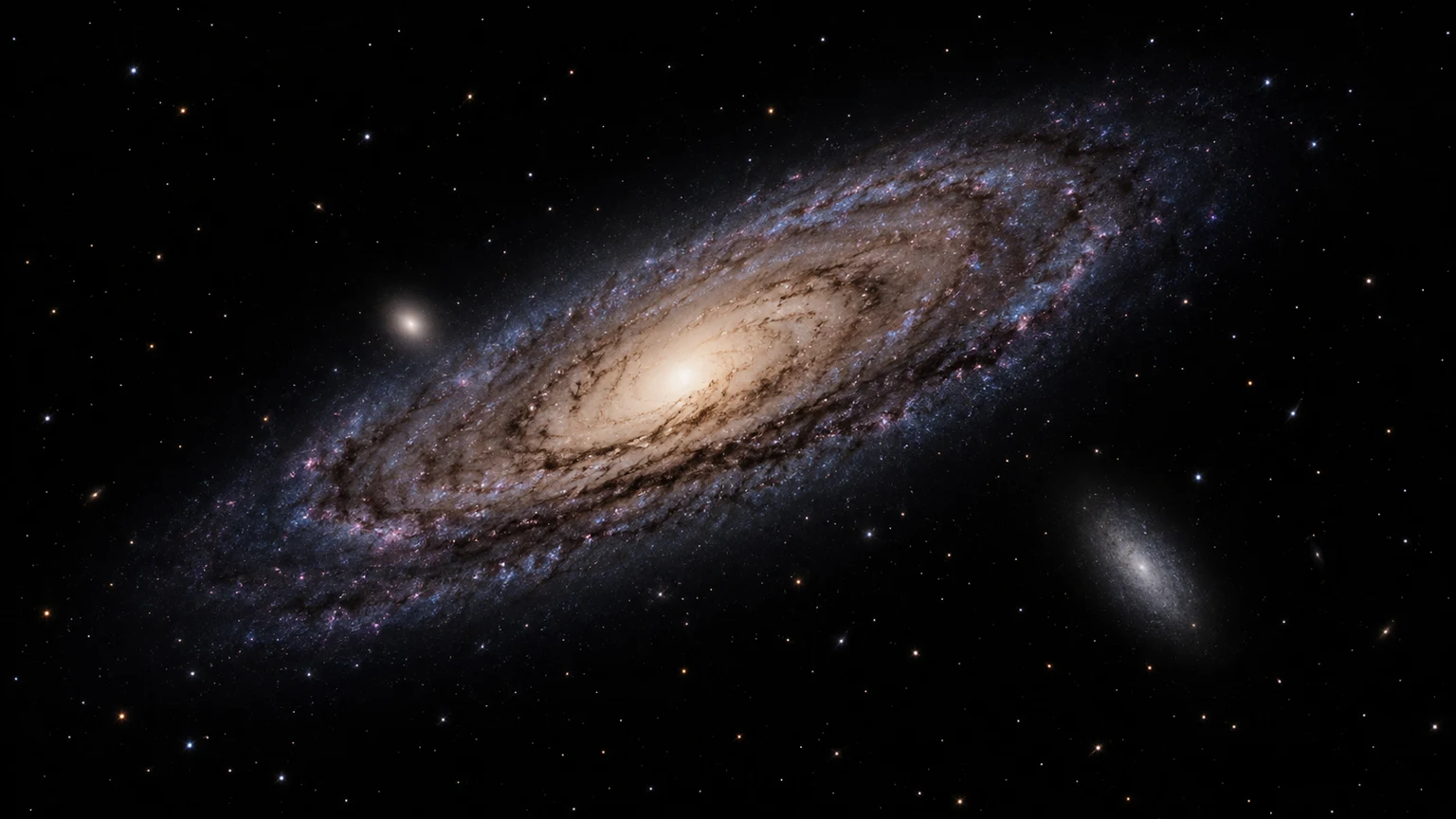
Andromeda is surrounded by smaller satellite galaxies. M32 is a compact, bright companion; M110 appears more diffuse. Together with the Milky Way and other galaxies, Andromeda belongs to the Local Group. The companion scene illustrates their different appearances rather than plotting precise positions or distances.

Explore galaxies in the atlas ↗
Artist’s impression of Andromeda’s tilted stellar disk, bright central bulge and dark dust lanes. Inspired by astronomical observations; not a telescope photograph.

The great spiral

Artist’s impression of Andromeda’s tilted stellar disk, bright central bulge and dark dust lanes. Inspired by astronomical observations; not a telescope photograph.

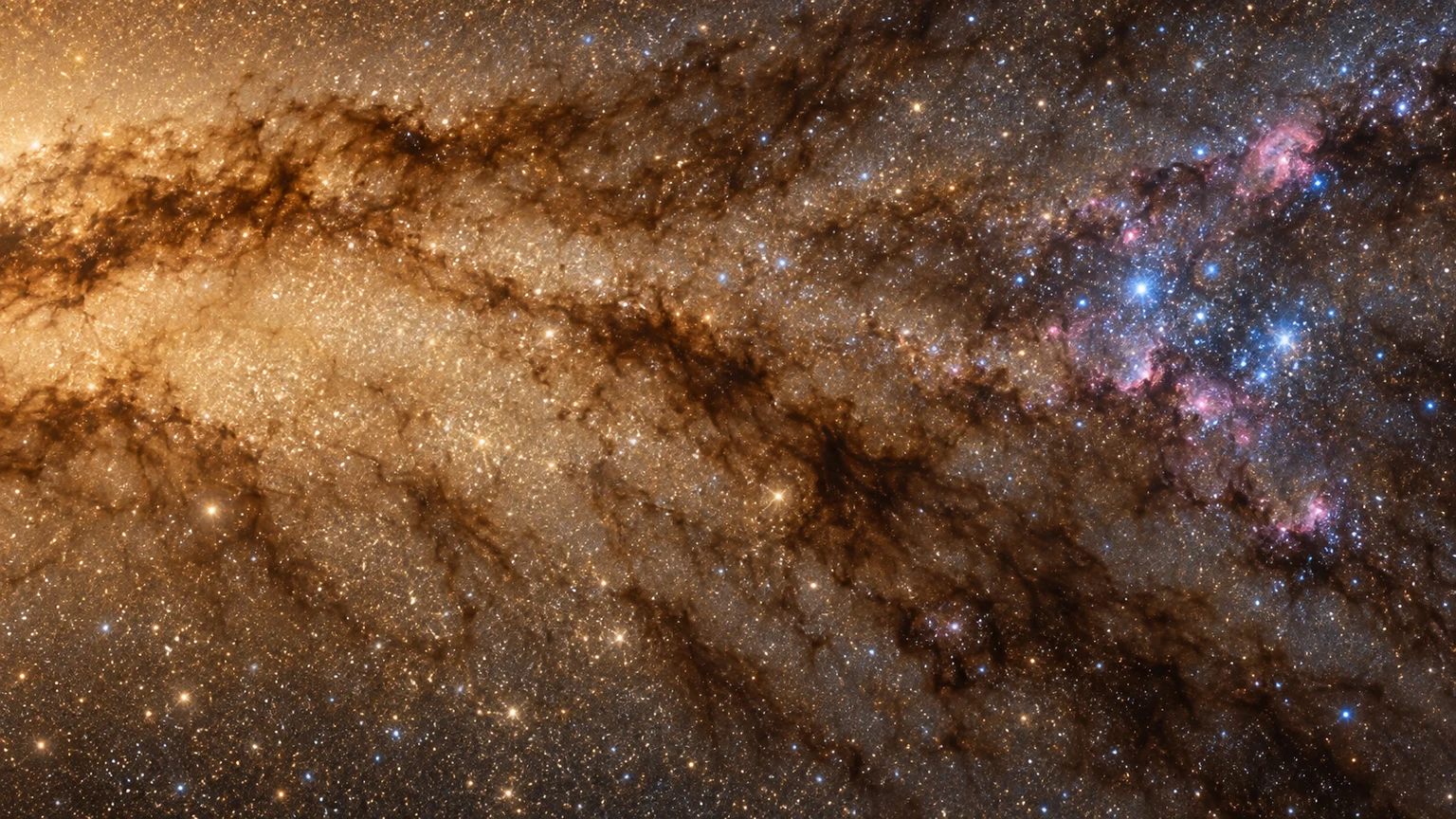
Illustrative close study of an Andromeda-like disk region: dark dust crosses older starlight beside a young blue stellar association. A hypothetical view, not a mapped individual location.

Stars behind the dust

Illustrative close study of an Andromeda-like disk region: dark dust crosses older starlight beside a young blue stellar association. A hypothetical view, not a mapped individual location.

Artist’s reconstruction of Andromeda with compact M32 and diffuse M110. The arrangement and relative brightness are illustrative, not a measured sky chart.

A galaxy and its companions

Artist’s reconstruction of Andromeda with compact M32 and diffuse M110. The arrangement and relative brightness are illustrative, not a measured sky chart.