LOCAL GROUP / GALAXY DOSSIER

Milky Way

Our home galaxy.

EXPLORE THE INSTRUMENTS
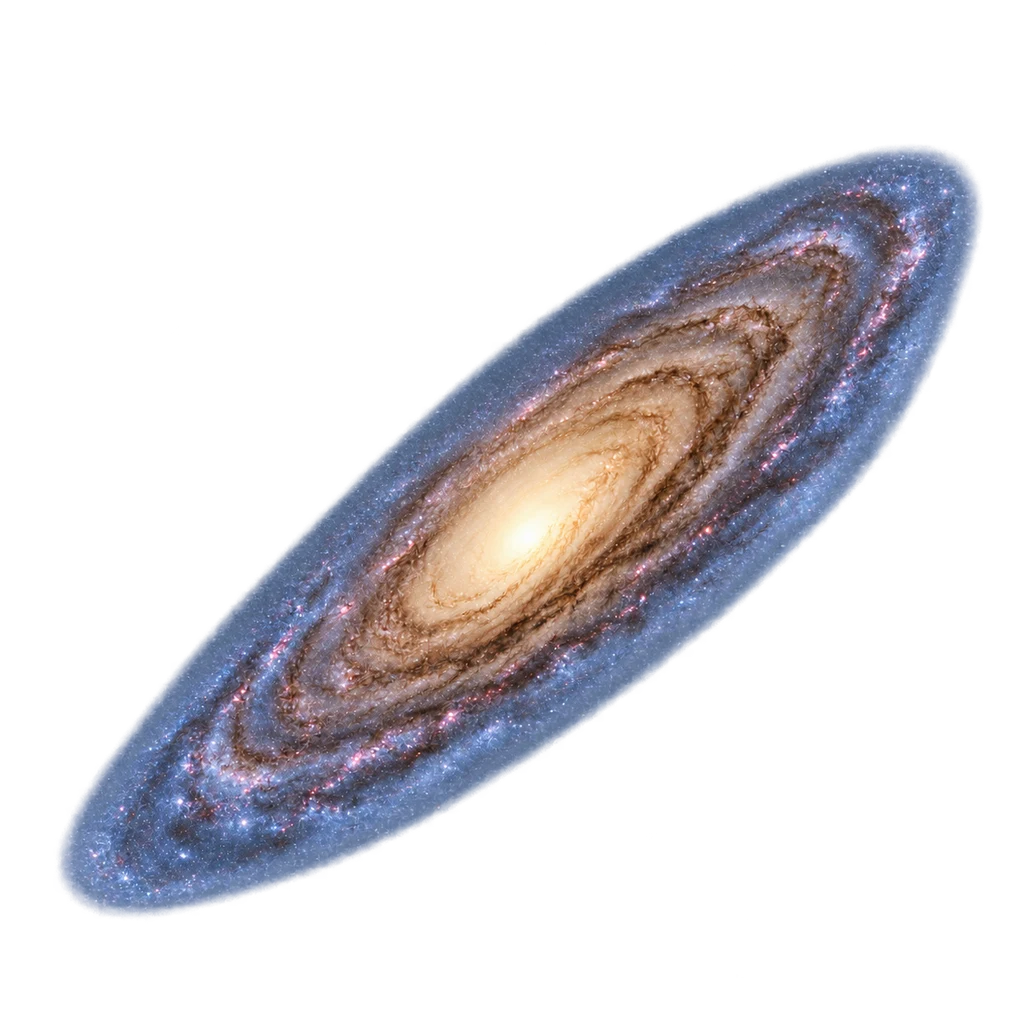
Artist’s reconstruction of Milky Way
BARRED SPIRAL GALAXYARTIST’S RECONSTRUCTION

Light between galaxies ↗

03
MILKY WAYANDROMEDALIGHT IN TRANSIT →
2.5 million yearsLIGHT TRAVEL TIME

Stellar scale ↗

04
MILKY WAYANDROMEDA≈ 100,000 ly≈ 260,000 lySTELLAR EXTENT · SHARED DIAMETER SCALE
SELECT A LAYER · SCHEMATIC
MILKY WAY

Instrument detail

Artist’s reconstruction of Milky Way

The galaxy we call home.

Every star you explore nearby belongs to a much larger home: a spiral galaxy of stars, gas and dust, seen from within its disk.

Research-informed artistic reconstruction. Shape, colour and viewing angle are illustrative.

Our home galaxy

The Milky Way is the origin of this route. Zero marks our home galaxy, not the distance from the Sun to its centre. The Universe view places other galaxies by their approximate distance from us.

The moving dashes represent light travelling between galaxies. Their speed and the spacing of the galaxy icons are illustrative.

Find Milky Way in the Universe view ↗Explore our nearby stars ↗

100,000+ light-years across.

The stellar disk spans more than 100,000 light-years. A galaxy has no hard edge: its sparse halo and dark matter extend beyond the bright disk. This figure describes the disk, not the full halo.

The overview compares this galaxy with a rounded Milky Way reference of 100,000 light-years on one linear scale. These luminous extents do not represent sharp physical edges.

MODEL VIEW
MILKY WAY / SPATIAL SCHEMATICOblique model view · depth and proportions are illustrative

SELECT A LAYER · SCHEMATIC

Turn the model to see how a broad stellar plane narrows in profile. These are illustrative viewpoints, not the galaxy’s measured orientation or a simulation of its motion.

A bar, a disk, a halo

A central bar of stars sits within a broad spiral disk. Gas and dust trace the arms, while a diffuse halo surrounds the disk. From our position inside, overlapping stars and dust turn this structure into the band of the Milky Way across the sky.

Select Halo, Disk or Bulge to highlight each component. This is a schematic model, not a reconstruction of exact proportions. Animation speed is not a physical rotation rate.
The Local Group

Our galaxy belongs to the Local Group, alongside Andromeda and many smaller galaxies. Satellite galaxies orbit the larger members; the nearest large spiral is therefore not the nearest galaxy of any size.

Explore galaxies in the atlas ↗
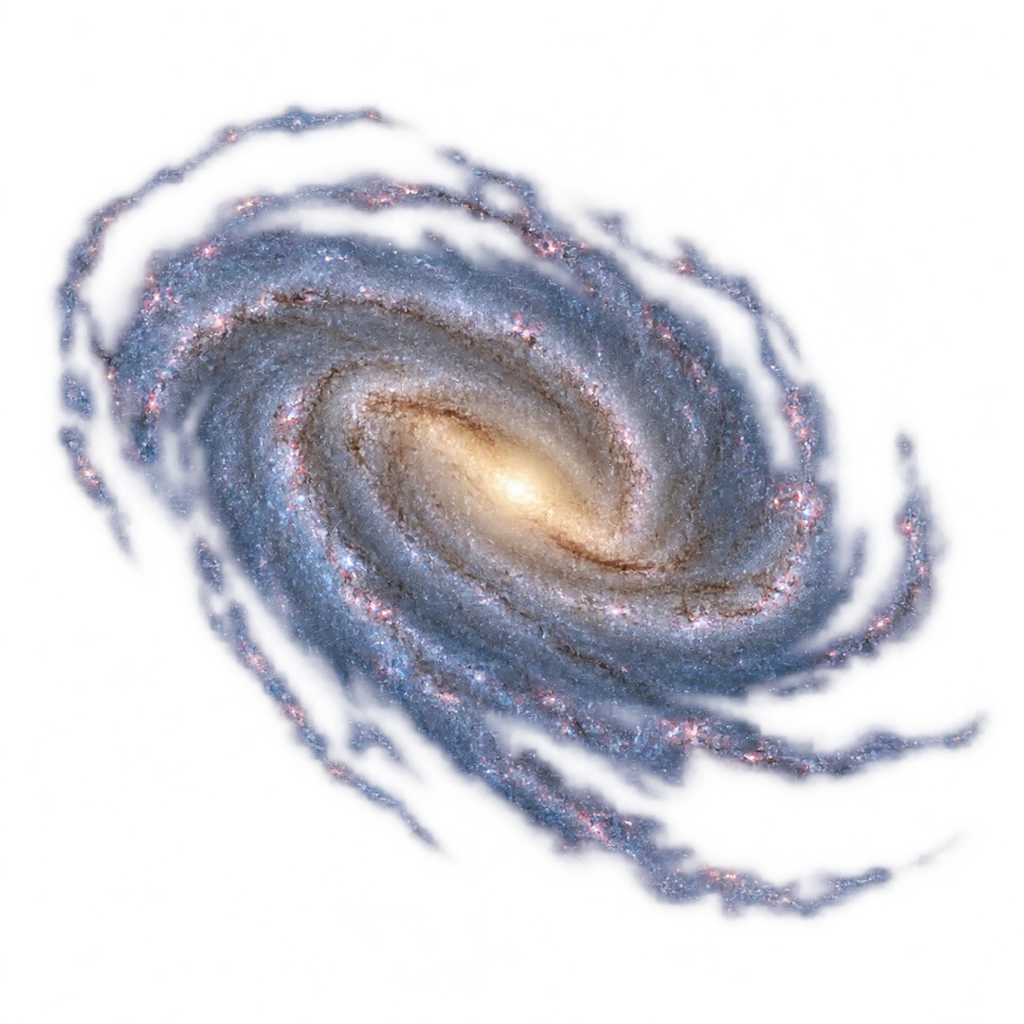
Artist’s reconstruction of an external view of the Milky Way. Its central bar, dust and spiral arms are illustrative; no spacecraft has photographed our entire galaxy from outside.

Above the spiral

Artist’s reconstruction of an external view of the Milky Way. Its central bar, dust and spiral arms are illustrative; no spacecraft has photographed our entire galaxy from outside.

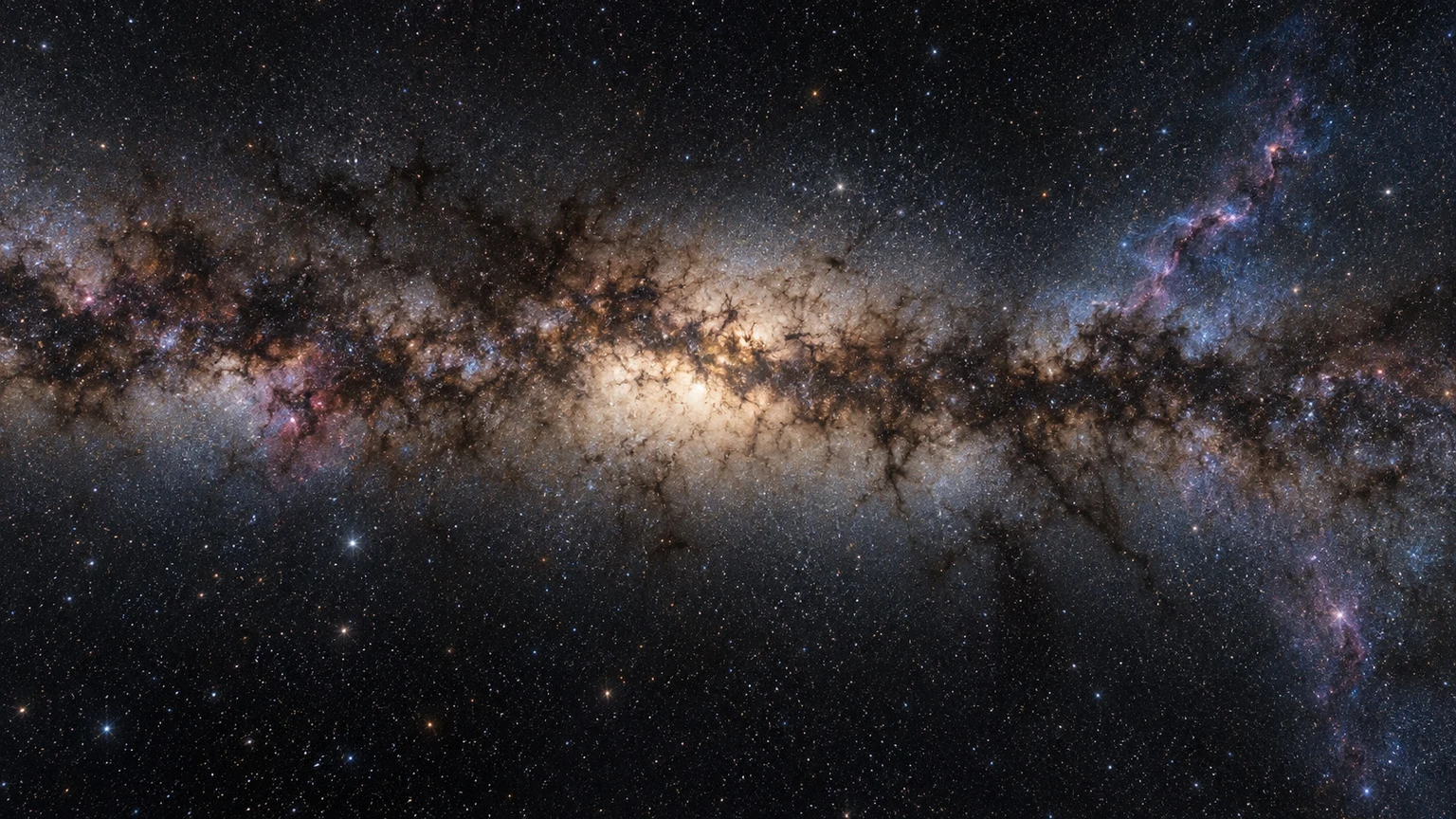
Illustrative view from within a galactic disk: countless stars form a pale band, interrupted by dark dust clouds. A hypothetical viewpoint, not a telescope photograph.

Inside the disk

Illustrative view from within a galactic disk: countless stars form a pale band, interrupted by dark dust clouds. A hypothetical viewpoint, not a telescope photograph.

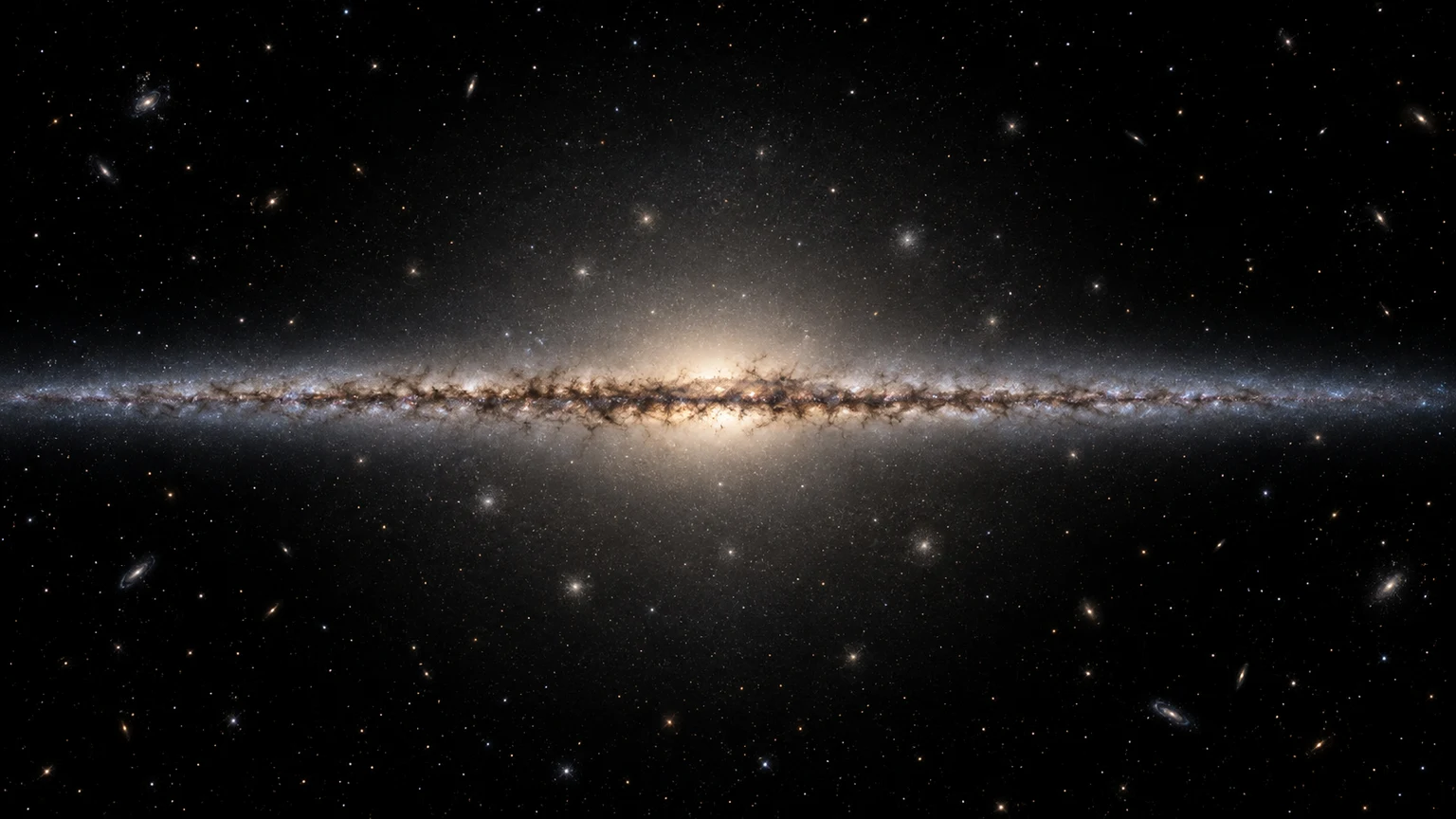
Artist’s reconstruction of the Milky Way seen edge-on. A thin stellar disk and dust lane surround the central bulge; the faint halo stretches above and below.

Along the edge

Artist’s reconstruction of the Milky Way seen edge-on. A thin stellar disk and dust lane surround the central bulge; the faint halo stretches above and below.