SATURN SYSTEM / SATELLITE DOSSIER

Atlas

Atlas is a tiny moon near the outer edge of Saturn’s A ring, wrapped in a broad equatorial ridge.

Interior ↗

03
Atlas interiorAtlas's internal structure is unresolved.Unresolved

Moon system ↗

04
Saturn moon orbitsSelected moons, ordered outward. Orbit sizes and positions are schematic; relative periods are preserved.SATURNPANDAPHNISATLASPROMETHEUSPANDORAEPIMETHEUSJANUSMIMASENCELADUSTETHYSTELESTOCALYPSODIONEHELENERHEATITANHYPERIONIAPETUSPHOEBE
ATLAS

Instrument detail

THE SKY FROM ATLAS

Saturn, in perspective.

SHARED ANGULAR SCALE
Saturn compared with Luna in Earth's skyAt semimajor-axis distance, Saturn spans approximately 51.9 degrees, 100.21 times the apparent diameter of Luna at its mean distance from Earth. Both disks share one angular scale.SATURNOUR MOON≈ 0.52°
Idealized size study · full disks · decorative lighting · rings excluded
ANGULAR DIAMETER
51.9°
OUR MOON'S APPARENT DIAMETER
100.21 ×
CENTER-TO-CENTER DISTANCE
137,700 km

The viewpoint is on Atlas’s nominal spherical surface, directly facing Saturn. The reference is Luna seen from Earth’s center at its mean distance. The reference distance is the orbit’s semimajor axis. Rounded body diameters and orbital elements set the disk sizes; terrain, phases, rings and the actual sky position are not modeled.

Explore Saturn ↗
Atlas orbitElliptical orbit viewed along the orbital axis, relative to Saturn. Motion is accelerated, not a live position. Distances are center to center.SATURNATLAS≈ 137,700 km
ONE ORBIT0.604602 Earth days around Saturn
Closest to Saturn
137,562 km
Farthest from Saturn
137,838 km

Atlas circles Saturn. Distances are measured between the centers of the two bodies.

This mean ellipse omits ring interactions and perturbations from nearby moons.

Atlas rotation compared with EarthThe markers follow equal elapsed time on both worlds. Equal elapsed time and sidereal rotation rates. Polar schematic: sizes, axial tilt and seasons are not shown. Illumination uses a circular mean orbit, not a live sky prediction.SAME ELAPSED TIME · POLAR SCHEMATICATLAS14.5 hoursSIDEREAL ROTATIONPrograde spinEARTH23.9 hoursSIDEREAL ROTATION≈ 24 h · solar day
Marked longitude · equal time on both worlds
ONE SIDEREAL ROTATION14.5 hours

Turning through space

The comparison uses approximately synchronous rotation: Atlas turns roughly once per orbit and keeps broadly the same hemisphere toward Saturn. Fine orientation variations and axial tilt are omitted.

0 Earth hoursShared clock

Spin comparison only; no solar day is inferred. Sizes and starting longitudes are schematic, not live positions.

Satellite atlasMoons
Saturn moon orbitsSelected moons, ordered outward. Orbit sizes and positions are schematic; relative periods are preserved.SATURNPANDAPHNISATLASPROMETHEUSPANDORAEPIMETHEUSJANUSMIMASENCELADUSTETHYSTELESTOCALYPSODIONEHELENERHEATITANHYPERIONIAPETUSPHOEBE
FEATURED MOONS19
  1. 01Pan ↗0.575051 days
  2. 02Daphnis ↗0.59408 days
  3. 03Atlas0.604602 days
  4. 04Prometheus ↗0.615878 days
  5. 05Pandora ↗0.631369 days
  6. 06Epimetheus ↗0.697012 days
  7. 07Janus ↗0.697353 days
  8. 08Mimas ↗0.9424 days
  9. 09Enceladus ↗1.37 days
  10. 10Tethys ↗1.8878 days
  11. 11Telesto ↗1.887802 days
  12. 12Calypso ↗1.887803 days
  13. 13Dione ↗2.7369 days
  14. 14Helene ↗2.736916 days
  15. 15Rhea ↗4.5175 days
  16. 16Titan ↗15.95 days
  17. 17Hyperion ↗21.2767 days
  18. 18Iapetus ↗79.331 days
  19. 19Phoebe ↗550.3039 days

Saturn’s moon system includes hazy Titan and icy Enceladus. Methane lakes on Titan and water jets from Enceladus make these worlds compelling destinations in their own right. Saturn itself takes about 29.4 Earth years to complete an orbit.

Janus and Epimetheus share nearly the same orbital distance and exchange inner and outer positions. Their separated tracks here are schematic; this view does not simulate that exchange. Telesto and Calypso share Tethys’s orbit, roughly 60 degrees ahead and behind. Their tracks and positions are also separated schematically here; co-orbital libration is not simulated. Helene similarly shares Dione’s orbit in the leading region.

Atlas gravityEqual launches at 2 m/s; shared metre scale; air resistance ignored.0 m500 m1000 m1500 mEARTH9.80 m/s²ATLAS0.0016 m/s²NOMINAL ESTIMATE
ATLAS / EARTH GRAVITY0.00017 ×

This is a spherical GM/r² estimate using the mean radius. Atlas’s equatorial ridge, rotation and Saturn’s tides make local effective gravity differ from this simple comparison.

Same push, different gravity

Both balls launch at 2 m/s, using the same height and time scales. Weaker gravity gives a higher jump and a longer time in the air. Air resistance is ignored. This idealized comparison uses constant spherical gravity GM/r²; local terrain, tides and rotation are excluded. Playback runs 206× faster for both balls.

Earth · height / airtime
0.20 m / 0.41 s
Atlas · height / airtime
1232.49 m / 2464.97 s
Atlas interiorAtlas's internal structure is unresolved.Unresolved

Beyond the surface

Atlas’s internal structure is unresolved. Its external shape does not establish separate ice and rock layers or a present-day ocean.

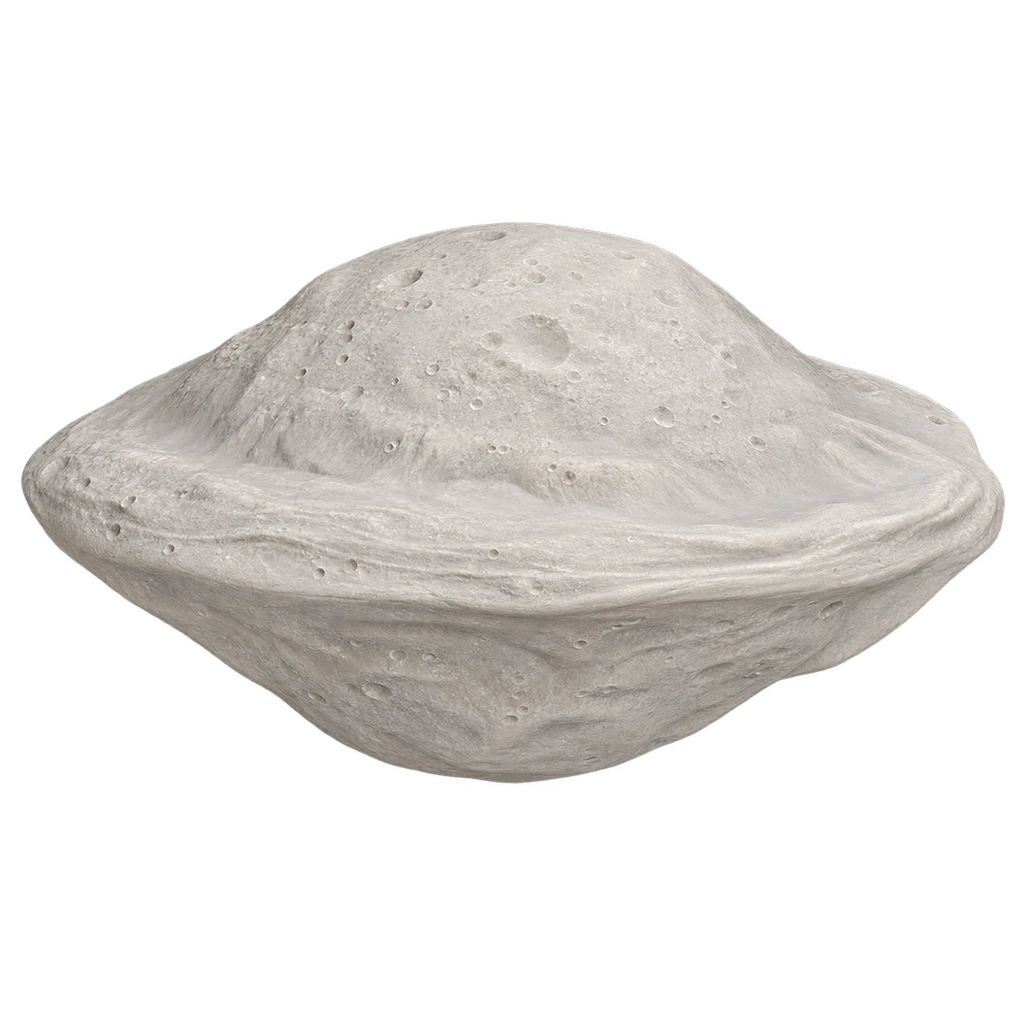
    Artist’s impression of Atlas

    A moon with a wide waist.

    Atlas has a rounded central body surrounded by a broad equatorial ridge. The distinctive outline gives it a saucer-like appearance. The portrait follows this overall form; the ground-level studies imagine local dust, slopes and fragments.

    A small shape in Voyager images.

    The Voyager 1 team identified Atlas in encounter photographs in 1980. Cassini later provided much closer views of this small member of Saturn’s ring environment.

    Low density, unresolved structure.

    The adopted mass and mean size imply a density near 0.39 grams per cubic centimeter. This is consistent with substantial porosity in an ice-rich body. The arrangement of material inside Atlas is unresolved; separate layers or a present-day ocean are not established.

    Just beyond the A ring.

    The adopted mean orbit lies about 137,700 kilometers from Saturn’s center and takes 0.604602 Earth days. The spin instrument uses approximate synchronous rotation. This simple ellipse omits interactions with ring material and neighboring moons.
    DIAMETER / EARTH0.0024×
    EARTHATLAS
    EARTH
    12,742 km
    ATLAS
    30.2 km
    Mean diameters · circles share one scale

    30.2 km is the adopted mean diameter. Atlas is irregularly shaped; this circle represents equivalent size, not its longest dimension.

    ATMOSPHERE
    No substantial atmosphere detectedEffectively airless

    Atlas is effectively airless. No substantial atmosphere is known to provide breathable air or surface pressure.

    SURFACE TEMPERATURE
    Cold exposed surface
    SURFACE PRESSURE
    Effectively airless
    HABITABILITYNo life detected

    No life has been detected, and a habitable environment has not been established.

    UNPROTECTED HUMANSNot survivable

    The exposed surface requires oxygen, pressure protection and thermal control.

    Planet and landscape images are artistic interpretations.

    • NASA ↗
      • Classification and orbital data
      • Rotation and internal structure constraints
      • Natural conditions and human survival
      • Landscape
      • Discovery
    • NASA ↗
      • Parent-body diameter for the angular sky comparison
    • NASA / JPL ↗
      • GM and mean radius; spherical gravity estimate GM/r²
      • Size, physical data and atmospheric constraints
      • Interior
    • NASA / JPL ↗
      • Mean orbital dimensions; distances from parent center
      • Orbit
    • naif.jpl.nasa.gov ↗
      • Rotation model and synchronous or independent spin
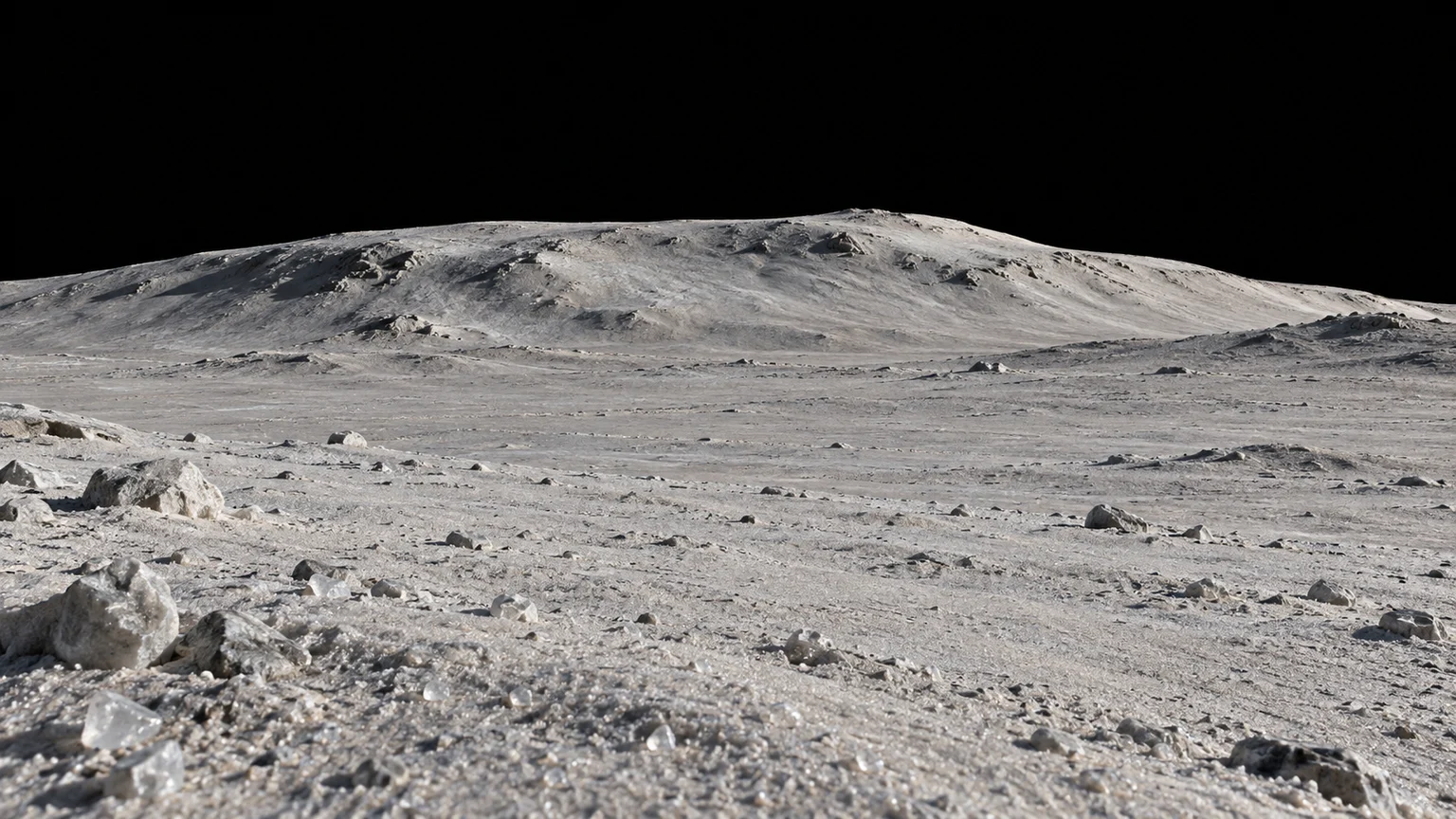
    An artistic reconstruction of icy dust and gentle slopes near Atlas’s equatorial ridge. Local ground features are imagined, not a surveyed site.

    At the foot of the ridge

    An artistic reconstruction of icy dust and gentle slopes near Atlas’s equatorial ridge. Local ground features are imagined, not a surveyed site.

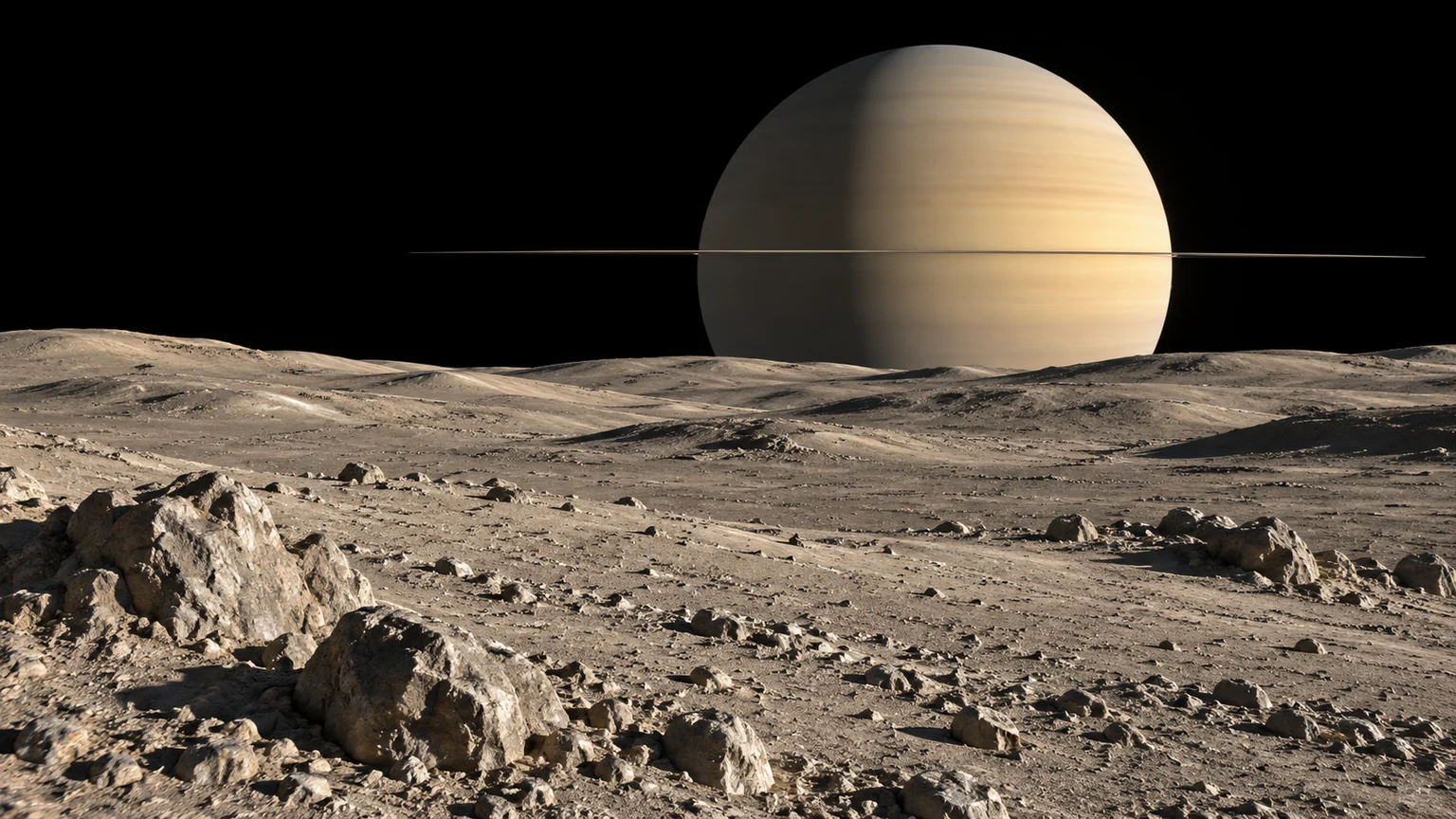
    An imagined view from the Saturn-facing side of Atlas. The nearly edge-on rings, horizon and illumination are artistic interpretations.

    Saturn above Atlas

    An imagined view from the Saturn-facing side of Atlas. The nearly edge-on rings, horizon and illumination are artistic interpretations.

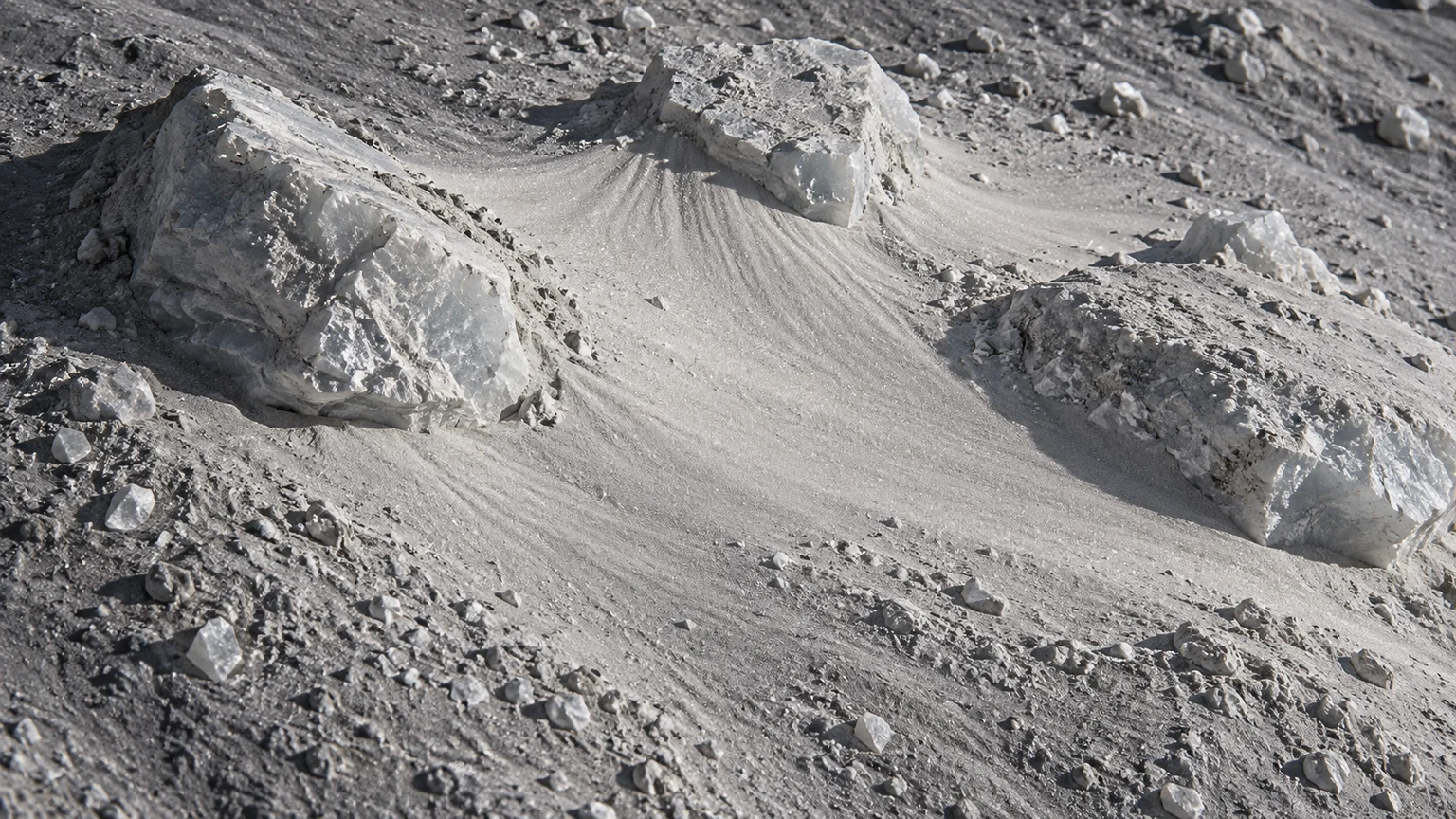
    A fan of pale fine grains collecting against three squat icy fragments. An artistic reconstruction of Atlas; local detail, lighting and viewpoint are imagined.

    Surface fragments in close view

    A fan of pale fine grains collecting against three squat icy fragments. An artistic reconstruction of Atlas; local detail, lighting and viewpoint are imagined.