URANUS SYSTEM / SATELLITE DOSSIER

Bianca

Bianca is a small irregular moon of Uranus, orbiting between Ophelia and Cressida in a little over ten hours.

DIAMETER / EARTH0.0040×
EARTHBIANCA
ATMOSPHERE
No substantial atmosphere detectedEffectively airless
SURFACE TEMPERATURE
Cold exposed surface
SURFACE PRESSURE
Effectively airless
HABITABILITYNo life detected
UNPROTECTED HUMANSNot survivable

Interior ↗

03
Bianca interiorBianca's internal structure is unresolved.Unresolved

Moon system ↗

04
Uranus moon orbitsSelected moons, ordered outward. Orbit sizes and positions are schematic; relative periods are preserved.URANUSCORDELIAOPHELIABIANCACRESSIDADESDEMONAJULIETPORTIAROSALINDCUPIDBELINDAPERDITAPUCKMABMIRANDAARIELUMBRIELTITANIAOBERON
BIANCA

Instrument detail

THE SKY FROM BIANCA

Uranus, in perspective.

SHARED ANGULAR SCALE
Uranus compared with Luna in Earth's skyAt semimajor-axis distance, Uranus spans approximately 51.21 degrees, 98.87 times the apparent diameter of Luna at its mean distance from Earth. Both disks share one angular scale.URANUSOUR MOON≈ 0.52°
Idealized size study · full disks · decorative lighting · rings excluded
ANGULAR DIAMETER
51.21°
OUR MOON'S APPARENT DIAMETER
98.87 ×
CENTER-TO-CENTER DISTANCE
59,170 km

The viewpoint is on Bianca’s nominal spherical surface, directly facing Uranus. The reference is Luna seen from Earth’s center at its mean distance. The reference distance is the orbit’s semimajor axis. Rounded body diameters and orbital elements set the disk sizes; terrain, phases, rings and the actual sky position are not modeled.

Explore Uranus ↗
Bianca orbitElliptical orbit viewed along the orbital axis, relative to Uranus. Motion is accelerated, not a live position. Distances are center to center.URANUSBIANCA≈ 59,170 km
ONE ORBIT0.4347 Earth days around Uranus
Closest to Uranus
58,815 km
Farthest from Uranus
59,525 km

Bianca circles Uranus. Distances are measured between the centers of the two bodies.

This URA184 mean-element path omits inclination, precession, ring dynamics and perturbations. It is not a live position prediction.

Bianca rotation compared with EarthThe markers follow equal elapsed time on both worlds. Equal elapsed time and sidereal rotation rates. Polar schematic: sizes, axial tilt and seasons are not shown. Illumination uses a circular mean orbit, not a live sky prediction.SAME ELAPSED TIME · POLAR SCHEMATICBIANCA10.4 hoursSIDEREAL ROTATIONRetrograde spinEARTH23.9 hoursSIDEREAL ROTATION≈ 24 h · solar day
Marked longitude · equal time on both worlds
ONE SIDEREAL ROTATION10.4 hours

An approximately synchronous model

The standard orientation model is approximately synchronous, with one turn per orbit in the direction of Uranus’s rotation. This rate comparison omits axial tilt and small orientation variations.

0 Earth hoursShared clock

Spin comparison only; no solar day is inferred. Sizes and starting longitudes are schematic, not live positions.

Satellite atlasMoons
Uranus moon orbitsSelected moons, ordered outward. Orbit sizes and positions are schematic; relative periods are preserved.URANUSCORDELIAOPHELIABIANCACRESSIDADESDEMONAJULIETPORTIAROSALINDCUPIDBELINDAPERDITAPUCKMABMIRANDAARIELUMBRIELTITANIAOBERON
FEATURED MOONS18
  1. 01Cordelia ↗0.3347 days
  2. 02Ophelia ↗0.3764 days
  3. 03Bianca0.4347 days
  4. 04Cressida ↗0.4639 days
  5. 05Desdemona ↗0.4736 days
  6. 06Juliet ↗0.4931 days
  7. 07Portia ↗0.5132 days
  8. 08Rosalind ↗0.5583 days
  9. 09Cupid ↗0.6125 days
  10. 10Belinda ↗0.6236 days
  11. 11Perdita ↗0.6382 days
  12. 12Puck ↗0.761833 days
  13. 13Mab ↗0.9229 days
  14. 14Miranda ↗1.41 days
  15. 15Ariel ↗2.5204 days
  16. 16Umbriel ↗4.1442 days
  17. 17Titania ↗8.7059 days
  18. 18Oberon ↗13.4632 days

Faint rings and a family of moons surround Uranus. Many of those moons take their names from characters in Shakespeare and Alexander Pope. One journey around the Sun lasts about 84 Earth years.

GRAVITY UNKNOWNMASS UNCERTAIN
SURFACE GRAVITYUnknown

Mass remains uncertain

The cited mass estimate assumes a density. No measured mass is adopted, so the numerical gravity comparison is omitted.

Bianca interiorBianca's internal structure is unresolved.Unresolved

Beyond the surface

Bianca’s interior remains unresolved. The available observations do not establish distinct layers or a present-day ocean.

    Artist’s impression of Bianca

    A faint discovery before closest approach.

    Bianca was discovered on January 23, 1986 in images from Voyager 2. The flyby revealed a small companion whose surface remained far less resolved than those of Uranus’s major moons.

    An irregular body reduced to one number.

    The adopted equivalent diameter is about 51 kilometers. It represents a sphere of comparable volume, not the moon’s longest axis. Local pits and ridges in the illustrations are imagined.

    A compact circuit around Uranus.

    The adopted orbital scale is 59,170 kilometers from Uranus’s center, with a period of 0.4347 Earth days. This mean ellipse omits inclination, precession and interactions with nearby moons.

    A name from The Taming of the Shrew.

    Originally designated S/1986 U9, Bianca was named after Katharina’s sister in Shakespeare’s play. The familiar name belongs to a world whose local geology and interior remain poorly understood.

    DIAMETER / EARTH0.0040×
    EARTHBIANCA
    EARTH
    12,742 km
    BIANCA
    51.4 km
    Mean diameters · circles share one scale

    Approximately 51.4 km, derived from the ellipsoidal volume in French et al. (2024), Table 3; not the longest dimension.

    ATMOSPHERE
    No substantial atmosphere detectedEffectively airless

    Bianca is effectively airless. No substantial atmosphere is known.

    SURFACE TEMPERATURE
    Cold exposed surface
    SURFACE PRESSURE
    Effectively airless
    HABITABILITYNo life detected

    No life has been detected, and a habitable environment has not been established.

    UNPROTECTED HUMANSNot survivable

    The exposed surface requires oxygen, pressure protection and thermal control.

    Planet and landscape images are artistic interpretations.

    • NASA ↗
      • Classification and orbital data
      • Rotation and internal structure constraints
      • Natural conditions and human survival
      • Discovery
      • Name
    • NASA ↗
      • Parent-body diameter for the angular sky comparison
    • arxiv.org ↗
      • Mass and gravity constraints
      • Size, physical data and atmospheric constraints
      • Scale
    • NASA / JPL ↗
      • Mean orbital dimensions; distances from parent center
      • Orbit
    • naif.jpl.nasa.gov ↗
      • Rotation model and synchronous or independent spin
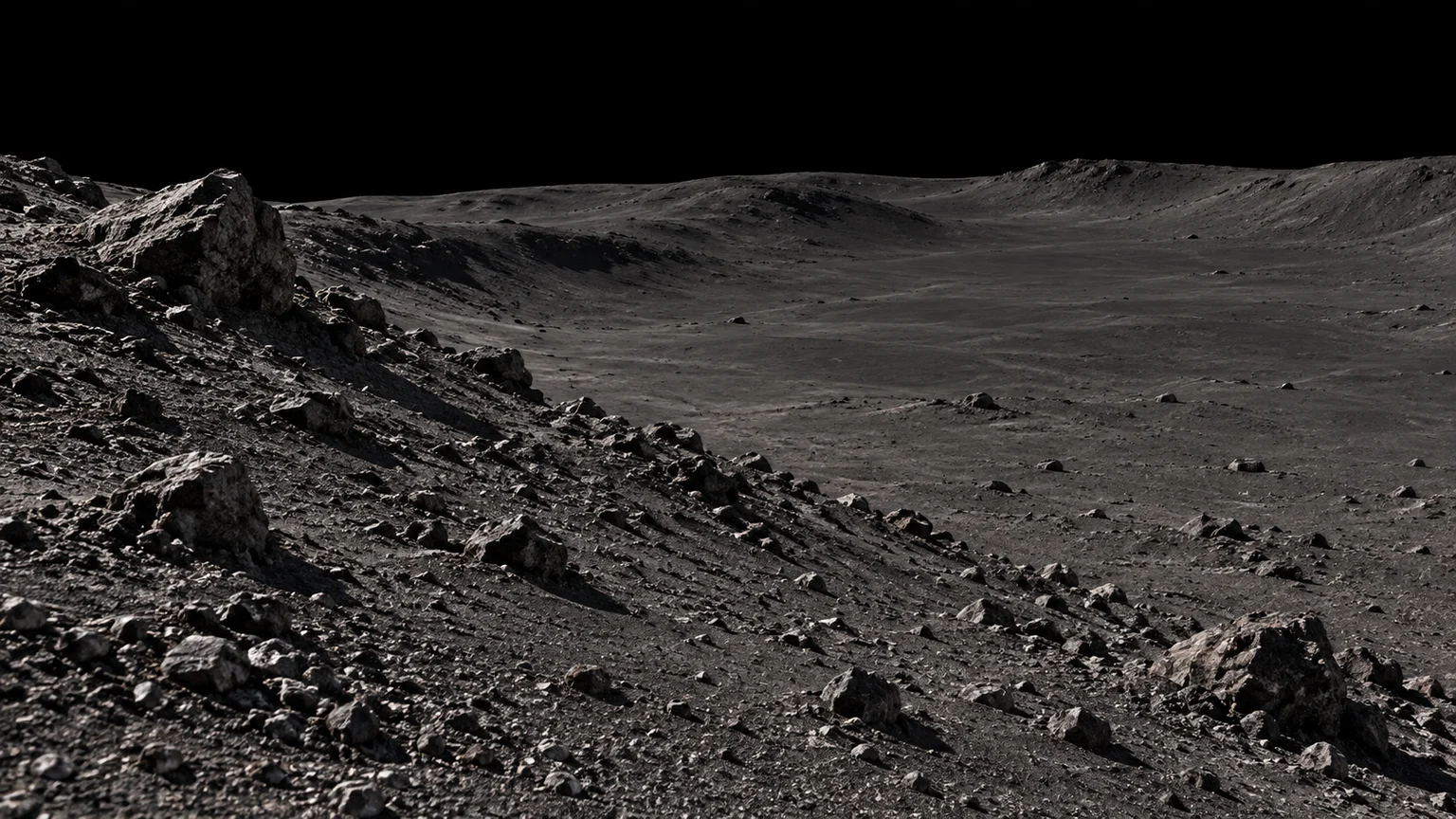
    A speculative ground-level view on Bianca. The fragments, depressions and distant relief are artistic reconstructions.

    Across an imagined hollow

    A speculative ground-level view on Bianca. The fragments, depressions and distant relief are artistic reconstructions.

    An imagined landscape on Bianca. Neither local terrain nor illumination reproduces a spacecraft panorama.

    Along a low rise

    An imagined landscape on Bianca. Neither local terrain nor illumination reproduces a spacecraft panorama.

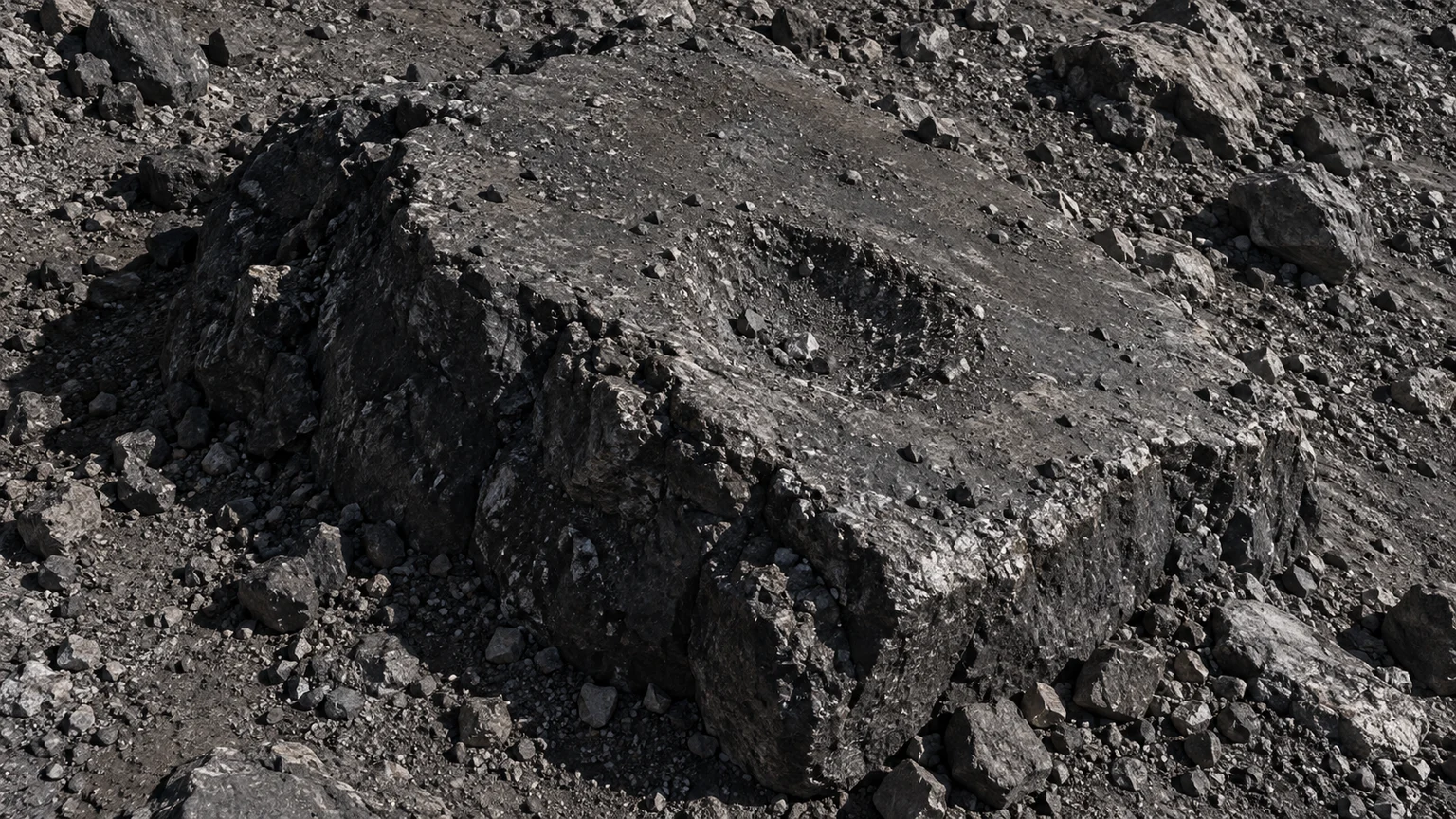
    A dark flat-topped fragment with a shallow pit in its rough face. An artistic reconstruction of Bianca; local detail, lighting and viewpoint are imagined.

    Surface fragments in close view

    A dark flat-topped fragment with a shallow pit in its rough face. An artistic reconstruction of Bianca; local detail, lighting and viewpoint are imagined.