Old hollows under bright debris.
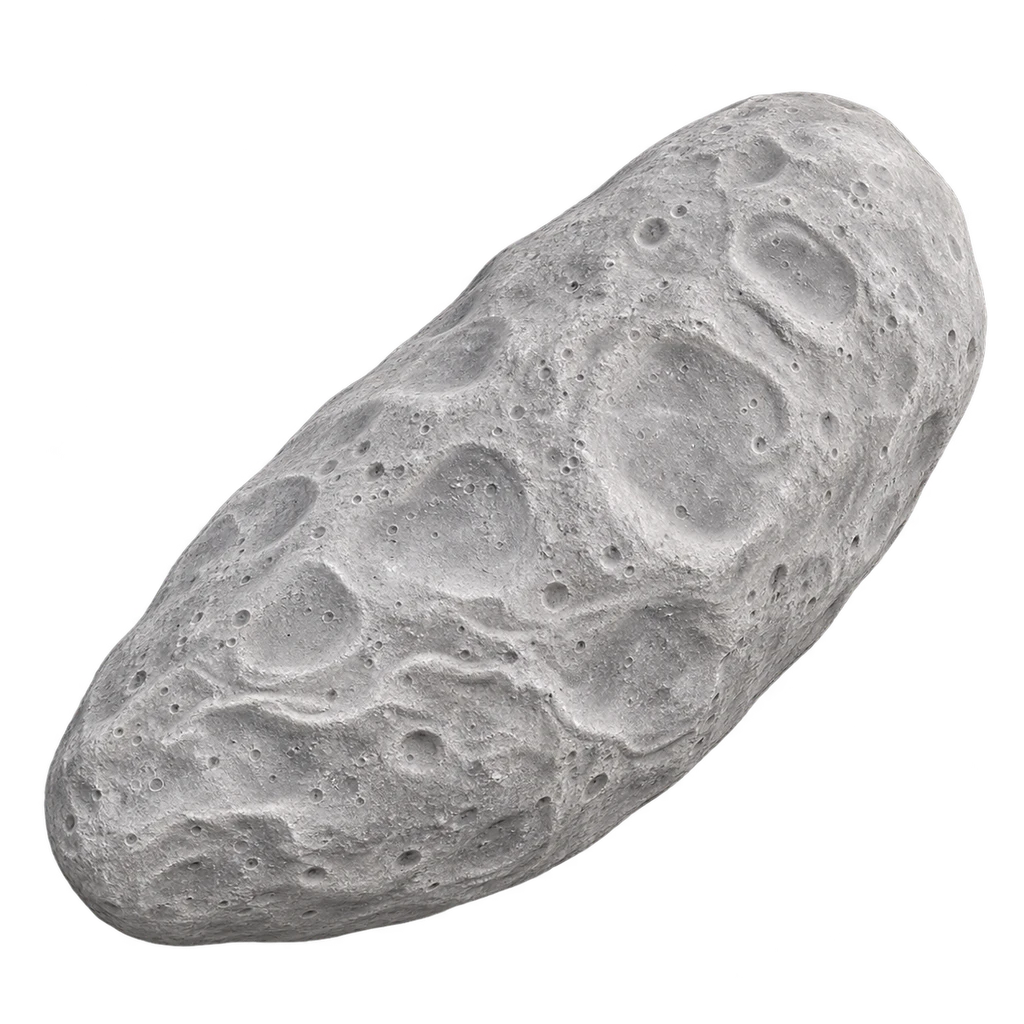
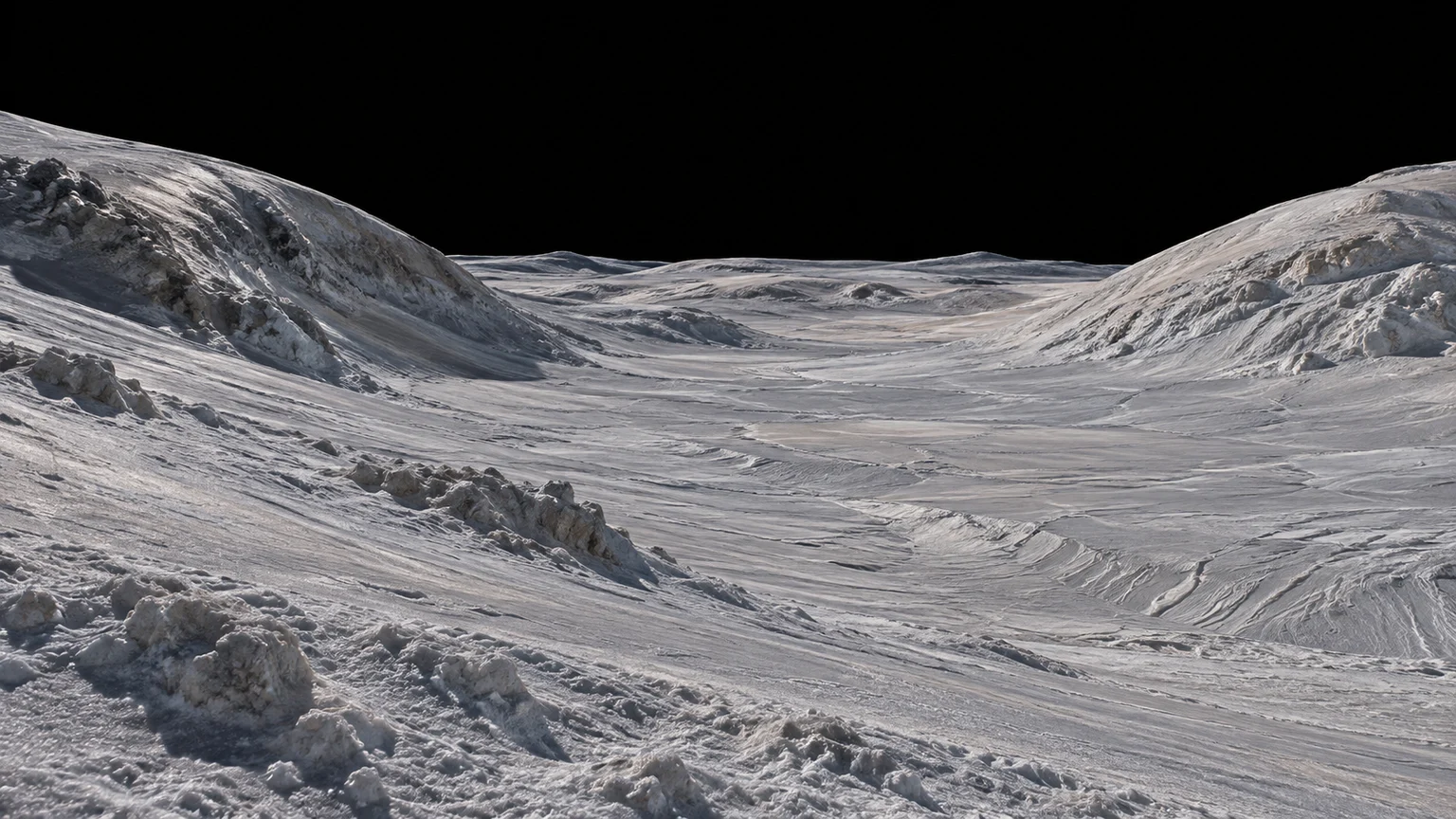
Calypso has an irregular shape influenced by overlapping impact depressions. Loose material appears to smooth its cratered exterior. Its bright surface may receive icy particles from Saturn’s E ring; the landscape studies interpret the terrain at an imagined ground-level scale.
Following the larger moon.
Calypso trails Tethys by roughly 60 degrees, near the L5 region of their shared Saturn-centered orbit. Telesto occupies the leading region. The three moons are co-orbital companions; the separated tracks in the system diagram are schematic.
Brightness does not reveal the layers.
Calypso’s adopted mean diameter is about 21.4 kilometers. The available mass estimate cited here uses an assumed density, so the gravity panel remains unquantified. A differentiated interior or a present-day ocean is not established.
The trailing part of a shared path.
One orbit takes 1.887803 Earth days at a mean orbital scale near 295,000 kilometers. The rotation comparison uses approximate synchronous spin. Neither the mean ellipse nor the system preview simulates the full co-orbital motion around Tethys’s trailing region.