A moon suggested by ripples.
Before Daphnis was identified in Cassini images in May 2005, waves along the Keeler Gap hinted that a small moon was present. Its gravity disturbs the ring particles close to the gap’s edges.
Different speeds, different wakes.
Ring material closer to Saturn moves faster than Daphnis, while material farther out moves more slowly. The resulting waves lead the moon on the inner edge and trail it on the outer edge. The simple orbit view does not model this particle motion.
Small enough for an unusually gentle jump.
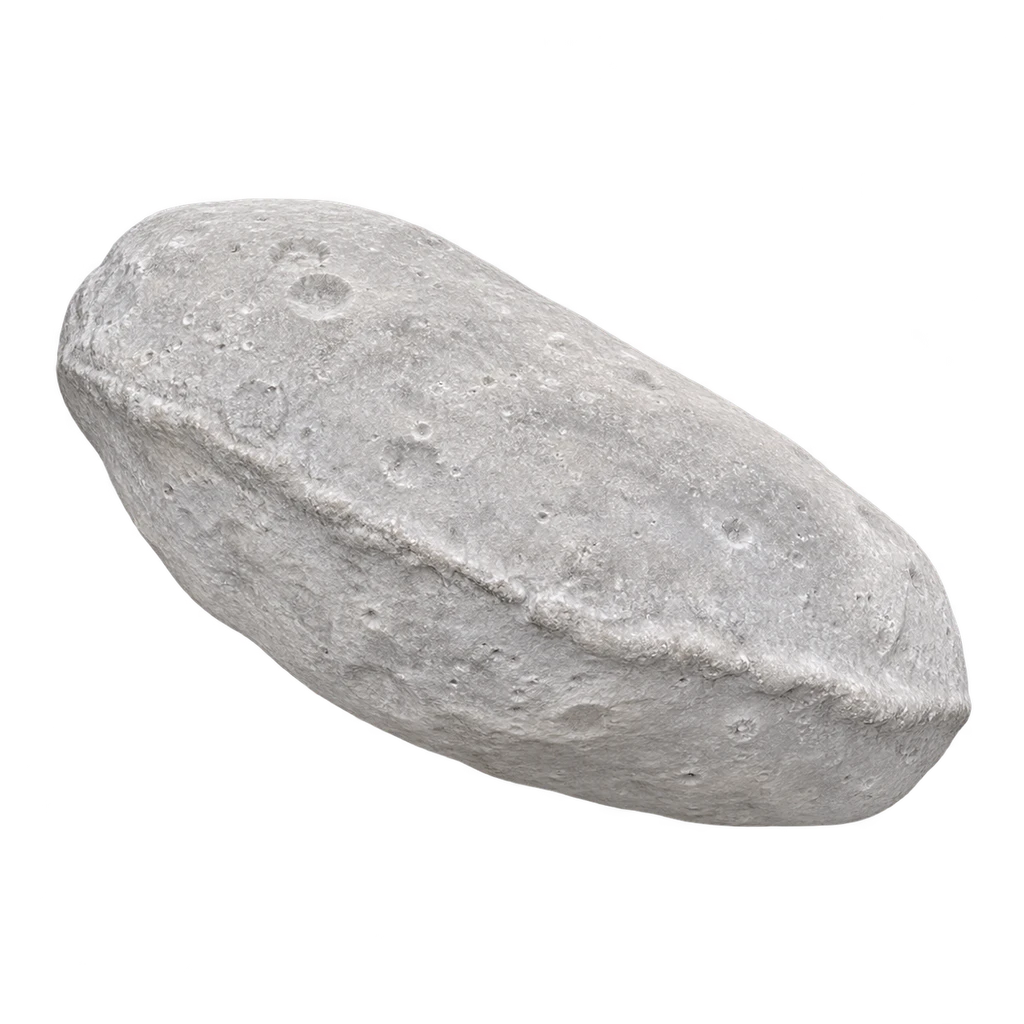
The adopted mean diameter is about 7.6 kilometers. A Cassini-based mass estimate gives very weak gravity, with substantial uncertainty. The jump comparison therefore uses a gentle 0.2 m/s launch. The body’s internal layers remain unresolved.
Within the A ring.
Daphnis circles Saturn at a mean orbital scale near 136,500 kilometers in 0.594080 Earth days. Eccentricity rounds to zero in the adopted table. The rotation illustration assumes synchronous spin; it does not present an independently measured rotation period.