SATURN SYSTEM / SATELLITE DOSSIER

Dione

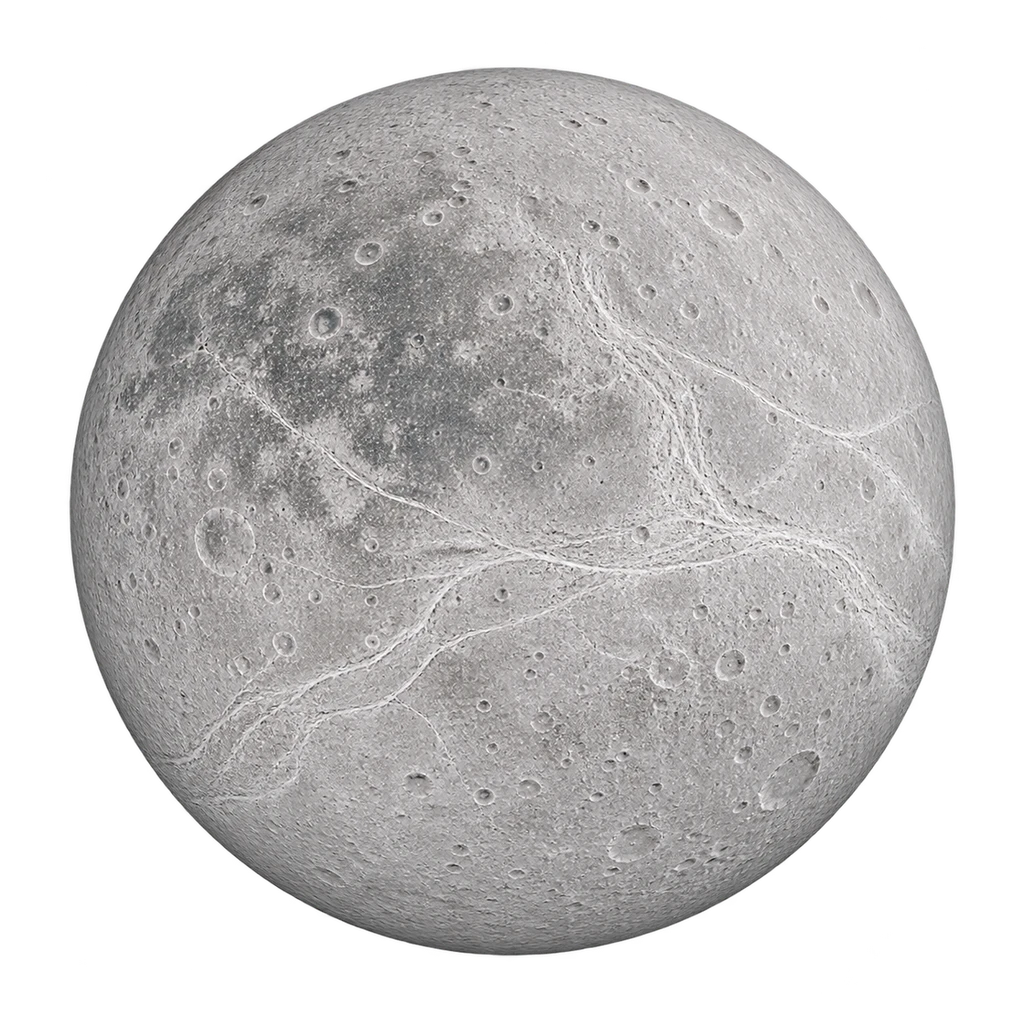
Dione is an icy moon of Saturn whose bright fracture cliffs cross ancient cratered plains.

DIAMETER / EARTH0.09×
EARTHDIONE
ATMOSPHERE
An extremely tenuous oxygen exosphereTrace exosphere · no bulk gas chart
SURFACE TEMPERATURE
Deeply cold icy surface
SURFACE PRESSURE
Extremely tenuous exosphere
HABITABILITYPossible ocean
UNPROTECTED HUMANSNot survivable

Interior ↗

03
Dione interiorDione's internal structure is unresolved.Unresolved

Moon system ↗

04
Saturn moon orbitsSelected moons, ordered outward. Orbit sizes and positions are schematic; relative periods are preserved.SATURNPANDAPHNISATLASPROMETHEUSPANDORAEPIMETHEUSJANUSMIMASENCELADUSTETHYSTELESTOCALYPSODIONEHELENERHEATITANHYPERIONIAPETUSPHOEBE
DIONE

Instrument detail

THE SKY FROM DIONE

Saturn, in perspective.

SHARED ANGULAR SCALE
Saturn compared with Luna in Earth's skyAt semimajor-axis distance, Saturn spans approximately 18.39 degrees, 35.5 times the apparent diameter of Luna at its mean distance from Earth. Both disks share one angular scale.SATURNOUR MOON≈ 0.52°
Idealized size study · full disks · decorative lighting · rings excluded
ANGULAR DIAMETER
18.39°
OUR MOON'S APPARENT DIAMETER
35.5 ×
CENTER-TO-CENTER DISTANCE
377,700 km

The viewpoint is on Dione’s nominal spherical surface, directly facing Saturn. The reference is Luna seen from Earth’s center at its mean distance. The reference distance is the orbit’s semimajor axis. Rounded body diameters and orbital elements set the disk sizes; terrain, phases, rings and the actual sky position are not modeled.

Explore Saturn ↗
Dione orbitElliptical orbit viewed along the orbital axis, relative to Saturn. Motion is accelerated, not a live position. Distances are center to center.SATURNDIONE≈ 377,700 km
ONE ORBIT2.7369 Earth days around Saturn
Closest to Saturn
376,945 km
Farthest from Saturn
378,455 km

Dione circles Saturn. Distances are measured between the centers of the two bodies.

Dione rotation compared with EarthThe markers follow equal elapsed time on both worlds. Equal elapsed time and sidereal rotation rates. Polar schematic: sizes, axial tilt and seasons are not shown. Illumination uses a circular mean orbit, not a live sky prediction.SAME ELAPSED TIME · POLAR SCHEMATICDIONE2.7 daysSIDEREAL ROTATIONPrograde spinEARTH23.9 hoursSIDEREAL ROTATION≈ 24 h · solar day
Marked longitude · equal time on both worlds
ONE SIDEREAL ROTATION2.7 days

Turning through space

Dione turns once in each orbit, so roughly the same hemisphere faces Saturn. The spin period is 2.7369 Earth days; this is not the interval between sunrises.

0 Earth hoursShared clock

Spin comparison only; no solar day is inferred. Sizes and starting longitudes are schematic, not live positions.

Satellite atlasMoons
Saturn moon orbitsSelected moons, ordered outward. Orbit sizes and positions are schematic; relative periods are preserved.SATURNPANDAPHNISATLASPROMETHEUSPANDORAEPIMETHEUSJANUSMIMASENCELADUSTETHYSTELESTOCALYPSODIONEHELENERHEATITANHYPERIONIAPETUSPHOEBE
FEATURED MOONS19
  1. 01Pan ↗0.575051 days
  2. 02Daphnis ↗0.59408 days
  3. 03Atlas ↗0.604602 days
  4. 04Prometheus ↗0.615878 days
  5. 05Pandora ↗0.631369 days
  6. 06Epimetheus ↗0.697012 days
  7. 07Janus ↗0.697353 days
  8. 08Mimas ↗0.9424 days
  9. 09Enceladus ↗1.37 days
  10. 10Tethys ↗1.8878 days
  11. 11Telesto ↗1.887802 days
  12. 12Calypso ↗1.887803 days
  13. 13Dione2.7369 days
  14. 14Helene ↗2.736916 days
  15. 15Rhea ↗4.5175 days
  16. 16Titan ↗15.95 days
  17. 17Hyperion ↗21.2767 days
  18. 18Iapetus ↗79.331 days
  19. 19Phoebe ↗550.3039 days

Saturn’s moon system includes hazy Titan and icy Enceladus. Methane lakes on Titan and water jets from Enceladus make these worlds compelling destinations in their own right. Saturn itself takes about 29.4 Earth years to complete an orbit.

Janus and Epimetheus share nearly the same orbital distance and exchange inner and outer positions. Their separated tracks here are schematic; this view does not simulate that exchange. Telesto and Calypso share Tethys’s orbit, roughly 60 degrees ahead and behind. Their tracks and positions are also separated schematically here; co-orbital libration is not simulated. Helene similarly shares Dione’s orbit in the leading region.

Dione gravityEqual launches at 2 m/s; shared metre scale; air resistance ignored.0 m5 m10 m15 mEARTH9.80 m/s²DIONE0.23 m/s²
DIONE / EARTH GRAVITY0.02 ×

Same push, different gravity

Both balls launch at 2 m/s, using the same height and time scales. Weaker gravity gives a higher jump and a longer time in the air. Air resistance is ignored. This idealized comparison uses constant spherical gravity GM/r²; local terrain, tides and rotation are excluded. Playback runs 2× faster for both balls.

Earth · height / airtime
0.20 m / 0.41 s
Dione · height / airtime
8.62 m / 17.24 s
Dione interiorDione's internal structure is unresolved.Unresolved

Beyond the surface

Cassini gravity and topography studies allow an ice shell above a possible ocean and rock-rich interior. The ocean and its detailed boundaries remain unconfirmed.

    Artist’s impression of Dione

    Wisps become cliffs.

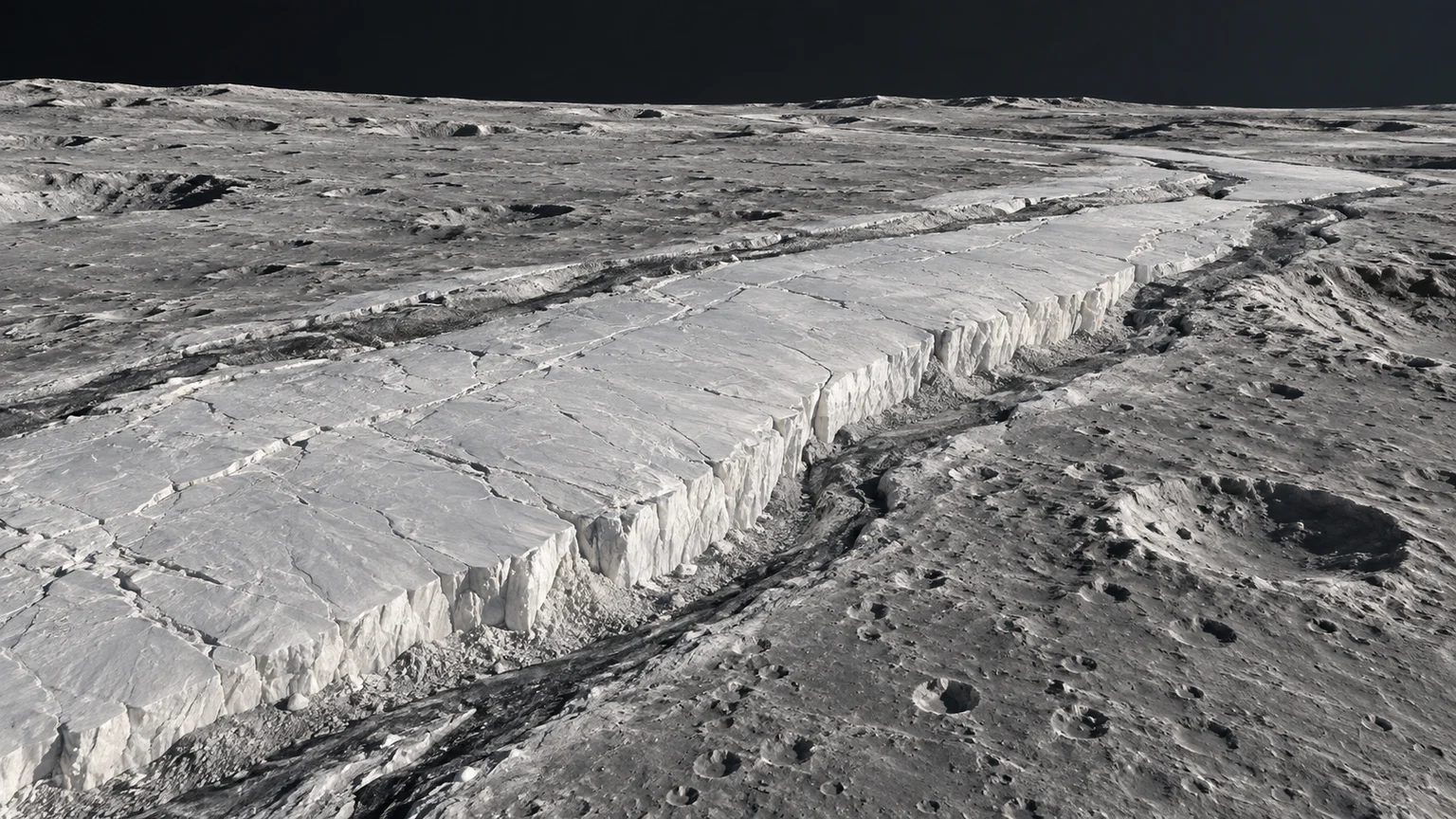
    From a distance, Dione’s bright streaks look almost delicate. Cassini revealed fractured terrain with exposed ice walls cutting across older craters and plains. Darker loose material falls away from some scarps, leaving brighter water ice visible beneath.

    A surface with several histories.

    Dense crater fields stand beside less heavily marked plains. Long fractures record past tectonic movement through this ice-rich crust. Dione also receives fine icy particles from Saturn’s E ring, material ultimately supplied by Enceladus’s plumes.

    Oxygen without breathable air.

    Cassini detected molecular oxygen ions around Dione, evidence of an extremely tenuous exosphere. Energetic particles or sunlight can release oxygen from surface ice. This sparse gas provides neither useful pressure nor breathable air; its presence is not evidence for biology.

    Part of Enceladus’s rhythm.

    Dione circles Saturn in about 2.7369 Earth days, at a mean orbital scale of 377,700 kilometers from the planet’s center. It keeps approximately the same hemisphere facing Saturn. Its orbital resonance with Enceladus links their motions, with the inner moon making about two circuits for each one by Dione.
    DIAMETER / EARTH0.09×
    EARTHDIONE
    EARTH
    12,742 km
    DIONE
    1,122.8 km
    Mean diameters · circles share one scale
    ATMOSPHERE
    An extremely tenuous oxygen exosphereTrace exosphere · no bulk gas chart

    Cassini detected molecular oxygen ions around Dione. The exosphere is far too sparse to provide breathable air or meaningful surface pressure; no bulk gas percentages are assumed.

    SURFACE TEMPERATURE
    Deeply cold icy surface
    SURFACE PRESSURE
    Extremely tenuous exosphere
    HABITABILITYPossible ocean

    Gravity and topography studies permit a subsurface ocean, but its properties and habitability are unresolved. No life has been detected.

    UNPROTECTED HUMANSNot survivable

    The exposed surface requires oxygen, pressure protection and thermal control.

    Planet and landscape images are artistic interpretations.

    • NASA ↗
      • Classification and orbital data
      • Landscape
      • Geology
      • Orbit
    • NASA ↗
      • Parent-body diameter for the angular sky comparison
    • NASA / JPL ↗
      • GM and mean radius; spherical gravity estimate GM/r²
    • NASA / JPL ↗
      • Mean orbital dimensions; distances from parent center
    • NASA ↗
      • Rotation and internal structure constraints
      • Natural conditions and human survival
    • NASA ↗
      • Size, physical data and atmospheric constraints
      • Environment
    An artist’s reconstruction inspired by Dione’s fault scarps. Exposed ice faces cross older terrain; the local cliffs and viewpoint are imagined.

    Where the bright ice breaks through

    An artist’s reconstruction inspired by Dione’s fault scarps. Exposed ice faces cross older terrain; the local cliffs and viewpoint are imagined.

    An imagined view across Dione’s cratered surface and distant fracture cliffs. Earthin, lighting and Saturn’s placement are artistic reconstructions, with nearly edge-on rings.

    A quiet plain beneath Saturn

    An imagined view across Dione’s cratered surface and distant fracture cliffs. Earthin, lighting and Saturn’s placement are artistic reconstructions, with nearly edge-on rings.

    A broad pale exposed ice slab bounded by dark narrow fractures on gray weathered ground. An artistic reconstruction of Dione; local detail, lighting and viewpoint are imagined.

    Details of a fractured slab

    A broad pale exposed ice slab bounded by dark narrow fractures on gray weathered ground. An artistic reconstruction of Dione; local detail, lighting and viewpoint are imagined.