A moon found during Voyager’s approach.
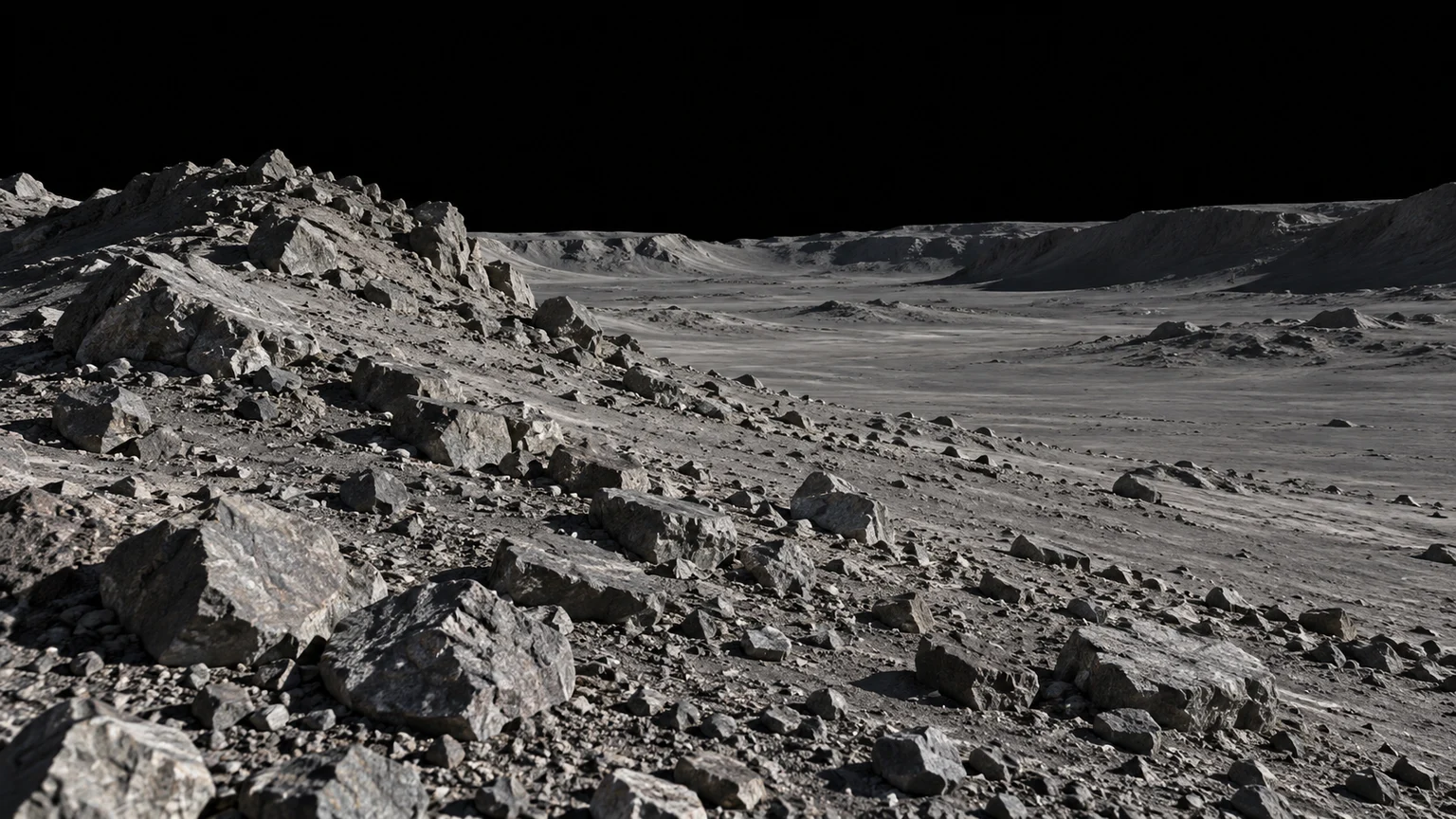
The Voyager 2 science team discovered Galatea in July 1989. The same encounter revealed new details of Neptune’s faint rings and arcs. Spacecraft coverage gives only limited surface information, so the ground-level studies are imagined landscapes.
Gravity beside a fragile ring system.
Galatea moves prograde, close to Neptune’s equatorial plane. Its gravitational influence is associated with disturbances in the rings. The simple orbital display does not simulate ring particles or explain the complete evolution of the arcs.
Size without a secure mass.
The adopted mean diameter is 158 kilometers. The published mass parameter carries an uncertainty larger than the nominal value, so no numerical gravity is assigned here. A measured interior structure or present-day ocean is not established.
A circuit in about ten hours.
The adopted mean path lies 62,000 kilometers from Neptune’s center, with a period of 0.428744 Earth days. Eccentricity rounds to zero in the source table. The spin comparison assumes approximately synchronous rotation rather than a measured surface orientation.