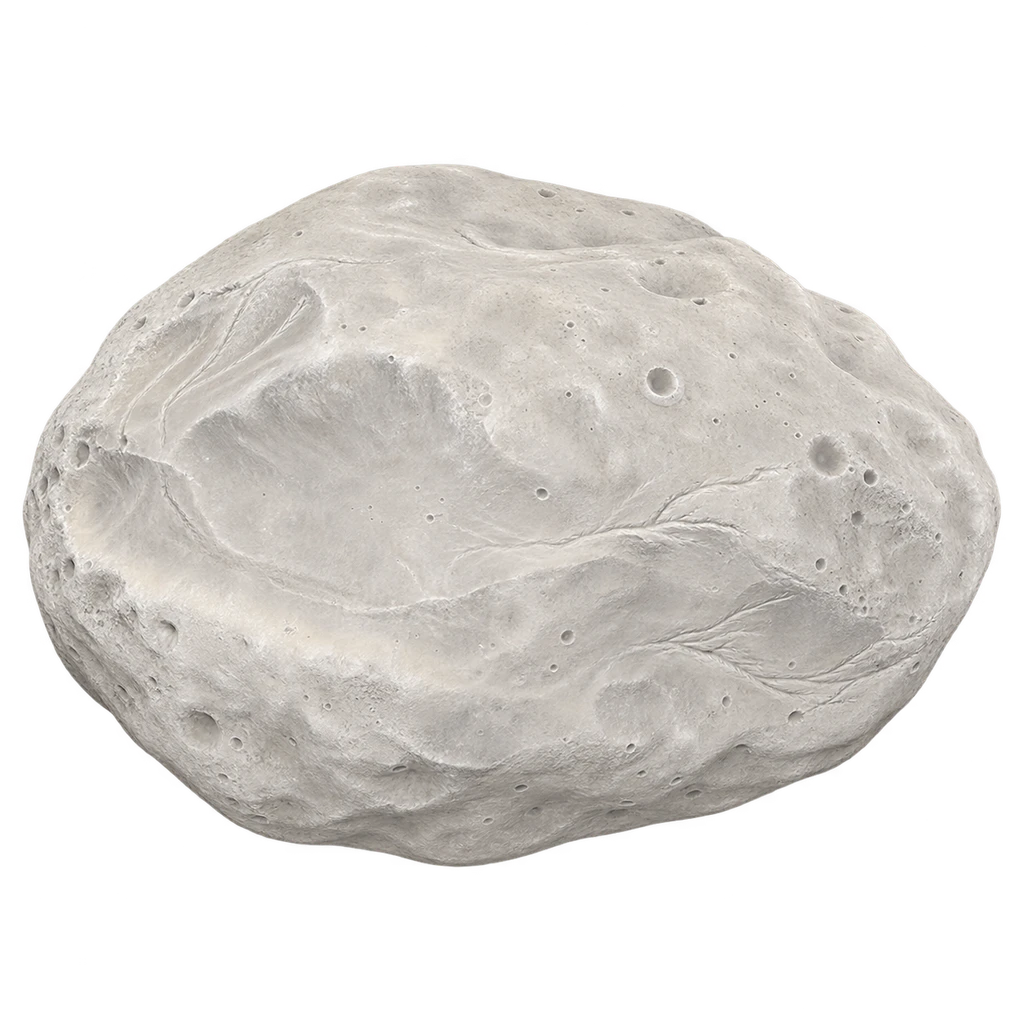
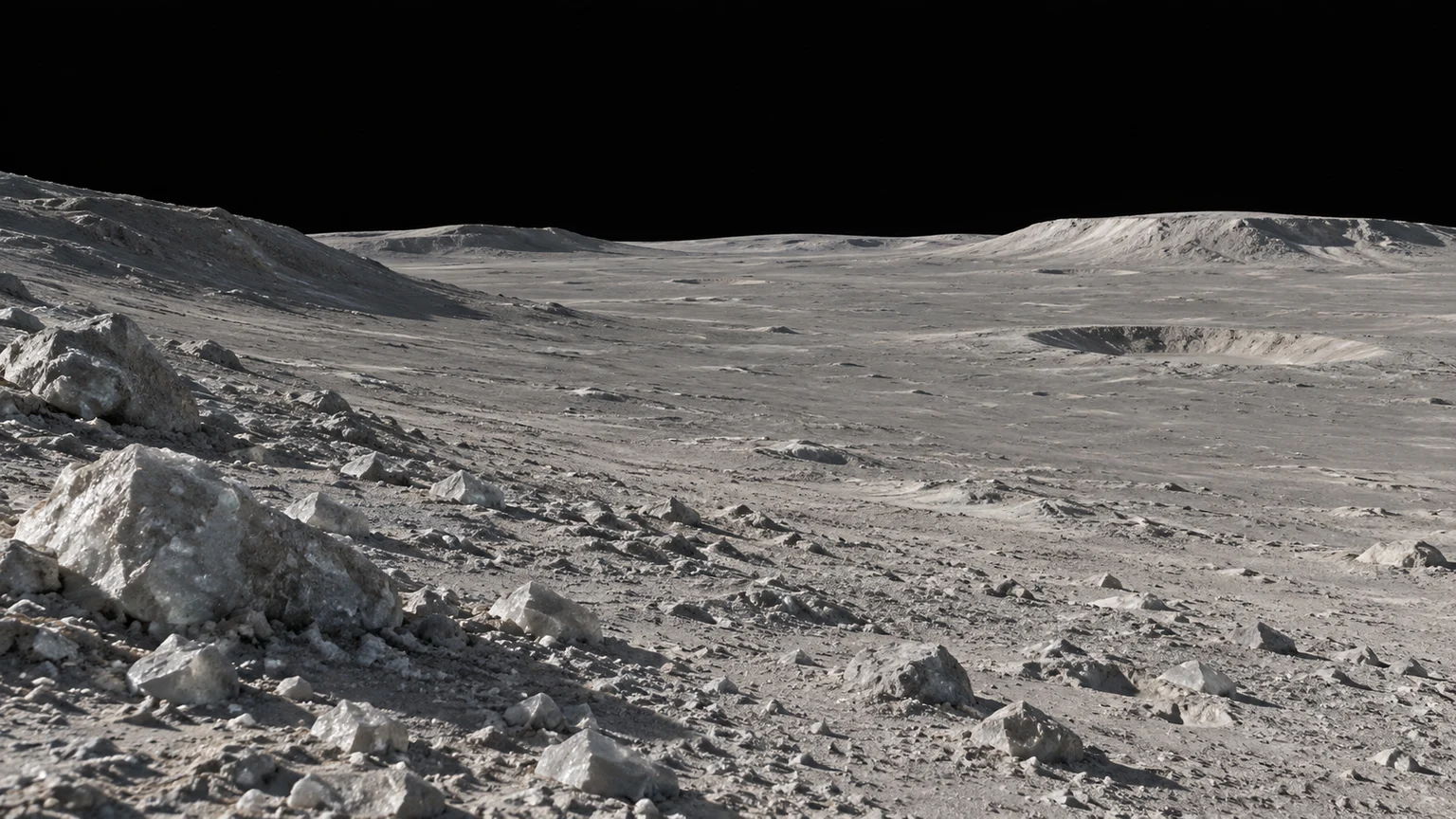
Debris moving down the slopes.
Cassini images of Helene show broad depressions, smooth areas, streaks and grooves. On the leading hemisphere, these patterns suggest fine material moving downhill. They are not evidence of flowing surface water. The local details in the landscape studies are imagined.
Ahead of Dione.
Helene occupies the leading L4 region of Dione’s Saturn-centered orbit, roughly 60 degrees ahead of the larger moon. It circles Saturn, not Dione. The system diagram separates their tracks for clarity and does not simulate their co-orbital libration.
A low-density world.
The adopted JPL mass and mean radius imply a bulk density near 0.29 grams per cubic centimeter. This is consistent with considerable empty space in an ice-rich body. The distribution of material is unresolved; distinct internal layers or an ocean are not established.
A shared rhythm of nearly three days.
The adopted mean orbital scale is 377,600 kilometers from Saturn’s center, with a period of 2.736916 Earth days. The spin comparison uses approximately synchronous rotation and omits fine orientation variations.