SATURN SYSTEM / SATELLITE DOSSIER

Hyperion

Hyperion is Saturn’s porous, irregular moon, with deep impact pits and a chaotic tumble.

DIAMETER / EARTH0.02×
EARTHHYPERION
ATMOSPHERE
No substantial atmosphere detectedEffectively airless
SURFACE TEMPERATURE
Deeply cold icy surface
SURFACE PRESSURE
Effectively airless
HABITABILITYNo life detected
UNPROTECTED HUMANSNot survivable

Interior ↗

03
Hyperion interiorHyperion's internal structure is unresolved.Unresolved

Moon system ↗

04
Saturn moon orbitsSelected moons, ordered outward. Orbit sizes and positions are schematic; relative periods are preserved.SATURNPANDAPHNISATLASPROMETHEUSPANDORAEPIMETHEUSJANUSMIMASENCELADUSTETHYSTELESTOCALYPSODIONEHELENERHEATITANHYPERIONIAPETUSPHOEBE
HYPERION

Instrument detail

THE SKY FROM HYPERION

Saturn, in perspective.

SHARED ANGULAR SCALE
Saturn compared with Luna in Earth's skyAt semimajor-axis distance, Saturn spans approximately 4.66 degrees, 9 times the apparent diameter of Luna at its mean distance from Earth. Both disks share one angular scale.SATURNOUR MOON≈ 0.52°
Idealized size study · full disks · decorative lighting · rings excluded
ANGULAR DIAMETER
4.66°
OUR MOON'S APPARENT DIAMETER
9 ×
CENTER-TO-CENTER DISTANCE
1,481,500 km

The viewpoint is on Hyperion’s nominal spherical surface, directly facing Saturn. The reference is Luna seen from Earth’s center at its mean distance. The reference distance is the orbit’s semimajor axis. Rounded body diameters and orbital elements set the disk sizes; terrain, phases, rings and the actual sky position are not modeled.

Explore Saturn ↗
Hyperion orbitElliptical orbit viewed along the orbital axis, relative to Saturn. Motion is accelerated, not a live position. Distances are center to center.SATURNHYPERION≈ 1,481,500 km
ONE ORBIT21.2767 Earth days around Saturn
Closest to Saturn
1,325,943 km
Farthest from Saturn
1,637,058 km

Hyperion circles Saturn. Distances are measured between the centers of the two bodies.

Hyperion rotationChaotic tumbling has no fixed spin period. Static portrait, not an orientation prediction.CHAOTIC TUMBLINGNO FIXED SPIN PERIOD
ROTATION STATEChaotic

An unpredictable tumble

Hyperion’s rotation rate and spin axis vary chaotically. It does not keep one face toward Saturn, and no single fixed rotation period describes its motion. The static portrait identifies the body; it is not an orientation prediction.

Satellite atlasMoons
Saturn moon orbitsSelected moons, ordered outward. Orbit sizes and positions are schematic; relative periods are preserved.SATURNPANDAPHNISATLASPROMETHEUSPANDORAEPIMETHEUSJANUSMIMASENCELADUSTETHYSTELESTOCALYPSODIONEHELENERHEATITANHYPERIONIAPETUSPHOEBE
FEATURED MOONS19
  1. 01Pan ↗0.575051 days
  2. 02Daphnis ↗0.59408 days
  3. 03Atlas ↗0.604602 days
  4. 04Prometheus ↗0.615878 days
  5. 05Pandora ↗0.631369 days
  6. 06Epimetheus ↗0.697012 days
  7. 07Janus ↗0.697353 days
  8. 08Mimas ↗0.9424 days
  9. 09Enceladus ↗1.37 days
  10. 10Tethys ↗1.8878 days
  11. 11Telesto ↗1.887802 days
  12. 12Calypso ↗1.887803 days
  13. 13Dione ↗2.7369 days
  14. 14Helene ↗2.736916 days
  15. 15Rhea ↗4.5175 days
  16. 16Titan ↗15.95 days
  17. 17Hyperion21.2767 days
  18. 18Iapetus ↗79.331 days
  19. 19Phoebe ↗550.3039 days

Saturn’s moon system includes hazy Titan and icy Enceladus. Methane lakes on Titan and water jets from Enceladus make these worlds compelling destinations in their own right. Saturn itself takes about 29.4 Earth years to complete an orbit.

Janus and Epimetheus share nearly the same orbital distance and exchange inner and outer positions. Their separated tracks here are schematic; this view does not simulate that exchange. Telesto and Calypso share Tethys’s orbit, roughly 60 degrees ahead and behind. Their tracks and positions are also separated schematically here; co-orbital libration is not simulated. Helene similarly shares Dione’s orbit in the leading region.

Hyperion gravityEqual launches at 2 m/s; shared metre scale; air resistance ignored.0 m50 m100 m150 mEARTH9.80 m/s²HYPERION0.02 m/s²
HYPERION / EARTH GRAVITY0.0021 ×

Same push, different gravity

Both balls launch at 2 m/s, using the same height and time scales. Weaker gravity gives a higher jump and a longer time in the air. Air resistance is ignored. This idealized comparison uses constant spherical gravity GM/r²; local terrain, tides and rotation are excluded. Playback runs 17× faster for both balls.

Earth · height / airtime
0.20 m / 0.41 s
Hyperion · height / airtime
98.38 m / 196.77 s
Hyperion interiorHyperion's internal structure is unresolved.Unresolved

Beyond the surface

Hyperion’s low bulk density implies substantial porosity in an ice-rich body. A measured arrangement of rock, ice and voids is unavailable; a layered crust, mantle and core is not established.

    Artist’s impression of Hyperion

    A labyrinth of impact pits.

    Hyperion has an elongated, uneven outline and a surface crowded with deep craters. Narrow ridges separate many of the hollows; darker material gathers on their floors. Cassini revealed a moon whose texture resembles a sponge, although its landscape is solid ice-rich terrain.

    Much of the volume is empty space.

    Cassini measurements indicate a bulk density only a little over half that of water. High porosity helps explain the unusual craters: impacts can compress the surface, while weak gravity lets much of the excavated material escape. The precise arrangement of ice, rock and voids remains uncertain.

    No single face toward Saturn.

    Hyperion rotates chaotically. Its spin axis and rotation rate change, so a single repeating day cannot describe its motion. Its uneven shape, eccentric orbit and gravitational interaction with Titan prevent the simple synchronous rotation seen on many larger moons.

    An eccentric path beyond Titan.

    One orbit takes about 21.2767 Earth days, with a semimajor axis of 1,481,500 kilometers measured from Saturn’s center. This orbital period is distinct from Hyperion’s changing spin. The orbit diagram is a simplified mean ellipse, not a prediction of its current position.

    DIAMETER / EARTH0.02×
    EARTHHYPERION
    EARTH
    12,742 km
    HYPERION
    270 km
    Mean diameters · circles share one scale

    270 km is the volume-equivalent mean diameter. Hyperion is elongated and irregular; the comparison circle does not show its longest dimension.

    ATMOSPHERE
    No substantial atmosphere detectedEffectively airless

    Hyperion is effectively airless. No substantial atmosphere is known to provide breathable air or surface pressure.

    SURFACE TEMPERATURE
    Deeply cold icy surface
    SURFACE PRESSURE
    Effectively airless
    HABITABILITYNo life detected

    No life has been detected, and a habitable environment has not been established. The cold exposed surface offers no breathable air.

    UNPROTECTED HUMANSNot survivable

    The exposed surface requires oxygen, pressure protection and thermal control.

    Planet and landscape images are artistic interpretations.

    • NASA ↗
      • Classification and orbital data
      • Rotation model and synchronous or independent spin
      • Landscape
      • Rotation
    • NASA ↗
      • Parent-body diameter for the angular sky comparison
    • NASA / JPL ↗
      • GM and mean radius; spherical gravity estimate GM/r²
      • Size, physical data and atmospheric constraints
    • NASA / JPL ↗
      • Mean orbital dimensions; distances from parent center
      • Orbit
    • NASA ↗
      • Rotation and internal structure constraints
      • Natural conditions and human survival
      • Structure
    An artist’s reconstruction inspired by Hyperion’s closely packed impact pits. The local ridges, dark deposits and ground-level viewpoint are imagined.

    Between the crater walls

    An artist’s reconstruction inspired by Hyperion’s closely packed impact pits. The local ridges, dark deposits and ground-level viewpoint are imagined.

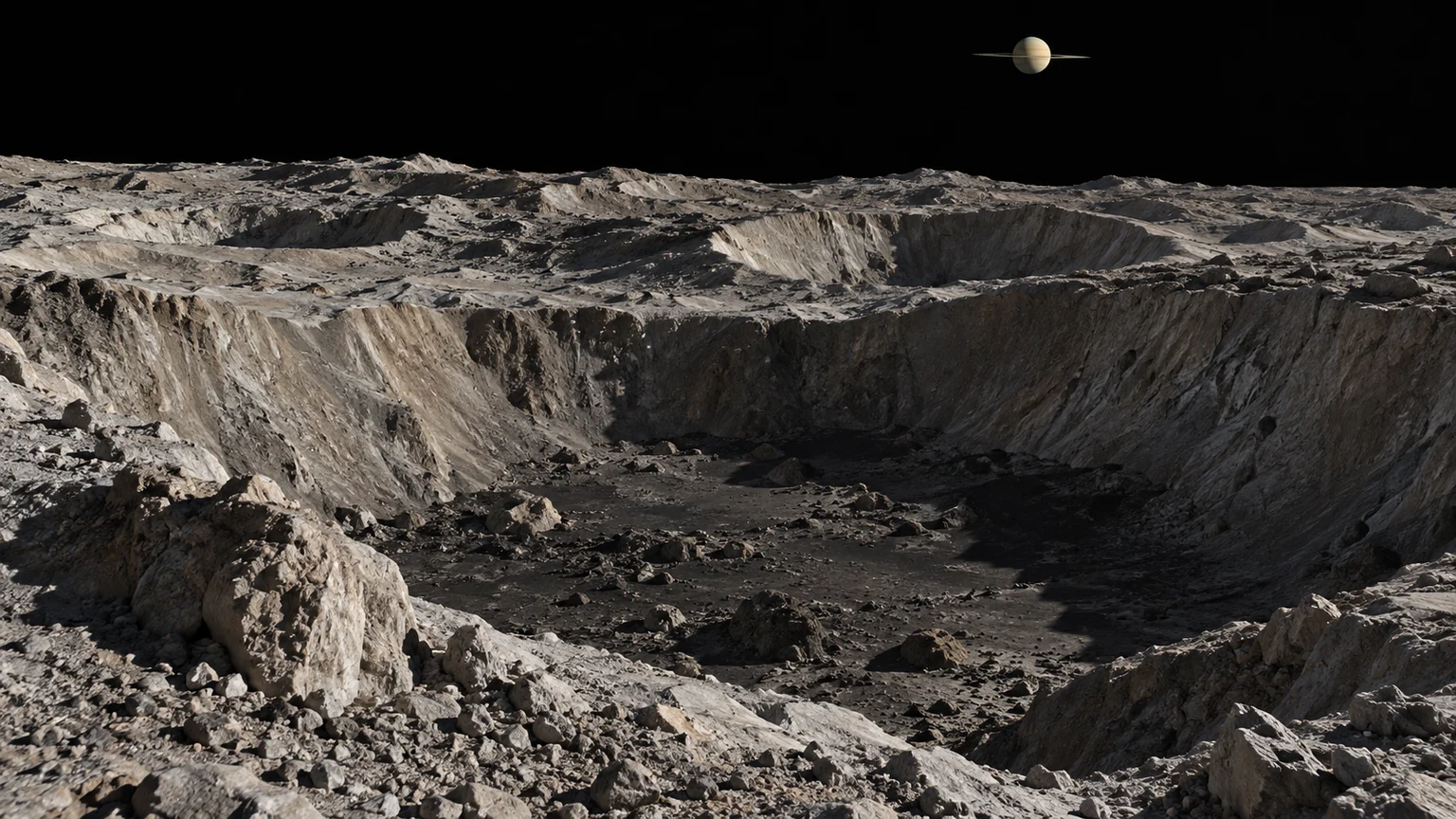
    An imagined view from Hyperion’s cratered terrain. The local geography, illumination and distant Saturn are artistic reconstructions; this scene does not imply a fixed orientation toward the planet.

    A tumbling world beneath Saturn

    An imagined view from Hyperion’s cratered terrain. The local geography, illumination and distant Saturn are artistic reconstructions; this scene does not imply a fixed orientation toward the planet.

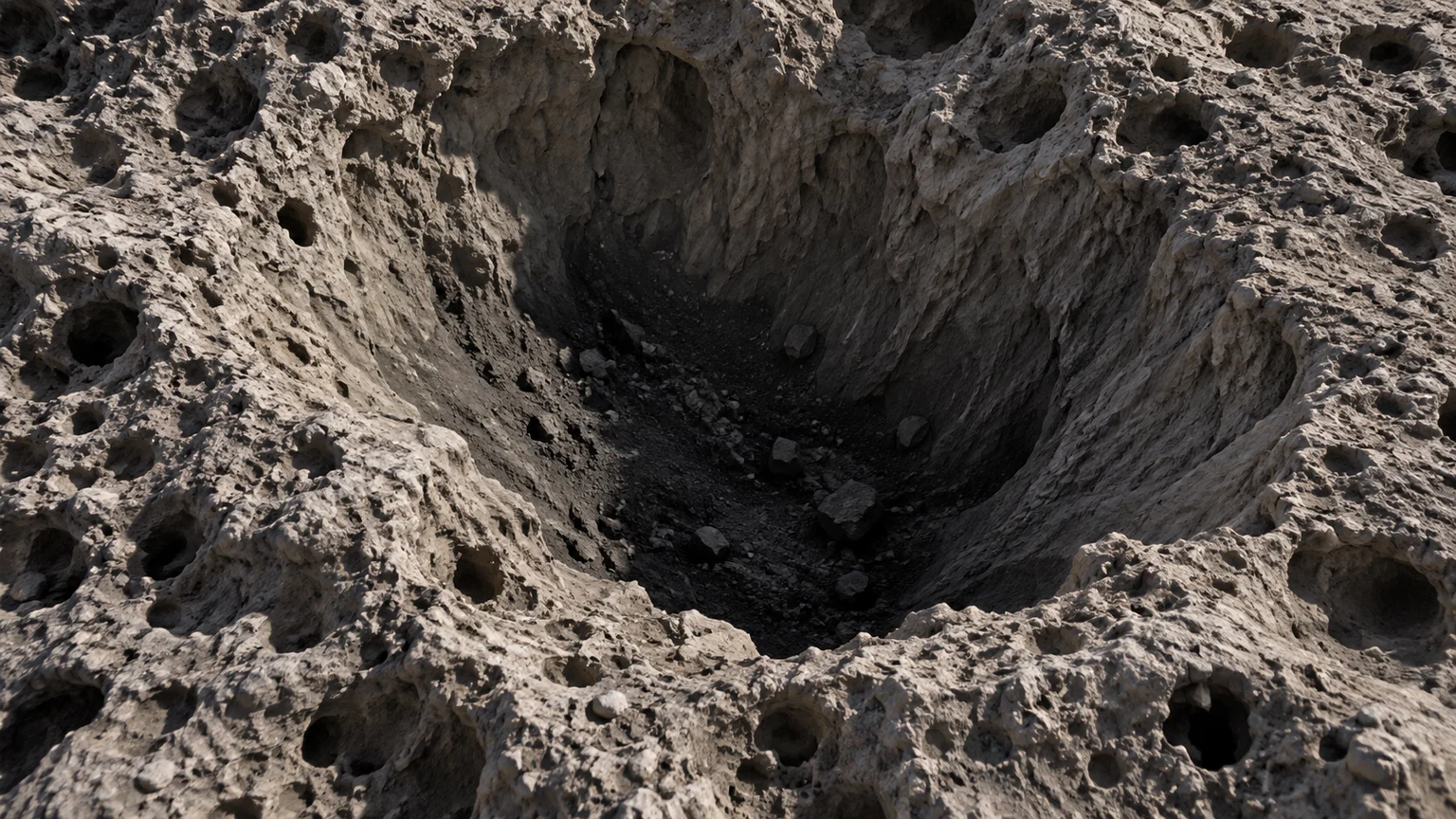
    One irregular deep small impact pit with muted tan-gray walls and very dark material at its bottom. An artistic reconstruction of Hyperion; local detail, lighting and viewpoint are imagined.

    A dark-floored impact pit

    One irregular deep small impact pit with muted tan-gray walls and very dark material at its bottom. An artistic reconstruction of Hyperion; local detail, lighting and viewpoint are imagined.