SATURN SYSTEM / SATELLITE DOSSIER

Iapetus

Iapetus is Saturn’s third-largest moon, with contrasting bright and dark terrain and a striking equatorial ridge.

DIAMETER / EARTH0.12×
EARTHIAPETUS
ATMOSPHERE
No substantial atmosphereEffectively airless
SURFACE TEMPERATURE
Deep cold · dark terrain warms more in sunlight
SURFACE PRESSURE
Effectively airless surface
HABITABILITYNo life detected
UNPROTECTED HUMANSNot survivable

Interior ↗

03
Iapetus interiorIapetus's internal structure is unresolved.Unresolved

Moon system ↗

04
Saturn moon orbitsSelected moons, ordered outward. Orbit sizes and positions are schematic; relative periods are preserved.SATURNPANDAPHNISATLASPROMETHEUSPANDORAEPIMETHEUSJANUSMIMASENCELADUSTETHYSTELESTOCALYPSODIONEHELENERHEATITANHYPERIONIAPETUSPHOEBE
IAPETUS

Instrument detail

THE SKY FROM IAPETUS

Saturn, in perspective.

SHARED ANGULAR SCALE
Saturn compared with Luna in Earth's skyAt semimajor-axis distance, Saturn spans approximately 1.94 degrees, 3.74 times the apparent diameter of Luna at its mean distance from Earth. Both disks share one angular scale.SATURNOUR MOON≈ 0.52°
Idealized size study · full disks · decorative lighting · rings excluded
ANGULAR DIAMETER
1.94°
OUR MOON'S APPARENT DIAMETER
3.74 ×
CENTER-TO-CENTER DISTANCE
3,561,700 km

The viewpoint is on Iapetus’s nominal spherical surface, directly facing Saturn. The reference is Luna seen from Earth’s center at its mean distance. The reference distance is the orbit’s semimajor axis. Rounded body diameters and orbital elements set the disk sizes; terrain, phases, rings and the actual sky position are not modeled.

Explore Saturn ↗
Iapetus orbitElliptical orbit viewed along the orbital axis, relative to Saturn. Motion is accelerated, not a live position. Distances are center to center.SATURNIAPETUS≈ 3,561,700 km
ONE ORBIT79.3310 Earth days around Saturn
Closest to Saturn
3,461,972 km
Farthest from Saturn
3,661,428 km

Iapetus circles Saturn. Distances are measured between the centers of the two bodies.

Iapetus rotation compared with EarthThe markers follow equal elapsed time on both worlds. Equal elapsed time and sidereal rotation rates. Polar schematic: sizes, axial tilt and seasons are not shown. Illumination uses a circular mean orbit, not a live sky prediction.SAME ELAPSED TIME · POLAR SCHEMATICIAPETUS79.3 daysSIDEREAL ROTATIONPrograde spinEARTH23.9 hoursSIDEREAL ROTATION≈ 24 h · solar day
Marked longitude · equal time on both worlds
ONE SIDEREAL ROTATION79.3 days

Turning through space

Iapetus turns once in each orbit, so roughly the same hemisphere faces Saturn. The spin period is 79.331 Earth days; this is not the interval between sunrises.

0 Earth hoursShared clock

Spin comparison only; no solar day is inferred. Sizes and starting longitudes are schematic, not live positions.

Satellite atlasMoons
Saturn moon orbitsSelected moons, ordered outward. Orbit sizes and positions are schematic; relative periods are preserved.SATURNPANDAPHNISATLASPROMETHEUSPANDORAEPIMETHEUSJANUSMIMASENCELADUSTETHYSTELESTOCALYPSODIONEHELENERHEATITANHYPERIONIAPETUSPHOEBE
FEATURED MOONS19
  1. 01Pan ↗0.575051 days
  2. 02Daphnis ↗0.59408 days
  3. 03Atlas ↗0.604602 days
  4. 04Prometheus ↗0.615878 days
  5. 05Pandora ↗0.631369 days
  6. 06Epimetheus ↗0.697012 days
  7. 07Janus ↗0.697353 days
  8. 08Mimas ↗0.9424 days
  9. 09Enceladus ↗1.37 days
  10. 10Tethys ↗1.8878 days
  11. 11Telesto ↗1.887802 days
  12. 12Calypso ↗1.887803 days
  13. 13Dione ↗2.7369 days
  14. 14Helene ↗2.736916 days
  15. 15Rhea ↗4.5175 days
  16. 16Titan ↗15.95 days
  17. 17Hyperion ↗21.2767 days
  18. 18Iapetus79.331 days
  19. 19Phoebe ↗550.3039 days

Saturn’s moon system includes hazy Titan and icy Enceladus. Methane lakes on Titan and water jets from Enceladus make these worlds compelling destinations in their own right. Saturn itself takes about 29.4 Earth years to complete an orbit.

Janus and Epimetheus share nearly the same orbital distance and exchange inner and outer positions. Their separated tracks here are schematic; this view does not simulate that exchange. Telesto and Calypso share Tethys’s orbit, roughly 60 degrees ahead and behind. Their tracks and positions are also separated schematically here; co-orbital libration is not simulated. Helene similarly shares Dione’s orbit in the leading region.

Iapetus gravityEqual launches at 2 m/s; shared metre scale; air resistance ignored.0 m5 m10 m15 mEARTH9.80 m/s²IAPETUS0.22 m/s²
IAPETUS / EARTH GRAVITY0.02 ×

Same push, different gravity

Both balls launch at 2 m/s, using the same height and time scales. Weaker gravity gives a higher jump and a longer time in the air. Air resistance is ignored. This idealized comparison uses constant spherical gravity GM/r²; local terrain, tides and rotation are excluded. Playback runs 2× faster for both balls.

Earth · height / airtime
0.20 m / 0.41 s
Iapetus · height / airtime
8.95 m / 17.90 s
Iapetus interiorIapetus's internal structure is unresolved.Unresolved

Beyond the surface

Iapetus’s low mean density indicates an ice-rich body. The distribution of rock, the internal boundaries and any past liquid layers remain uncertain; a present-day ocean is not established.

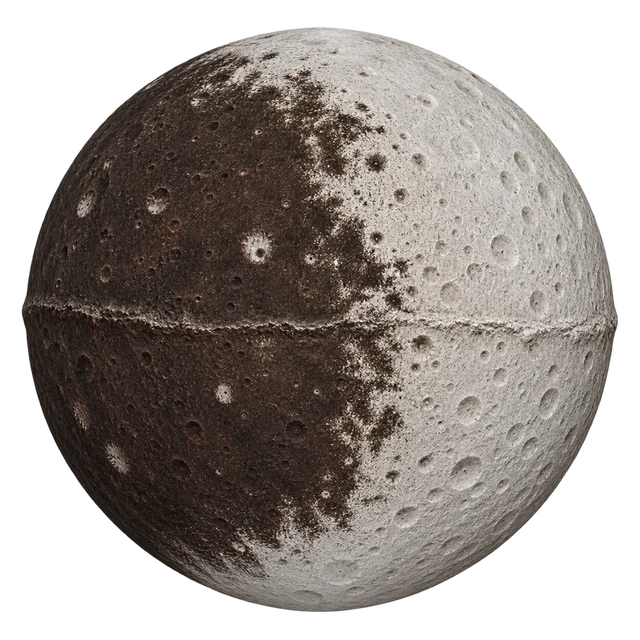
    Artist’s impression of Iapetus

    A contrast made of material.

    Saturn’s third-largest moon has a dark leading hemisphere and a much brighter trailing side. The dark terrain, called Cassini Regio, is a surface coating rather than a permanent night side. Craters mark both terrains, preserving a long history of impacts.

    A small difference can grow.

    A leading explanation begins with dark dust arriving from elsewhere in the Saturn system. Darkened areas absorb more sunlight, allowing water ice to sublime and migrate toward colder terrain. This thermal segregation can amplify the original contrast, leaving dark areas darker and icy areas brighter.

    A mountain chain around the waist.

    A remarkable ridge follows part of Iapetus’s equator, giving the moon its walnut-like profile. Its mountains rise kilometers above nearby terrain. The origin of this unusual feature remains debated; the landscape records an early history that is not yet fully understood.

    A slow journey beyond Titan.

    Iapetus takes about 79.331 Earth days to orbit Saturn at a mean distance of roughly 3.56 million kilometers from the planet’s center. Its orbit lies well beyond Titan’s. The moon rotates synchronously, keeping approximately the same hemisphere toward Saturn.
    DIAMETER / EARTH0.12×
    EARTHIAPETUS
    EARTH
    12,742 km
    IAPETUS
    1,468.6 km
    Mean diameters · circles share one scale
    ATMOSPHERE
    No substantial atmosphereEffectively airless

    Iapetus is effectively airless. Its exposed ice and dark surface coating experience a long heating and cooling cycle.

    SURFACE TEMPERATURE
    Deep cold · dark terrain warms more in sunlight
    SURFACE PRESSURE
    Effectively airless surface
    HABITABILITYNo life detected

    No life or habitable liquid-water environment has been established on Iapetus. Surface ice migration does not imply biological activity.

    UNPROTECTED HUMANSNot survivable

    A visitor would need oxygen, pressure protection and thermal control on this cold, exposed surface.

    Planet and landscape images are artistic interpretations.

    • NASA ↗
      • Classification and orbital data
      • Size, physical data and atmospheric constraints
      • Landscape
      • Equatorial ridge
    • NASA ↗
      • Parent-body diameter for the angular sky comparison
    • NASA / JPL ↗
      • GM and mean radius; spherical gravity estimate GM/r²
    • NASA / JPL ↗
      • Mean orbital dimensions; distances from parent center
      • Orbit
    • NASA ↗
      • Rotation and internal structure constraints
      • Natural conditions and human survival
      • Surface process
    An artist’s reconstruction inspired by Iapetus’s equatorial ridge. The peaks, nearby rubble and ground-level viewpoint are imagined rather than an exact mapped location.

    Mountains along the equator

    An artist’s reconstruction inspired by Iapetus’s equatorial ridge. The peaks, nearby rubble and ground-level viewpoint are imagined rather than an exact mapped location.

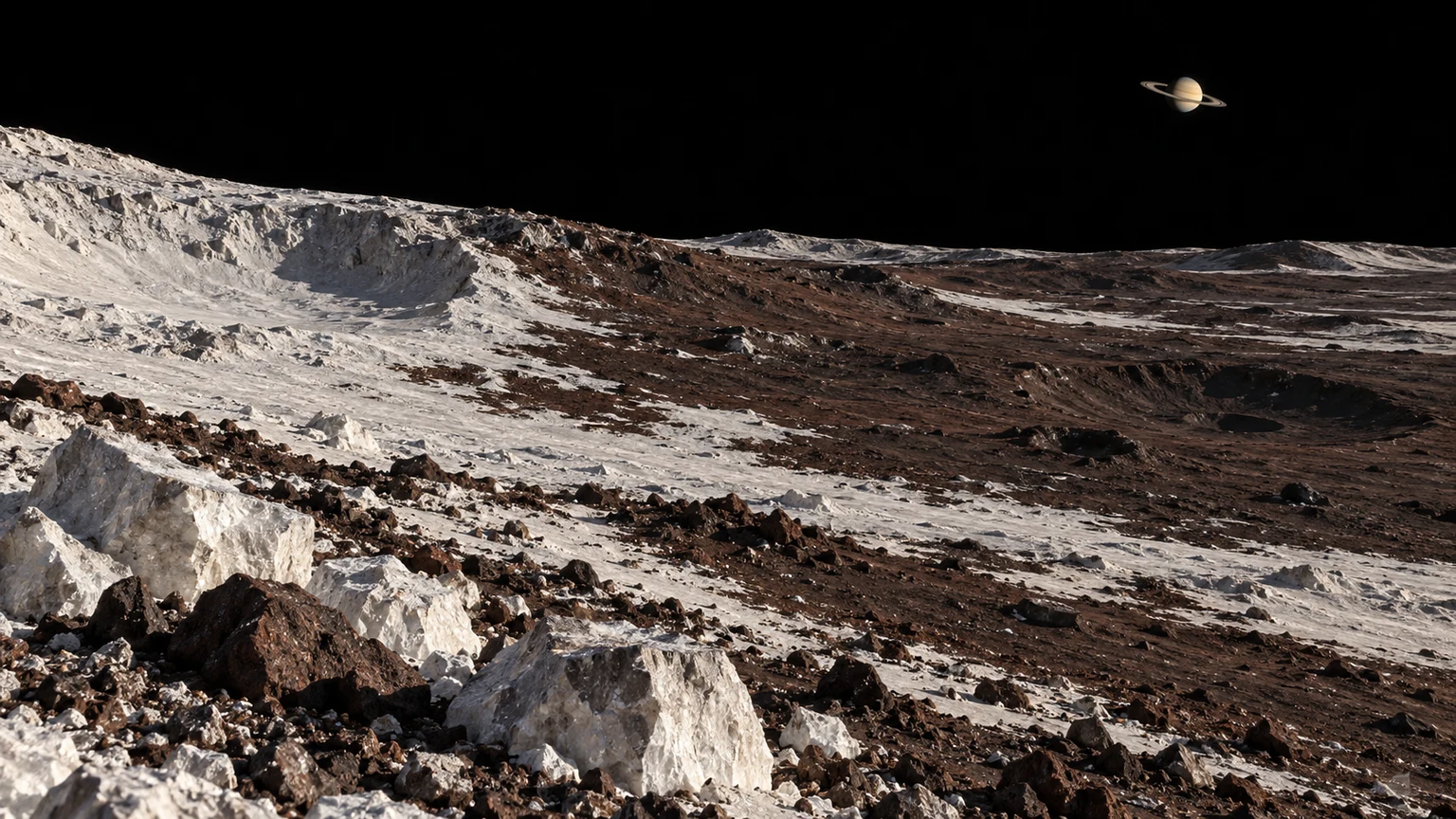
    An imagined landscape at the boundary of Iapetus’s contrasting terrains, with distant Saturn. Surface details, lighting and the planetary view are artistic reconstructions.

    Where dark terrain meets bright ice

    An imagined landscape at the boundary of Iapetus’s contrasting terrains, with distant Saturn. Surface details, lighting and the planetary view are artistic reconstructions.

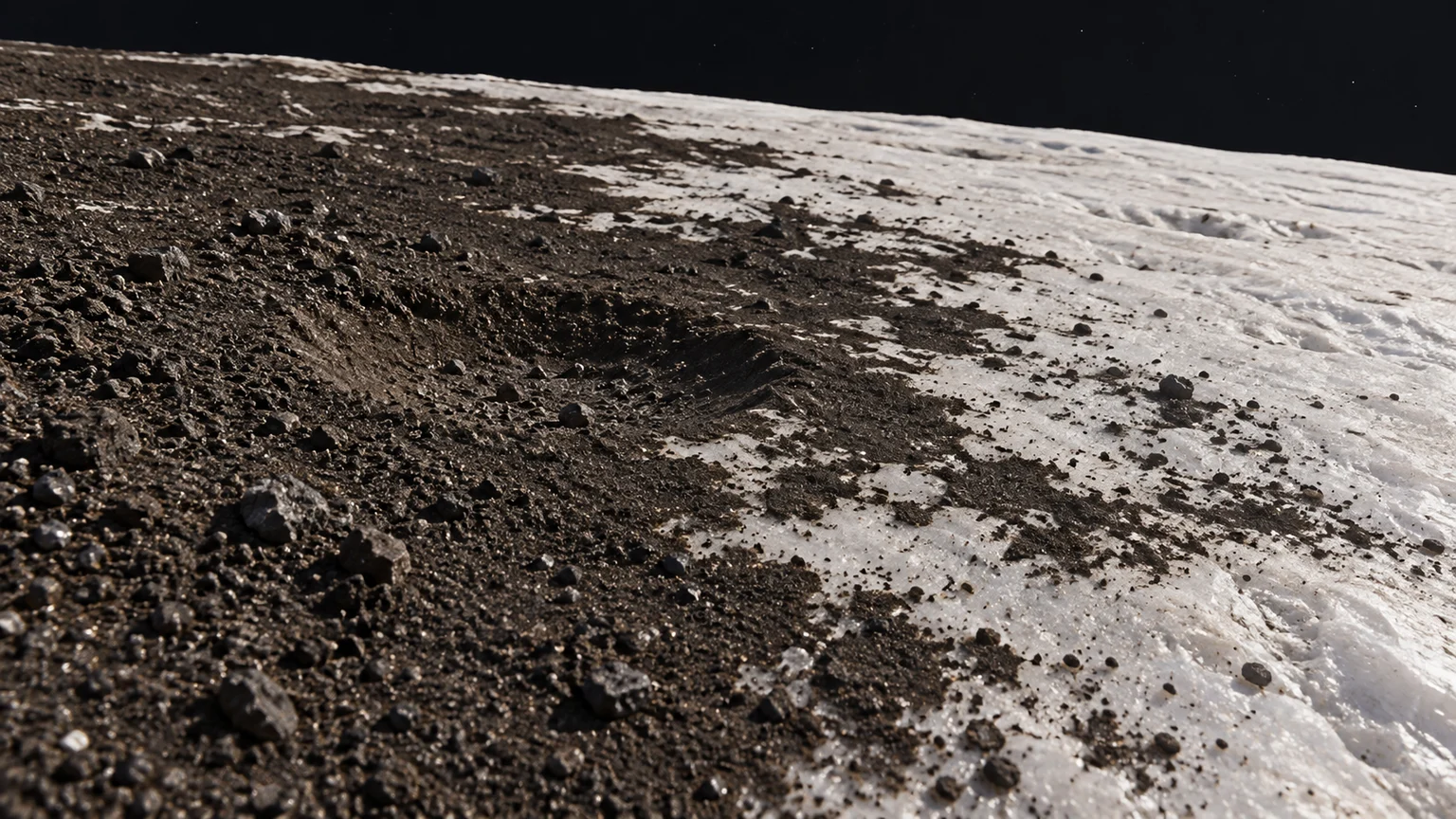
    A patchy thin charcoal-brown granular coating over pale ice, with a small shallow depression. An artistic reconstruction of Iapetus; local detail, lighting and viewpoint are imagined.

    Dark grains over pale ice

    A patchy thin charcoal-brown granular coating over pale ice, with a small shallow depression. An artistic reconstruction of Iapetus; local detail, lighting and viewpoint are imagined.