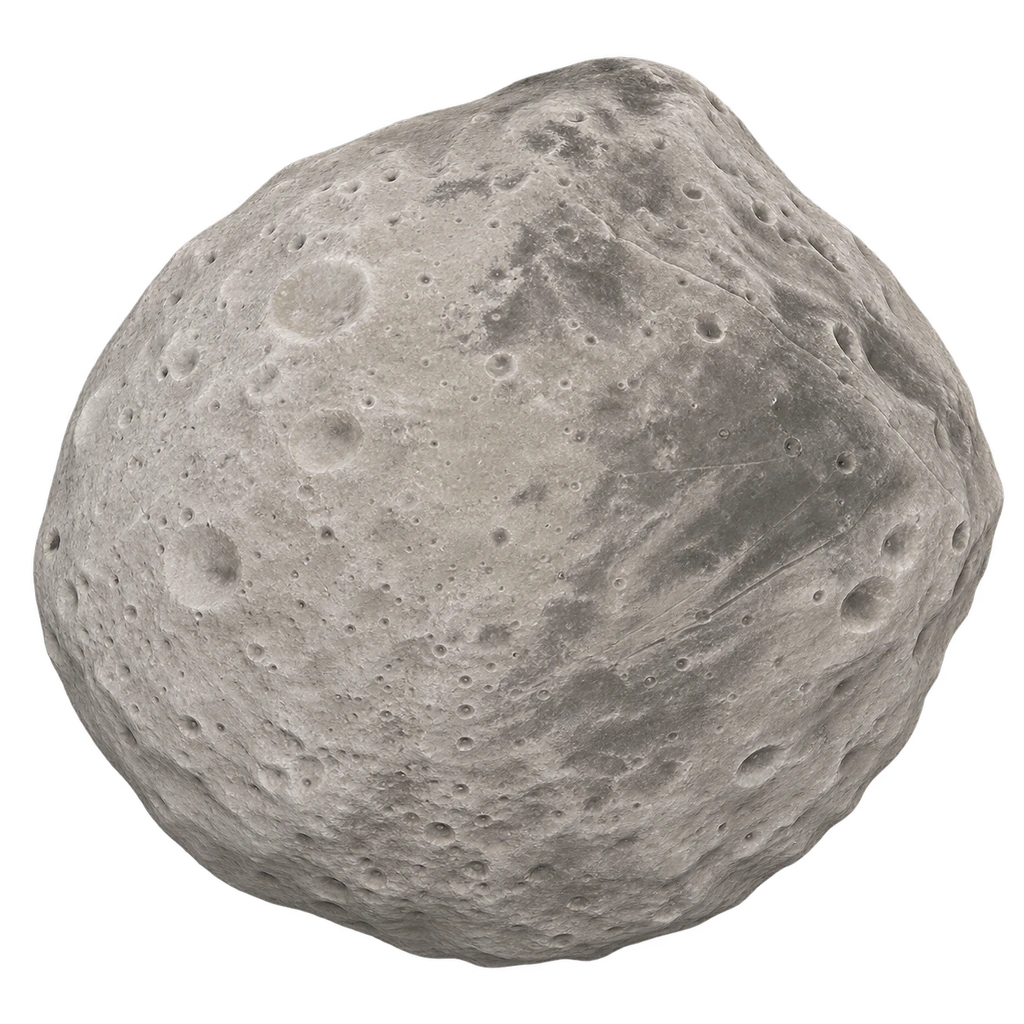
Old craters on a small icy body.
Janus has an uneven outline and impact craters softened by loose surface material. Brighter slopes contrast with darker, smoother patches. Cassini images reveal this battered terrain, while the ground-level studies here imagine views no lander has photographed.
A repeating exchange with Epimetheus.
Janus and Epimetheus occupy neighboring paths in a 1:1 orbital resonance. As the inner moon catches the outer one, their mutual gravity exchanges their inner and outer positions roughly every four years. They avoid collision rather than overtaking on one unchanged track.
Ice with room between the pieces.
Janus’s low bulk density, about 0.64 grams per cubic centimeter, points to substantial porosity in an ice-rich body. These bulk measurements do not resolve internal layers. A differentiated core or a present-day ocean is not established.
A mean path, not the whole dance.
The adopted orbital scale is about 151,500 kilometers from Saturn’s center, with a period near 0.697353 Earth days. Janus keeps approximately the same face toward Saturn. The displayed ellipse shows a representative mean orbit; it does not simulate the gravitational exchange with Epimetheus.