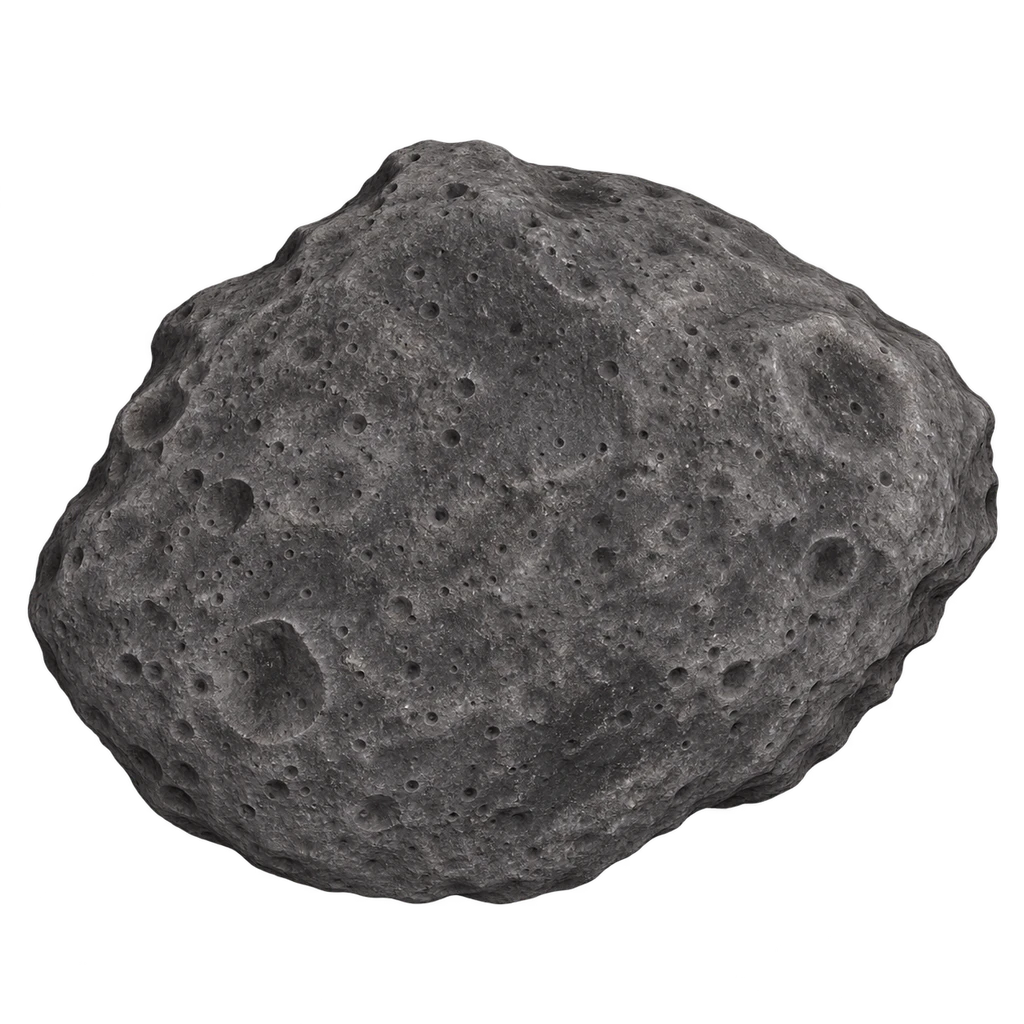
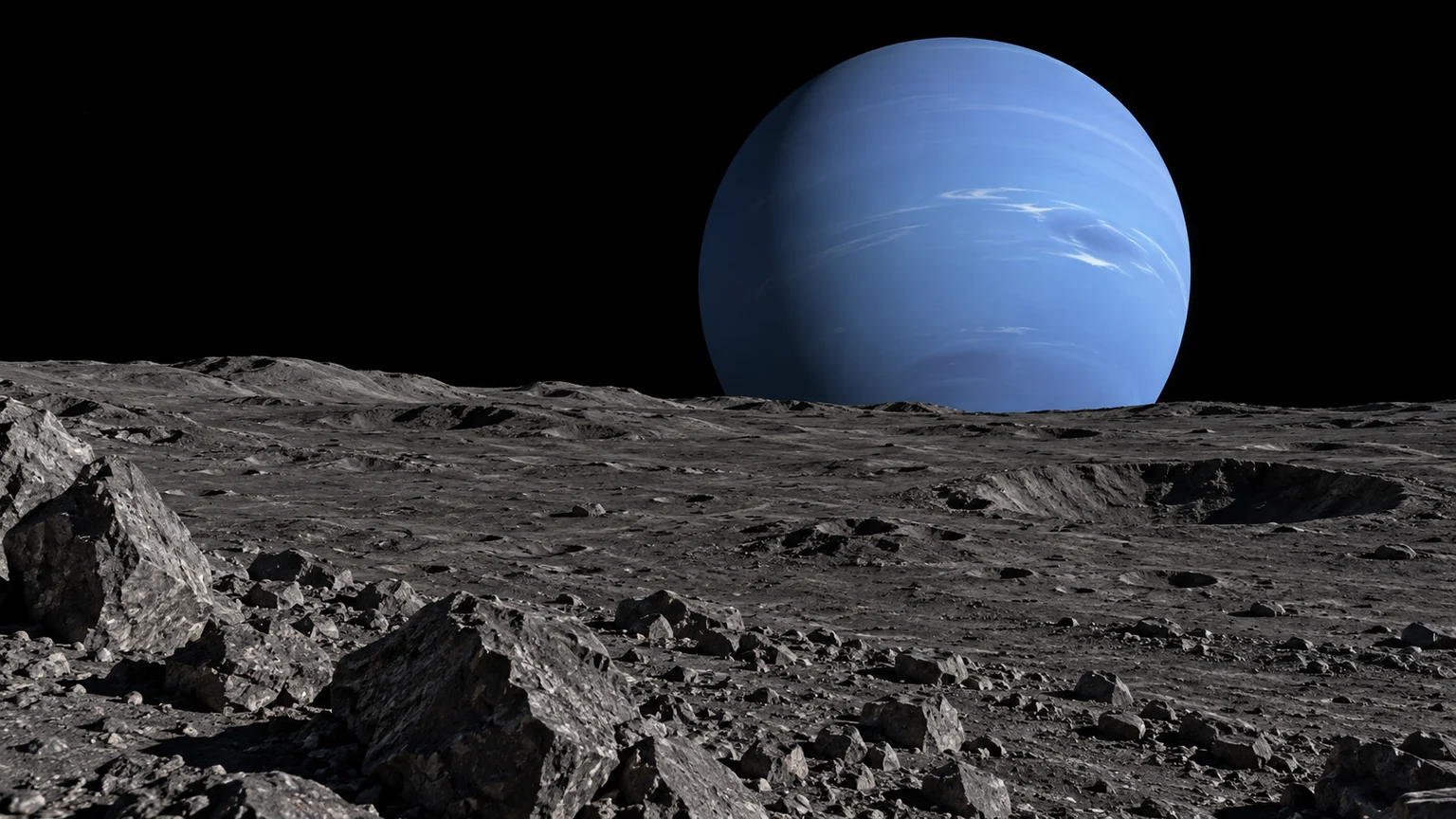
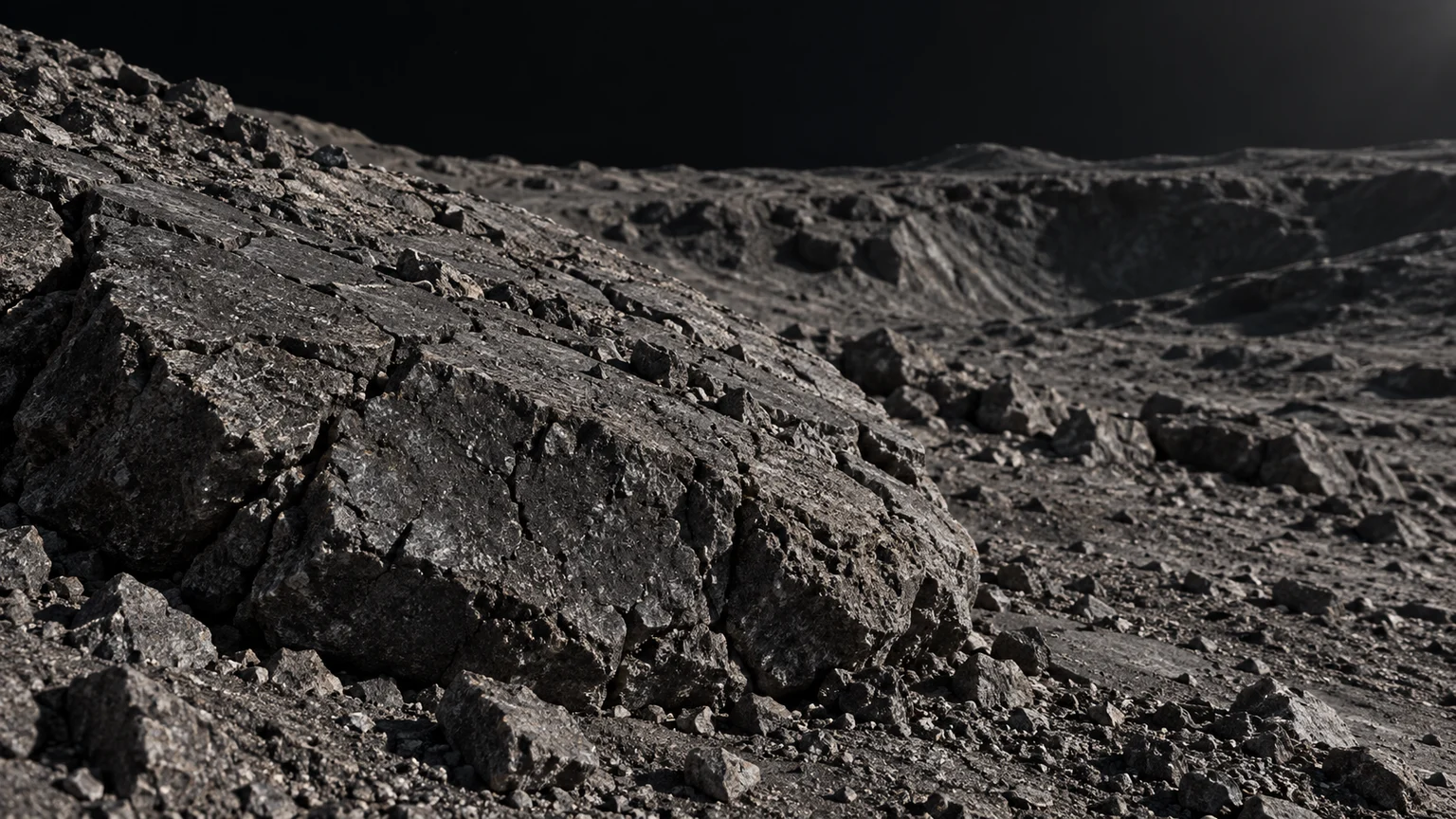
An uneven world in Voyager’s view.
Larissa’s dark exterior is heavily cratered and distinctly irregular. Voyager 2 resolved the moon in 1989 after an earlier ground-based observation in 1981. Available images constrain its broad appearance, but the detailed ground-level landscapes here are imagined.
A short circuit around Neptune.
The adopted mean orbit lies about 73,500 kilometers from Neptune’s center. Its period is 0.554989 Earth days, or about 13.32 hours. The path is nearly circular and prograde; the diagram uses mean elements rather than predicting a current position.
The same face, approximately.
The standard orientation model treats Larissa as synchronously rotating. One spin takes approximately one orbit, keeping broadly the same hemisphere toward Neptune. The simple comparison omits pole variations and fine orientation terms; it illustrates the mean rotation rate.
Too little mass information for a gravity claim.
Larissa’s mass is poorly constrained: the uncertainty in the adopted gravitational parameter greatly exceeds its central value. A reliable numerical surface gravity cannot be inferred from that value. Its internal layering and any present-day liquid reservoir also remain unresolved.