EARTH SYSTEM / SATELLITE DOSSIER

Luna

Luna is Earth’s rocky moon, marked by ancient lava plains and impact craters.

Interior ↗

03
Luna interiorSchematic cutaway · layer thicknesses are not to scale. Rocky crust, Rocky mantle, Metallic core.Rocky crustRocky mantleMetallic core

Moon system ↗

04
Earth moon orbitsSelected moons, ordered outward. Orbit sizes and positions are schematic; relative periods are preserved.EARTHLUNA
LUNA

Instrument detail

THE SKY FROM LUNA

Earth, in perspective.

SHARED ANGULAR SCALE
Earth compared with Luna in Earth's skyAt semimajor-axis distance, Earth spans approximately 1.91 degrees, 3.69 times the apparent diameter of Luna at its mean distance from Earth. Both disks share one angular scale.EARTHOUR MOON≈ 0.52°
Idealized size study · full disks · decorative lighting · rings excluded
ANGULAR DIAMETER
1.91°
OUR MOON'S APPARENT DIAMETER
3.69 ×
CENTER-TO-CENTER DISTANCE
384,400 km

The viewpoint is on Luna’s nominal spherical surface, directly facing Earth. The reference is Luna seen from Earth’s center at its mean distance. The reference distance is the orbit’s semimajor axis. Rounded body diameters and orbital elements set the disk sizes; terrain, phases, rings and the actual sky position are not modeled.

Explore Earth ↗
Luna orbitElliptical orbit viewed along the orbital axis, relative to Earth. Motion is accelerated, not a live position. Distances are center to center.EARTHLUNA≈ 384,400 km
ONE ORBIT27.32 Earth days around Earth
Closest to Earth
363,104 km
Farthest from Earth
405,696 km

Luna circles Earth. Distances are measured between the centers of the two bodies.

Luna rotation compared with EarthThe marked hemisphere keeps facing Earth. Equal elapsed time and sidereal rotation rates. Polar schematic: sizes, axial tilt and seasons are not shown. Illumination uses a circular mean orbit, not a live sky prediction.SAME ELAPSED TIME · POLAR SCHEMATICLUNA27.3 daysSIDEREAL ROTATIONFaces EarthEARTH23.9 hoursSIDEREAL ROTATION≈ 24 h · solar day
Marked longitude · equal time on both worlds
ONE SIDEREAL ROTATION27.3 days

Turning through space

Luna turns once in each orbit, so roughly the same hemisphere faces Earth. The spin period is 27.32 Earth days; this is not the interval between sunrises.

The small companion marker shows the direction to Earth. The same hemisphere stays oriented toward it; this is not a measure of daylight.

Synchronous rotation · NASA ↗
0 Earth hoursShared clock

Mean orientation model; small librations are omitted. No solar day is inferred from the satellite orbit. Sizes and starting longitudes are schematic, not live positions.

Satellite atlasMoons
Earth moon orbitsSelected moons, ordered outward. Orbit sizes and positions are schematic; relative periods are preserved.EARTHLUNA
NATURAL MOONS01
  1. 01Luna27.32 days

Earth has one permanent natural moon. Its gravitational influence helps stabilize the planet’s axial wobble.

Luna gravityEqual launches at 2 m/s; shared metre scale; air resistance ignored.0.0 m0.5 m1.0 m1.5 mEARTH9.80 m/s²LUNA1.62 m/s²
LUNA / EARTH GRAVITY0.17 ×

Same push, different gravity

Both balls launch at 2 m/s, using the same height and time scales. Weaker gravity gives a higher jump and a longer time in the air. Air resistance is ignored. This idealized comparison uses constant spherical gravity GM/r²; local terrain, tides and rotation are excluded.

Earth · height / airtime
0.20 m / 0.41 s
Luna · height / airtime
1.23 m / 2.46 s
Luna interiorSchematic cutaway · layer thicknesses are not to scale. Rocky crust, Rocky mantle, Metallic core. Select a layer below to highlight it.010203
Schematic cutaway · layer thicknesses are not to scale.
EXPLORE THE LAYERS
  1. 01
    INFERRED

    A solid crust forms the outer boundary, covered by impact debris.

  2. 02
    INFERRED

    Silicate-rich material lies beneath the outer layers.

  3. 03
    INFERRED

    Seismic and other measurements support a small iron-rich core with solid and liquid regions.

Select a material to connect its description with the cutaway. Colors and textures identify regions; they do not show measured temperature.

Artist’s impression of Luna

Two shades of lunar history.

The dark maria are broad plains formed by ancient basaltic lava. Brighter highlands preserve older, heavily cratered terrain. The familiar pattern in our sky is a geological map, written across a world of rock and dust.

One face, changing light.

Luna rotates once per orbit, keeping roughly the same face toward Earth. Its phases come from changing illumination. The far side is not permanently dark: both hemispheres experience daylight and night.

Cold traps in permanent shadow.

Some polar depressions never receive direct sunlight. Ice can survive in these exceptionally cold places, although most exposed lunar terrain is dry. A deposit of frozen water is very different from a surface lake.

A landscape that keeps its marks.

With no rain or ordinary wind, impact scars remain for immense spans of time. Small impacts continually disturb the regolith. Exploring this quiet-looking ground means reading a history that Earth’s weather and geology often erase.

DIAMETER / EARTH0.27×
EARTHLUNA
EARTH
12,742 km
LUNA
3,474.8 km
Mean diameters · circles share one scale
ATMOSPHERE
A trace envelope, not airNo substantial atmosphere

Luna’s very tenuous exosphere cannot provide breathable air or Earth-like weather. It does not justify a bulk atmosphere percentage chart.

SURFACE TEMPERATURE
Extreme day/night contrast
SURFACE PRESSURE
Near-vacuum
HABITABILITYNo life detected

The exposed surface lacks stable liquid water and protective air. Polar ice alone does not make it habitable.

UNPROTECTED HUMANSNot survivable

There is no breathable air. Pressure protection, oxygen and thermal protection are essential; an apparently solid landscape is not a safe human environment.

Planet and landscape images are artistic interpretations.

  • NASA ↗
    • Classification and orbital data
    • Rotation and internal structure constraints
    • Natural conditions and human survival
    • Landscape
    • Time
    • Ice
    • Record
  • NASA ↗
    • Parent-body diameter for the angular sky comparison
  • NASA / JPL ↗
    • GM and mean radius; spherical gravity estimate GM/r²
  • NASA / JPL ↗
    • Mean orbital dimensions; distances from parent center
  • NASA ↗
    • Size, physical data and atmospheric constraints
An imagined lunar basalt plain under hard sunlight. Gray regolith and scattered rocks suggest a mare landscape, not a specific landing site.

Across the mare

An imagined lunar basalt plain under hard sunlight. Gray regolith and scattered rocks suggest a mare landscape, not a specific landing site.

An imagined view of pale lunar impact debris and an old crater wall. The scene is a reconstruction, not a photograph from a named location.

Into the highlands

An imagined view of pale lunar impact debris and an old crater wall. The scene is a reconstruction, not a photograph from a named location.

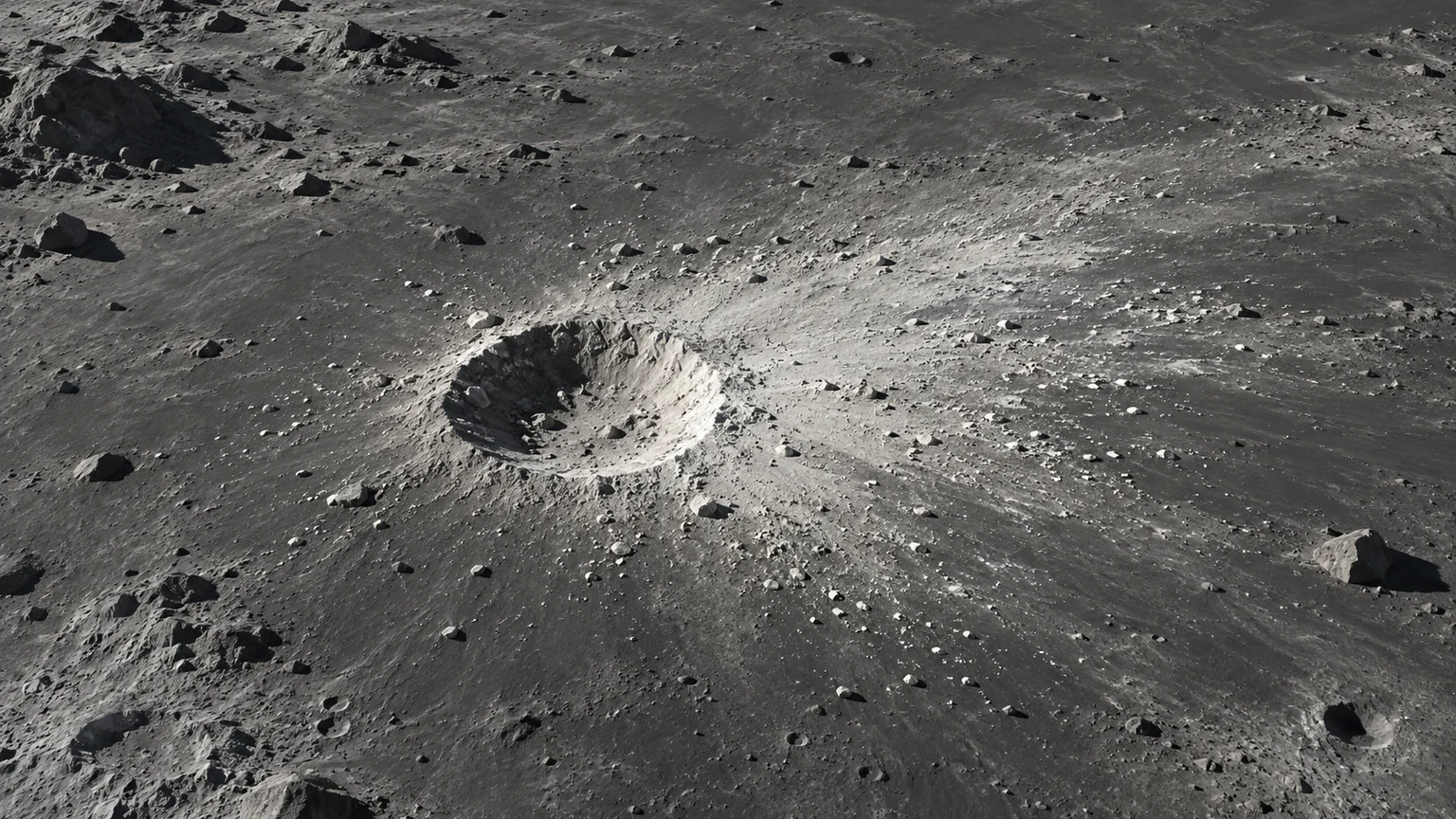
A small crisp lunar impact crater with an asymmetric spread of pale ejecta and scattered blocks on gray regolith. An artistic reconstruction of Luna; local detail, lighting and viewpoint are imagined.

A fresh impact in close view

A small crisp lunar impact crater with an asymmetric spread of pale ejecta and scattered blocks on gray regolith. An artistic reconstruction of Luna; local detail, lighting and viewpoint are imagined.