MARS SYSTEM / SATELLITE DOSSIER

Phobos

Phobos is a small, irregular moon that circles Mars in less than eight hours.

Interior ↗

03
Phobos interiorPhobos's internal structure is unresolved.Unresolved

Moon system ↗

04
Mars moon orbitsSelected moons, ordered outward. Orbit sizes and positions are schematic; relative periods are preserved.MARSPHOBOSDEIMOS
PHOBOS

Instrument detail

THE SKY FROM PHOBOS

Mars, in perspective.

SHARED ANGULAR SCALE
Mars compared with Luna in Earth's skyAt semimajor-axis distance, Mars spans approximately 42.45 degrees, 81.96 times the apparent diameter of Luna at its mean distance from Earth. Both disks share one angular scale.MARSOUR MOON≈ 0.52°
Idealized size study · full disks · decorative lighting · rings excluded
ANGULAR DIAMETER
42.45°
OUR MOON'S APPARENT DIAMETER
81.96 ×
CENTER-TO-CENTER DISTANCE
9,375 km

The viewpoint is on Phobos’s nominal spherical surface, directly facing Mars. The reference is Luna seen from Earth’s center at its mean distance. The reference distance is the orbit’s semimajor axis. Rounded body diameters and orbital elements set the disk sizes; terrain, phases, rings and the actual sky position are not modeled.

Explore Mars ↗
Phobos orbitElliptical orbit viewed along the orbital axis, relative to Mars. Motion is accelerated, not a live position. Distances are center to center.MARSPHOBOS≈ 9,375 km
ONE ORBIT0.3189 Earth days around Mars · about 7 h 39 min
Closest to Mars
9,234 km
Farthest from Mars
9,516 km

Phobos circles Mars. Distances are measured between the centers of the two bodies.

Phobos rotation compared with EarthThe markers follow equal elapsed time on both worlds. Equal elapsed time and sidereal rotation rates. Polar schematic: sizes, axial tilt and seasons are not shown. Illumination uses a circular mean orbit, not a live sky prediction.SAME ELAPSED TIME · POLAR SCHEMATICPHOBOS7.7 hoursSIDEREAL ROTATIONPrograde spinEARTH23.9 hoursSIDEREAL ROTATION≈ 24 h · solar day
Marked longitude · equal time on both worlds
ONE SIDEREAL ROTATION7.7 hours

Turning through space

Phobos turns once in each orbit, so roughly the same hemisphere faces Mars. The spin period is 0.3189 Earth days; this is not the interval between sunrises.

0 Earth hoursShared clock

Spin comparison only; no solar day is inferred. Sizes and starting longitudes are schematic, not live positions.

Satellite atlasMoons
Mars moon orbitsSelected moons, ordered outward. Orbit sizes and positions are schematic; relative periods are preserved.MARSPHOBOSDEIMOS
NATURAL MOONS02
  1. 01Phobos0.3189 days
  2. 02Deimos ↗1.2625 days

Phobos and Deimos are Mars’s two small, irregular moons. Phobos orbits closer to the planet; Deimos circles farther out. Neither is massive enough for gravity to give it the rounded shape of a large moon.

Phobos gravityEqual launches at 2 m/s; shared metre scale; air resistance ignored.0 m200 m400 m600 mEARTH9.80 m/s²PHOBOS0.0058 m/s²
PHOBOS / EARTH GRAVITY0.00059 ×

Same push, different gravity

Both balls launch at 2 m/s, using the same height and time scales. Weaker gravity gives a higher jump and a longer time in the air. Air resistance is ignored. This idealized comparison uses constant spherical gravity GM/r²; local terrain, tides and rotation are excluded. Playback runs 58× faster for both balls.

Earth · height / airtime
0.20 m / 0.41 s
Phobos · height / airtime
346.46 m / 692.91 s
Phobos interiorPhobos's internal structure is unresolved.Unresolved

Beyond the surface

Phobos’s low density suggests internal empty space. Its irregular shape and uncertain composition do not establish a crust–mantle–core structure.

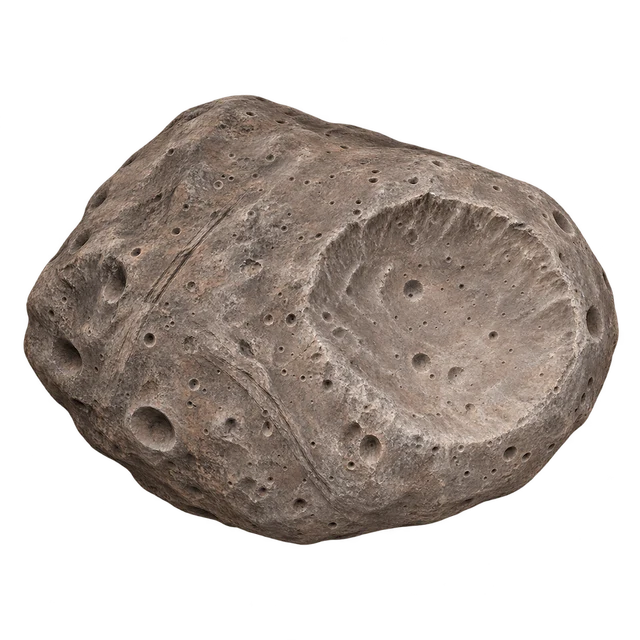
    Artist’s impression of Phobos

    A crater almost too large for its world.

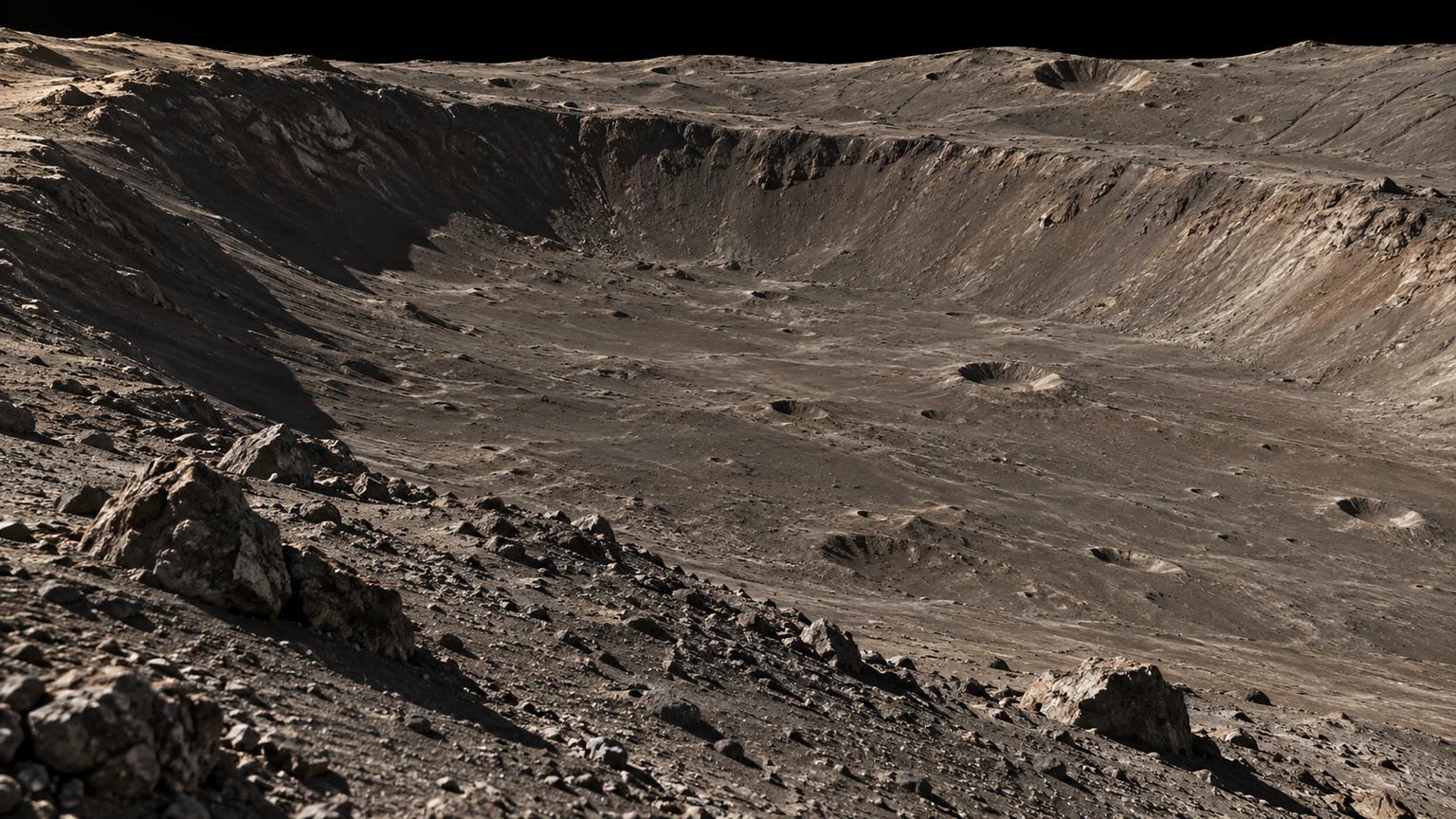
    Phobos has a lopsided outline, roughly 27 by 22 by 18 kilometers across. Stickney, an impact crater about nine kilometers wide, dominates one end. Smaller craters, grooves and loose dust give this tiny moon a deeply worked surface.

    Around Mars before the day is done.

    One orbit takes about seven hours and 39 minutes. Phobos overtakes Mars’s rotation, so an observer on the planet sees it rise in the west and set in the east. Its short circuit makes a Martian day long enough for several journeys around the planet.

    A familiar shape, an unresolved beginning.

    Its dark, irregular appearance invites comparison with an asteroid. Yet resemblance alone does not settle how it arrived here. Capture and formation from debris produced by an impact on Mars remain competing explanations for the origins of the Martian moons.

    The orbit is slowly closing.

    Phobos moves inward by about 1.8 meters per century. Over tens of millions of years, it may break apart into a ring or collide with Mars. Its future is tied to the planet below, even though the change is imperceptible during a single orbit.
    DIAMETER / EARTH0.0017×
    EARTHPHOBOS
    EARTH
    12,742 km
    PHOBOS
    22.16 km
    Mean diameters · circles share one scale

    Phobos is irregular, roughly 27 × 22 × 18 km. The 22.16 km mean diameter uses JPL’s 11.08 km mean radius; the comparison circle does not represent its true outline.

    ATMOSPHERE
    An exposed, airless surfaceNo atmosphere

    Phobos has no atmosphere. There is no bulk gas mixture to display.

    SURFACE TEMPERATURE
    Strong sunlight/shadow contrast
    SURFACE PRESSURE
    Near-vacuum
    HABITABILITYNo life detected

    An airless surface with strong temperature contrasts and no known stable liquid water offers no established habitat for life.

    UNPROTECTED HUMANSNot survivable

    Pressure protection, oxygen and thermal control are essential on this exposed surface.

    Planet and landscape images are artistic interpretations.

    • NASA ↗
      • Classification and orbital data
      • Rotation and internal structure constraints
      • Natural conditions and human survival
      • Landscape
      • Future
    • NASA ↗
      • Parent-body diameter for the angular sky comparison
    • NASA / JPL ↗
      • GM and mean radius; spherical gravity estimate GM/r²
      • Size, physical data and atmospheric constraints
    • NASA / JPL ↗
      • Mean orbital dimensions; distances from parent center
    • science.nasa.gov ↗
      • Time
    • science.nasa.gov ↗
      • Origin
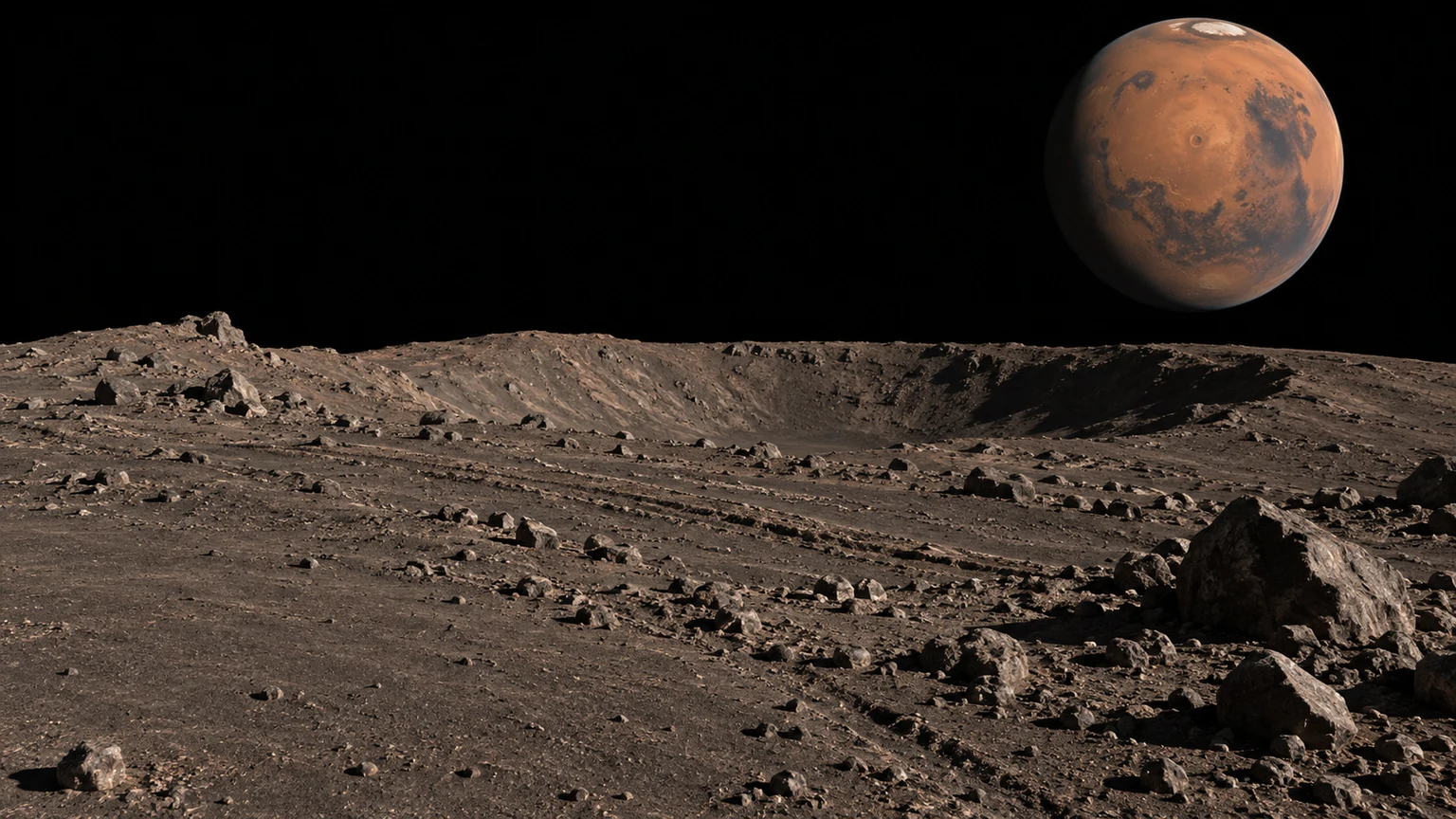
    An imagined view from the Mars-facing side of Phobos. Dust, stones and cratered terrain are research-informed; this viewpoint, local geography and the appearance of Mars are artistic reconstructions.

    Mars above the dust

    An imagined view from the Mars-facing side of Phobos. Dust, stones and cratered terrain are research-informed; this viewpoint, local geography and the appearance of Mars are artistic reconstructions.

    An artist’s reconstruction inspired by Stickney crater. The broad impact bowl and dusty slopes reflect observed terrain, while the viewpoint, lighting and individual rocks are imagined.

    Across Stickney

    An artist’s reconstruction inspired by Stickney crater. The broad impact bowl and dusty slopes reflect observed terrain, while the viewpoint, lighting and individual rocks are imagined.

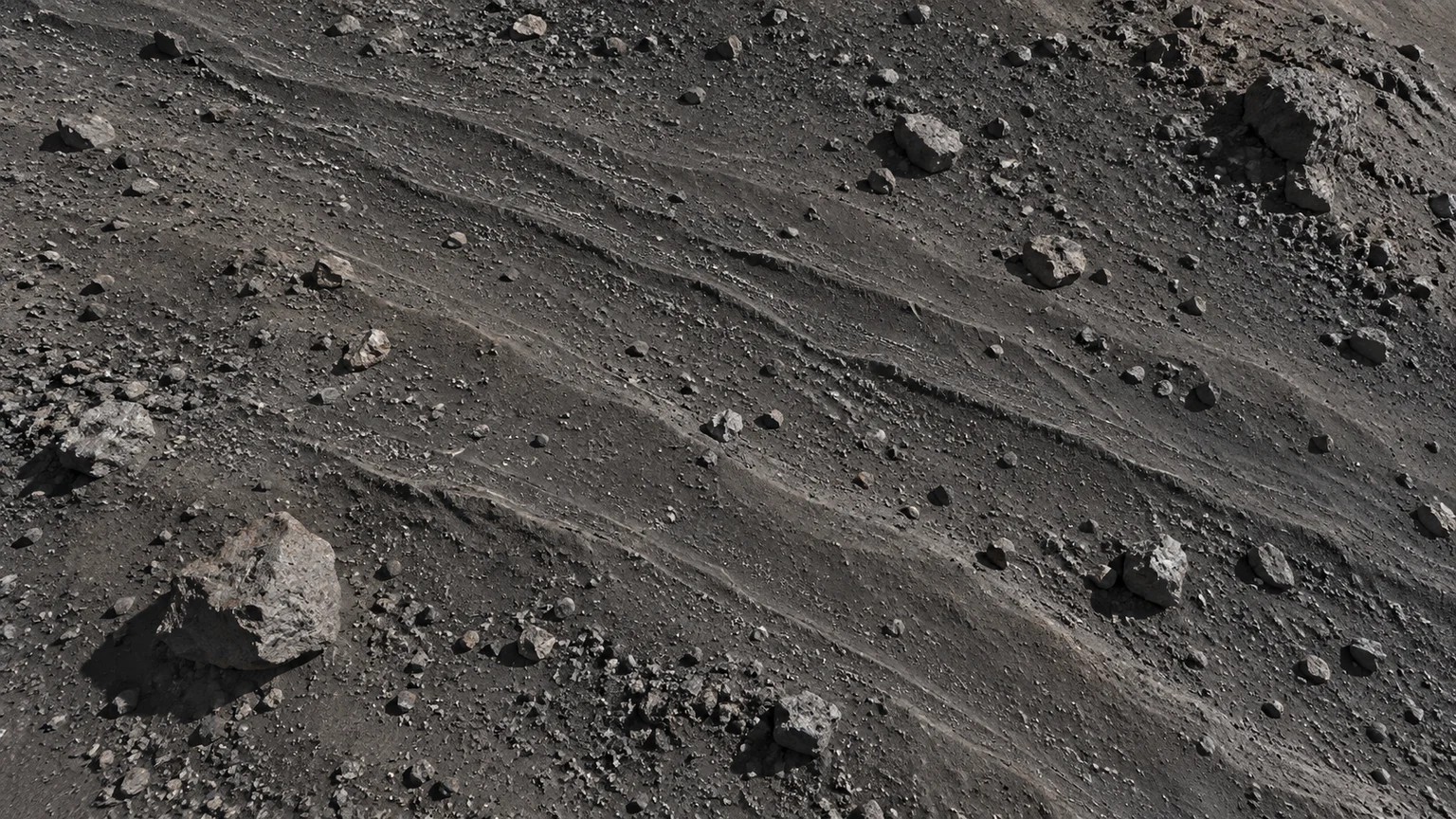
    Several shallow parallel grooves crossing dark gray regolith, scattered squat blocks. An artistic reconstruction of Phobos; local detail, lighting and viewpoint are imagined.

    Grooves across the dust

    Several shallow parallel grooves crossing dark gray regolith, scattered squat blocks. An artistic reconstruction of Phobos; local detail, lighting and viewpoint are imagined.