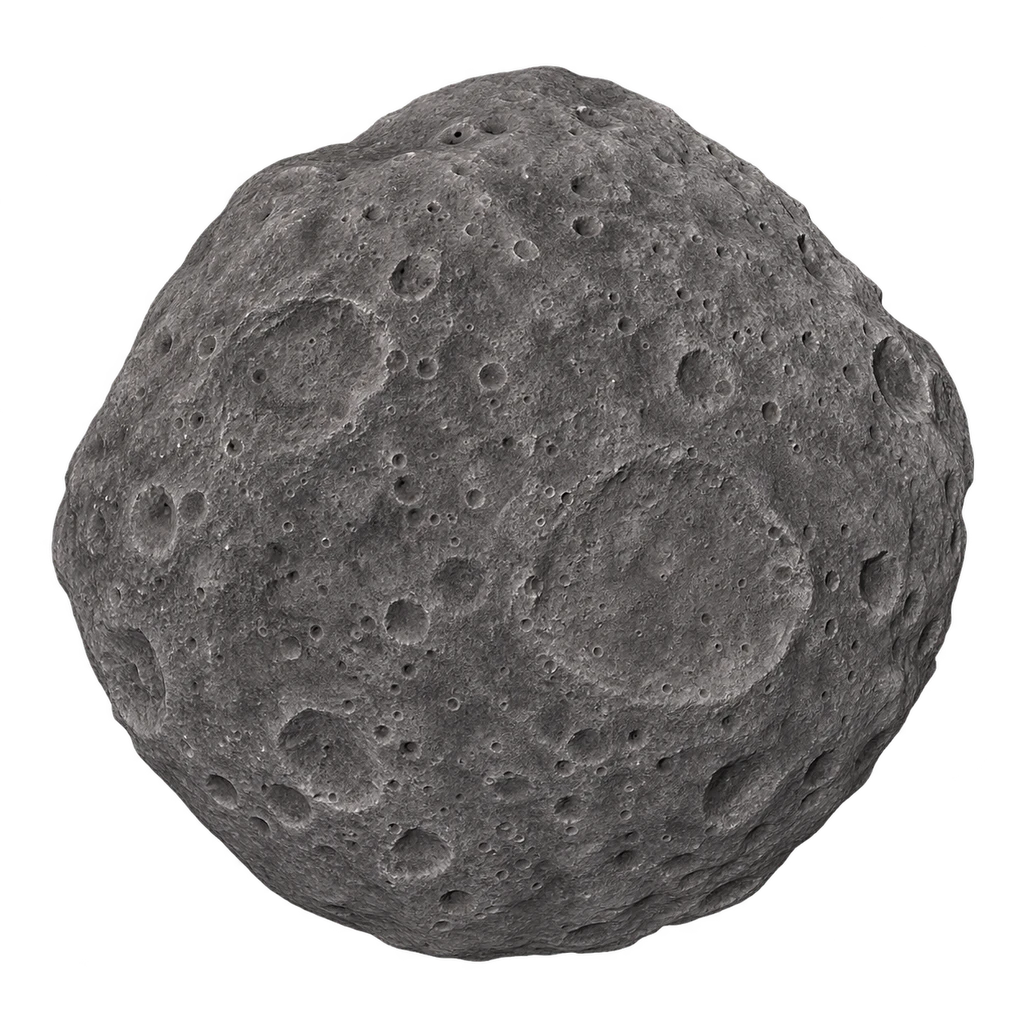
A moon found on the way to Uranus.
Puck was identified in Voyager 2 images in December 1985. It belongs to the inner moon system, well inside Miranda’s orbit. Its name comes from the mischievous sprite in Shakespeare’s A Midsummer Night’s Dream.
A dark, cratered exterior.
Puck has a dark cratered surface, with spectral evidence for water ice. Spacecraft coverage remains limited. The portrait is a broad interpretation, and individual ridges, craters and foreground rocks in the landscape studies are imagined.
An estimate is not an interior map.
Published mass estimates can depend on an assumed density. This dossier therefore leaves the gravity comparison unquantified. Size and surface brightness alone cannot resolve a rocky core, separate ice layers or a liquid reservoir.
One turn in roughly eighteen hours.
The adopted mean orbital scale is about 86,004 kilometers from Uranus’s center, with a period of 0.761833 Earth days. The standard orientation model is approximately synchronous. Puck follows Uranus’s rotation; the spin comparison omits the system’s large axial tilt.