NEPTUNE SYSTEM / SATELLITE DOSSIER

Thalassa

Thalassa is a small, flattened inner moon of Neptune whose orbital motion is coupled to neighboring Naiad.

DIAMETER / EARTH0.0063×
EARTHTHALASSA
ATMOSPHERE
No substantial atmosphere detectedEffectively airless
SURFACE TEMPERATURE
Cold exposed surface
SURFACE PRESSURE
Effectively airless
HABITABILITYNo life detected
UNPROTECTED HUMANSNot survivable

Interior ↗

03
Thalassa interiorThalassa's internal structure is unresolved.Unresolved

Moon system ↗

04
Neptune moon orbitsSelected moons, ordered outward. Orbit sizes and positions are schematic; relative periods are preserved.NEPTUNENAIADTHALASSADESPINAGALATEALARISSAHIPPOCAMPPROTEUSTRITONNEREID
THALASSA

Instrument detail

THE SKY FROM THALASSA

Neptune, in perspective.

SHARED ANGULAR SCALE
Neptune compared with Luna in Earth's skyAt semimajor-axis distance, Neptune spans approximately 59.3 degrees, 114.49 times the apparent diameter of Luna at its mean distance from Earth. Both disks share one angular scale.NEPTUNEOUR MOON≈ 0.52°
Idealized size study · full disks · decorative lighting · rings excluded
ANGULAR DIAMETER
59.3°
OUR MOON'S APPARENT DIAMETER
114.49 ×
CENTER-TO-CENTER DISTANCE
50,100 km

The viewpoint is on Thalassa’s nominal spherical surface, directly facing Neptune. The reference is Luna seen from Earth’s center at its mean distance. The reference distance is the orbit’s semimajor axis. Rounded body diameters and orbital elements set the disk sizes; terrain, phases, rings and the actual sky position are not modeled.

Explore Neptune ↗
Thalassa orbitElliptical orbit viewed along the orbital axis, relative to Neptune. Motion is accelerated, not a live position. Distances are center to center.NEPTUNETHALASSA≈ 50,100 km
ONE ORBIT0.311078 Earth days around Neptune
Closest to Neptune
50,100 km
Farthest from Neptune
50,100 km

Thalassa circles Neptune. Distances are measured between the centers of the two bodies.

Naiad and Thalassa have a three-dimensional resonant relationship. This mean circular path omits orbital inclination, vertical separation and their coupled motion; it is not a simulation of close approaches.

Thalassa rotation compared with EarthThe markers follow equal elapsed time on both worlds. Equal elapsed time and sidereal rotation rates. Polar schematic: sizes, axial tilt and seasons are not shown. Illumination uses a circular mean orbit, not a live sky prediction.SAME ELAPSED TIME · POLAR SCHEMATICTHALASSA7.5 hoursSIDEREAL ROTATIONPrograde spinEARTH23.9 hoursSIDEREAL ROTATION≈ 24 h · solar day
Marked longitude · equal time on both worlds
ONE SIDEREAL ROTATION7.5 hours

Turning through space

The standard orientation model is approximately synchronous: Thalassa turns roughly once per orbit, keeping broadly the same hemisphere toward Neptune. The rate comparison omits axial tilt and fine pole variations.

0 Earth hoursShared clock

Spin comparison only; no solar day is inferred. Sizes and starting longitudes are schematic, not live positions.

Satellite atlasMoons
Neptune moon orbitsSelected moons, ordered outward. Orbit sizes and positions are schematic; relative periods are preserved.NEPTUNENAIADTHALASSADESPINAGALATEALARISSAHIPPOCAMPPROTEUSTRITONNEREID
FEATURED MOONS09
  1. 01Naiad ↗0.29398 days
  2. 02Thalassa0.311078 days
  3. 03Despina ↗0.334656 days
  4. 04Galatea ↗0.428744 days
  5. 05Larissa ↗0.554989 days
  6. 06Hippocamp ↗0.95039 days
  7. 07Proteus ↗1.1223 days
  8. 08Triton ↗5.88 days
  9. 09Nereid ↗360.133039 days

A family of moons circles the planet.

Triton travels in the opposite direction to Neptune’s rotation. Naiad and Thalassa have a three-dimensional resonant relationship; this flat schematic does not show their orbital inclinations or vertical separation.

Thalassa gravityEqual launches at 2 m/s; shared metre scale; air resistance ignored.0 m50 m100 m150 mEARTH9.80 m/s²THALASSA0.01 m/s²NOMINAL ESTIMATE
THALASSA / EARTH GRAVITY0.0015 ×

This is a nominal spherical GM/r² estimate. JPL gives GM = 0.02359 ± 0.00522 km³/s² and mean radius 40 ± 8 km. Mass and size uncertainty are substantial; shape, tides and rotation add local differences.

Same push, different gravity

Both balls launch at 2 m/s, using the same height and time scales. Weaker gravity gives a higher jump and a longer time in the air. Air resistance is ignored. This idealized comparison uses constant spherical gravity GM/r²; local terrain, tides and rotation are excluded. Playback runs 23× faster for both balls.

Earth · height / airtime
0.20 m / 0.41 s
Thalassa · height / airtime
135.65 m / 271.30 s
Thalassa interiorThalassa's internal structure is unresolved.Unresolved

Beyond the surface

Thalassa’s interior is unresolved. Limited surface imagery and uncertain bulk properties do not establish distinct ice and rock layers, a differentiated core or a present-day ocean.

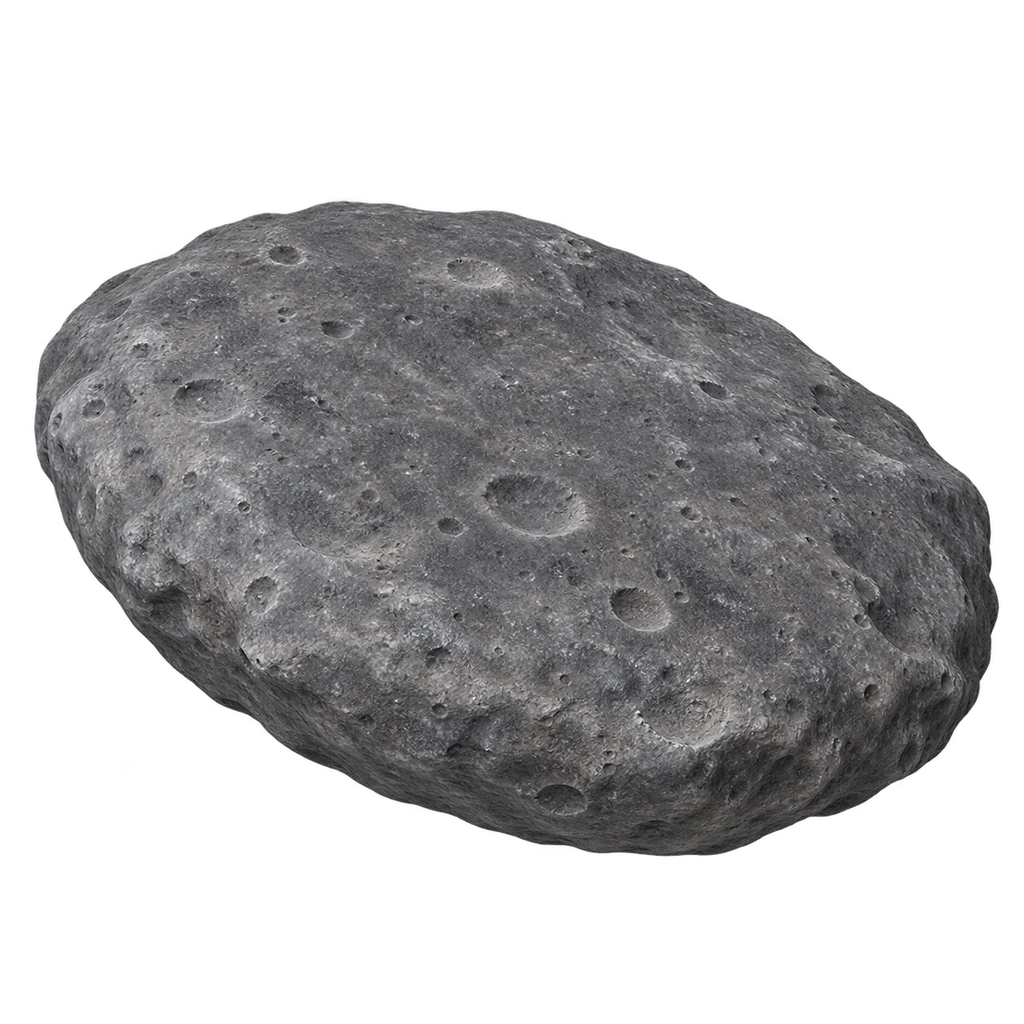
    Artist’s impression of Thalassa

    An unusually flattened outline.

    Thalassa is roughly disk-shaped rather than spherical. Its overall outline is better constrained than the details of its surface. The portrait interprets that flattened body; individual craters and foreground fragments in the landscapes are imagined.

    A repeating pattern with Naiad.

    Naiad passes above and below Thalassa’s orbital plane in a repeating resonant pattern. This three-dimensional arrangement keeps the moons well separated at their close approaches. The flat system diagram does not reproduce the pattern.

    Bulk measurements have limits.

    The adopted mean diameter is 80 kilometers. JPL provides a nominal mass parameter, but both mass and radius carry appreciable uncertainty. The gravity display is a spherical estimate; it does not establish a mapped interior, a rocky core or an ocean.

    Less than half a day.

    Thalassa’s adopted mean orbit lies 50,100 kilometers from Neptune’s center and takes 0.311078 Earth days. Eccentricity rounds to zero in the table. Approximate synchronous spin is used for the rotation comparison.
    DIAMETER / EARTH0.0063×
    EARTHTHALASSA
    EARTH
    12,742 km
    THALASSA
    80 km
    Mean diameters · circles share one scale

    80 km is the adopted JPL mean diameter. The irregular outline and uncertainty in radius make this an approximate equivalent-size comparison.

    ATMOSPHERE
    No substantial atmosphere detectedEffectively airless

    Thalassa is effectively airless. No substantial atmosphere is known to provide breathable air or surface pressure.

    SURFACE TEMPERATURE
    Cold exposed surface
    SURFACE PRESSURE
    Effectively airless
    HABITABILITYNo life detected

    No life has been detected, and a habitable environment has not been established.

    UNPROTECTED HUMANSNot survivable

    The exposed surface requires oxygen, pressure protection and thermal control.

    Planet and landscape images are artistic interpretations.

    • NASA ↗
      • Classification and orbital data
      • Rotation and internal structure constraints
      • Natural conditions and human survival
      • Shape
    • NASA ↗
      • Parent-body diameter for the angular sky comparison
    • NASA / JPL ↗
      • GM and mean radius; spherical gravity estimate GM/r²
      • Size, physical data and atmospheric constraints
      • Interior
    • NASA / JPL ↗
      • Mean orbital dimensions; distances from parent center
      • Orbit
    • naif.jpl.nasa.gov ↗
      • Rotation model and synchronous or independent spin
    • www.jpl.nasa.gov ↗
      • Companions
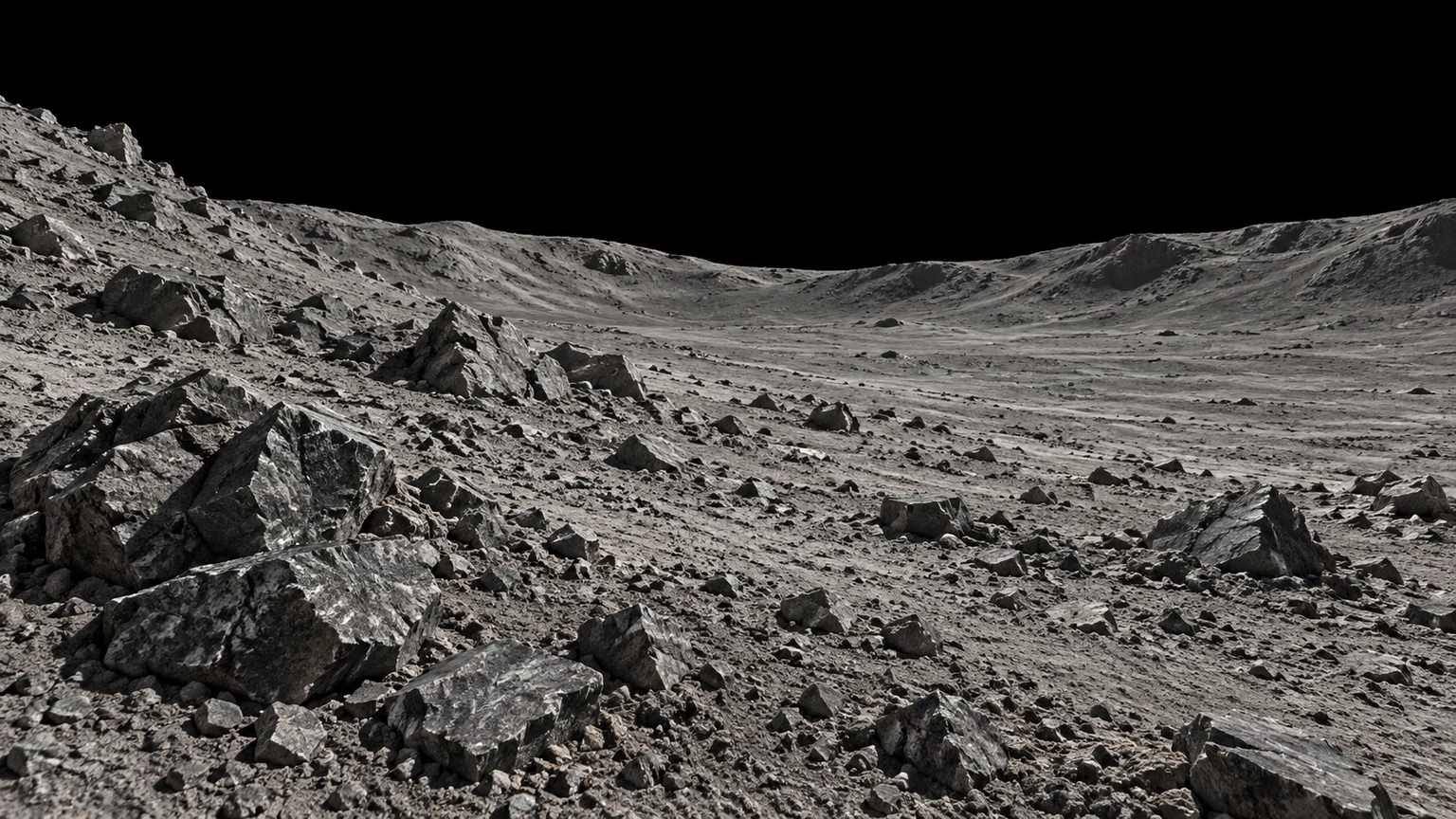
    An imagined ground-level view of Thalassa’s dark exterior. The terrain is an artistic reconstruction, not a surveyed site.

    Across a shallow hollow

    An imagined ground-level view of Thalassa’s dark exterior. The terrain is an artistic reconstruction, not a surveyed site.

    A landscape study on Thalassa with imagined granular debris and subdued relief. Limited spacecraft imagery does not define these local features.

    Along a low rim

    A landscape study on Thalassa with imagined granular debris and subdued relief. Limited spacecraft imagery does not define these local features.

    Flattened gray fragments arranged on a shallow sloping granular patch. An artistic reconstruction of Thalassa; local detail, lighting and viewpoint are imagined.

    Surface fragments in close view

    Flattened gray fragments arranged on a shallow sloping granular patch. An artistic reconstruction of Thalassa; local detail, lighting and viewpoint are imagined.