NEPTUNE SYSTEM / SATELLITE DOSSIER

Triton

Triton is Neptune’s largest moon, traveling against the planet’s rotation beneath a coating of nitrogen frost.

Artist’s impression of Triton

Nitrogen frost and signs of activity at the edge of Neptune’s realm.

DIAMETER / EARTH0.21×
EARTHTRITON
ATMOSPHERE
A tenuous nitrogen atmosphereToo thin for a useful percentage chart
SURFACE TEMPERATURE
≈ −235°C observed surface
SURFACE PRESSURE
Very thin atmosphere
HABITABILITYUncertain
UNPROTECTED HUMANSNot survivable

Interior ↗

03
Unresolvedinternal structure

Moon system ↗

04
Neptune moon orbitsSelected moons, ordered outward. Orbit sizes and positions are schematic; relative periods are preserved.NEPTUNENAIADTHALASSADESPINAGALATEALARISSAHIPPOCAMPPROTEUSTRITONNEREID
TRITON

Instrument detail

Triton orbitElliptical orbit viewed along the orbital axis, relative to Neptune. Motion is accelerated, not a live position. Distances are center to center.NEPTUNETRITON≈ 354,800 km
ONE ORBIT5.88 Earth days around Neptune
Closest to Neptune
354,800 km
Farthest from Neptune
354,800 km

Triton circles Neptune, opposite to the planet’s rotation. Distances are measured between the centers of the two bodies.

Triton rotationEqual elapsed time, with sidereal rotation rates and directions. Axial tilt and relative sizes are not shown.TRITON5.9 daysEARTH23.9 hours
ONE ROTATION5.9 days

One turn per orbit

Triton turns once in each orbit, so roughly the same hemisphere faces Neptune. The spin period is 5.88 Earth days; this is not the interval between sunrises.

Satellite atlasMoons
Neptune moon orbitsSelected moons, ordered outward. Orbit sizes and positions are schematic; relative periods are preserved.NEPTUNENAIADTHALASSADESPINAGALATEALARISSAHIPPOCAMPPROTEUSTRITONNEREID
FEATURED MOONS09
  1. 01Naiad ↗0.29398 days
  2. 02Thalassa ↗0.311078 days
  3. 03Despina ↗0.334656 days
  4. 04Galatea ↗0.428744 days
  5. 05Larissa ↗0.554989 days
  6. 06Hippocamp ↗0.95039 days
  7. 07Proteus ↗1.1223 days
  8. 08Triton5.88 days
  9. 09Nereid ↗360.133039 days

A family of moons circles the planet.

Triton travels in the opposite direction to Neptune’s rotation. Naiad and Thalassa have a three-dimensional resonant relationship; this flat schematic does not show their orbital inclinations or vertical separation.

Triton gravityEqual launches at 2 m/s; shared metre scale; air resistance ignored.0 m1 m2 m3 mEARTH9.80 m/s²TRITON0.78 m/s²
TRITON / EARTH GRAVITY0.08 ×

Same push, different gravity

Both balls launch at 2 m/s, using the same height and time scales. Weaker gravity gives a higher jump and a longer time in the air. Air resistance is ignored. This idealized comparison uses constant spherical gravity GM/r²; local terrain, tides and rotation are excluded.

Earth · height / airtime
0.20 m / 0.41 s
Triton · height / airtime
2.56 m / 5.12 s
Unresolvedinternal structure

Beyond the surface

Surface frost and geological activity are observed. The thickness of the ice, any liquid layer and the structure of the deep interior remain uncertain.

    Artist’s impression of Triton

    Against the planet’s rotation.

    Triton follows a retrograde orbit around Neptune. That unusual motion supports the idea that it originated elsewhere and was captured. Today it keeps the same face toward Neptune, despite its distinctive direction of travel.

    A landscape cold enough for nitrogen ice.

    At these temperatures, nitrogen can freeze onto the surface. Pale deposits and low-relief terrain reflect a world very different from terrestrial snowfields. Water ice forms stronger material beneath some of the more volatile surface deposits.

    Dark traces on a bright world.

    Voyager 2 observed geyser-like activity and dark streaks on Triton. These features showed that extreme cold does not rule out surface change. Seasonal sunlight can influence volatile materials even this far from the Sun.

    The interior remains a question.

    A captured origin and signs of activity make Triton an intriguing target. Its deep structure is still poorly constrained. Possibilities about internal liquid water should be treated as hypotheses, not as observations of an accessible ocean.

    DIAMETER / EARTH0.21×
    EARTHTRITON
    EARTH
    12,742 km
    TRITON
    2,706.8 km
    Mean diameters · circles share one scale
    ATMOSPHERE
    A tenuous nitrogen atmosphereToo thin for a useful percentage chart

    Nitrogen dominates the thin atmosphere, with methane present in small amounts. Its pressure is vastly below Earth’s.

    SURFACE TEMPERATURE
    ≈ −235°C observed surface
    SURFACE PRESSURE
    Very thin atmosphere
    HABITABILITYUncertain

    No life has been found. The exposed surface is extremely cold; potential deep habitats remain speculative.

    UNPROTECTED HUMANSNot survivable

    There is no breathable air. Pressure protection, oxygen and thermal protection are essential; an apparently solid landscape is not a safe human environment.

    Planet and landscape images are artistic interpretations.

    • NASA ↗
      • Classification and orbital data
      • Rotation and internal structure constraints
      • Natural conditions and human survival
      • Orbit
      • Frost
      • Activity
      • Unknowns
    • NASA / JPL ↗
      • GM and mean radius; spherical gravity estimate GM/r²
    • NASA / JPL ↗
      • Mean orbital dimensions; distances from parent center
    • NASA ↗
      • Size, physical data and atmospheric constraints
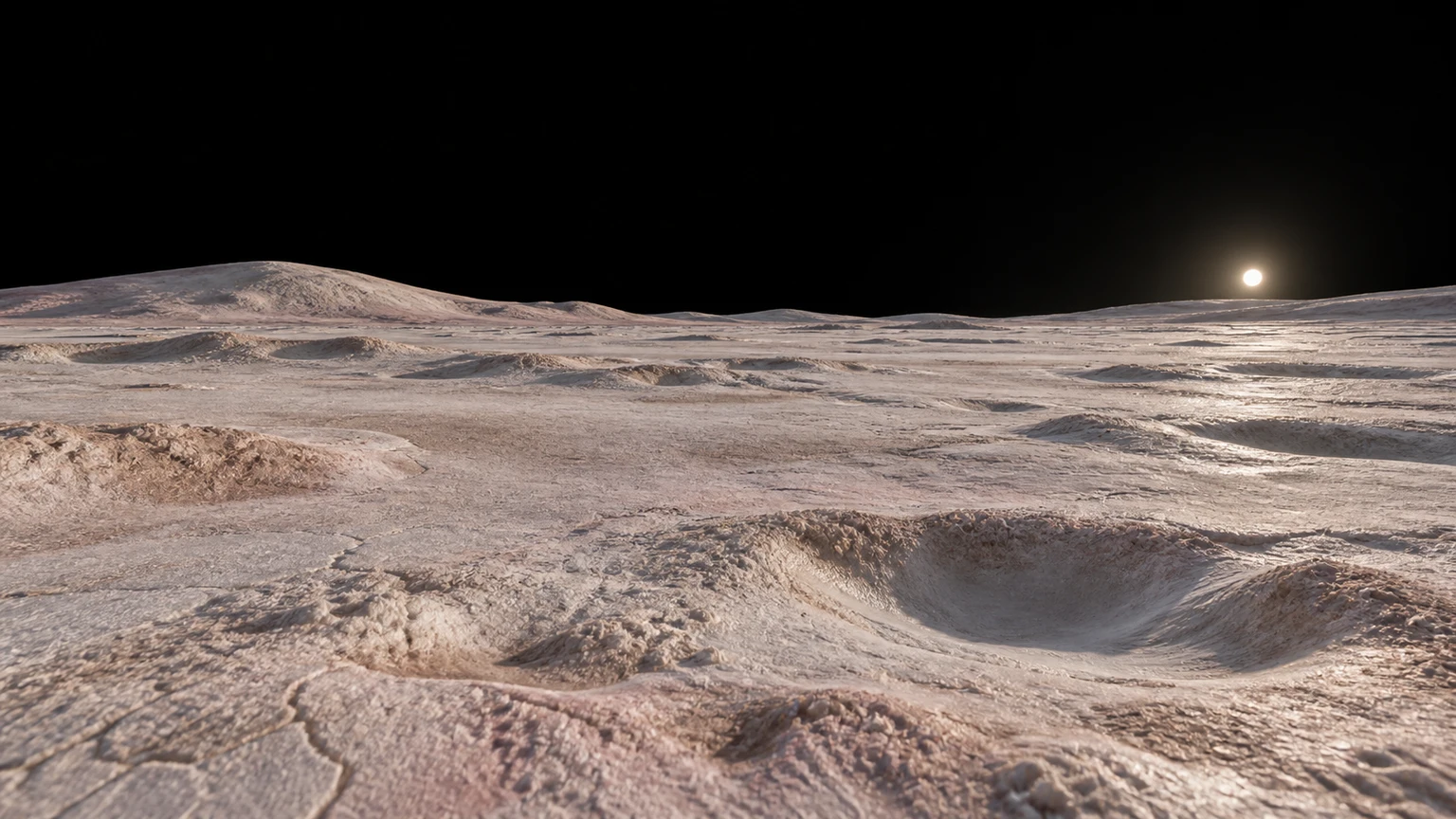
    An imagined low-relief frost landscape on Triton. Pale tones and hummocky terrain are interpretive, informed by Voyager views.

    Frozen nitrogen

    An imagined low-relief frost landscape on Triton. Pale tones and hummocky terrain are interpretive, informed by Voyager views.

    An imagined polar landscape with dark deposits and a faint distant plume. No particular vent or observed event is depicted.

    Traces across the frost

    An imagined polar landscape with dark deposits and a faint distant plume. No particular vent or observed event is depicted.

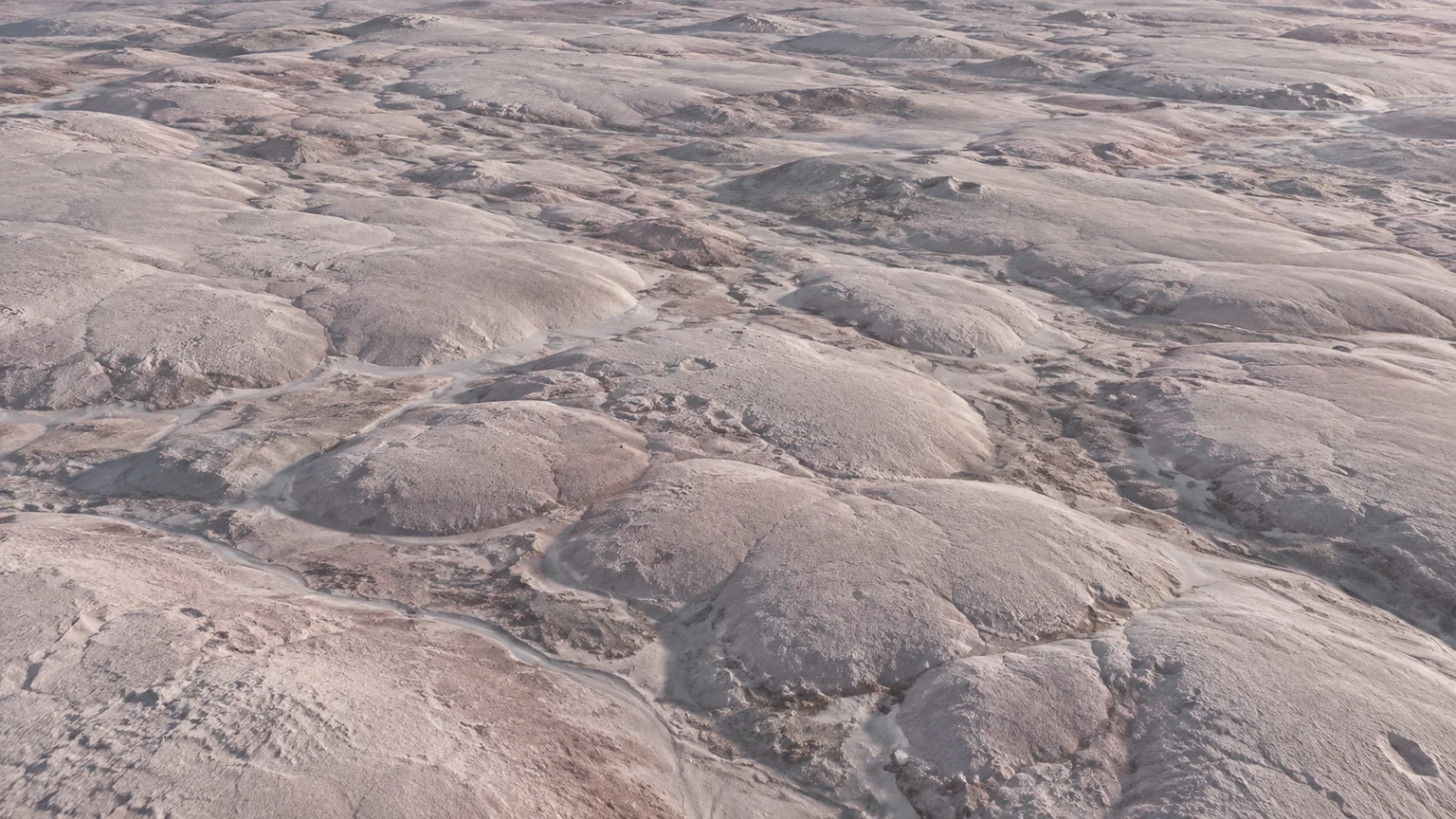
    Muted pale pink-gray hummocky cells and shallow irregular troughs. An artistic reconstruction of Triton; local detail, lighting and viewpoint are imagined.

    Textures in the frozen crust

    Muted pale pink-gray hummocky cells and shallow irregular troughs. An artistic reconstruction of Triton; local detail, lighting and viewpoint are imagined.