51 PEGASI SYSTEM / PLANETARY DOSSIER

51 Pegasi b

The historic hot Jupiter: a gas giant close to its star, with molecular signatures in its infrared light.

Artist’s impression of 51 Pegasi b; appearance and diameter are unconfirmed
Hot Jupiter

A giant planet in a four-day orbit.

Environment ↗

02
ATMOSPHERE

Water vapor detected

DIAMETER
Not measured
POSSIBILITY FOR LIFE
Incompatible with known life
WITHOUT PROTECTION
Not survivable

Mass comparison ↗

04
DYNAMICAL MASS0.61 × Jupiter

+0.06 / −0.05 Jupiter masses

The planet’s Doppler-shifted emission spectrum constrains its orbital speed and inclination.
51 PEGASI B

Instrument detail

Artist’s impression of 51 Pegasi b

Artist’s impression · appearance and diameter are unconfirmed.

The giant that broke the familiar pattern.

Announced in 1995, this was the first confirmed planet around a Sun-like star. Its discovery showed that a giant could orbit far closer to its star than Jupiter does to ours. Earlier exoplanets had already been found around a pulsar.

A year shorter than a working week.

At about 0.052 AU, 51 Pegasi b circles its host in roughly 4.23 Earth days. Its orbit subjects the gaseous world to strong stellar irradiation. The orbit diagram is schematic; it does not show the planet’s present position or its physical size to scale.

Reading motion in molecular lines.

High-resolution infrared spectra separate the planet’s moving molecular signal from the star. The adopted 2026 study detects water vapor and obtains a new orbital solution. Its mass and inclination differ from earlier analyses, so these values are presented as a specific published fit.

Clouds remain an imagined view.

Spectral signatures constrain gas without resolving individual bands or storms. The planet does not transit its star, so there is no measured transit radius for the diameter comparison. All three scenes depict possible atmospheric views, with no solid terrain or claim of an observed weather map.

Size, mass and atmosphere

DIAMETER / EARTH

Not measured.

The radius has not been measured; the illustration does not establish its size.

SIZE UNKNOWN
DYNAMICAL MASS / JUPITER
  • 51 Pegasi b0.61 (+0.06 / −0.05) M♃
  • Jupiter · reference mass1.00 M♃

Shared scale: 0–1.2 Jupiter masses. The planet’s Doppler-shifted emission spectrum constrains its orbital speed and inclination. Adopted mass 0.61 (+0.06 / −0.05) Jupiter masses from Cont et al. (2026). This spectroscopic solution differs from earlier inclination and mass estimates.

ATMOSPHERE / COMPOSITION

Water vapor detected

The 2026 CRIRES+ study identifies water vapor and finds an indication of carbon monoxide in the hot atmosphere. Water vapor is not evidence of liquid oceans. Cloud patterns, weather maps and exact gas percentages are not established.

Habitability

NATURAL CONDITIONSIncompatible with known life

The intensely heated environment described here does not provide conditions compatible with life as we know it. No life has been detected.

HUMANS / WITHOUT PROTECTIONNot survivable

Extreme heat and the absence of breathable conditions make this environment unsurvivable without protection. A precise survival timer would depend on location and is not assigned.

SOLID SURFACE
No accessible solid surface
ATMOSPHERIC TEMPERATURE
Hot; varies with altitude and location
PRESSURE
Depends on atmospheric depth
DIAMETER
Not directly measured by a transit

A year around 51 Pegasi

≈ 4.23 Earth days

Semimajor axis: 0.052 AU. One astronomical unit is approximately the mean Earth–Sun distance.

The overview is a schematic: sizes, orbital shape and the planet’s position are illustrative. It does not show a measured eccentricity, the orbit’s orientation or a live position.

At about 0.052 AU, 51 Pegasi b circles its host in roughly 4.23 Earth days. Its orbit subjects the gaseous world to strong stellar irradiation. The orbit diagram is schematic; it does not show the planet’s present position or its physical size to scale.

Cont et al. (2026) · orbital measurements ↗
Hypothetical pale and ochre cloud bands seen from above the limb. Their colors, height and pattern are invented; the planet’s diameter is not set by this illustration.

Over the banded atmosphere

Hypothetical pale and ochre cloud bands seen from above the limb. Their colors, height and pattern are invented; the planet’s diameter is not set by this illustration.

An imagined view above atmospheric cloud banks. There is no ground beneath the scene, and these specific clouds have not been mapped.

Among the high clouds

An imagined view above atmospheric cloud banks. There is no ground beneath the scene, and these specific clouds have not been mapped.

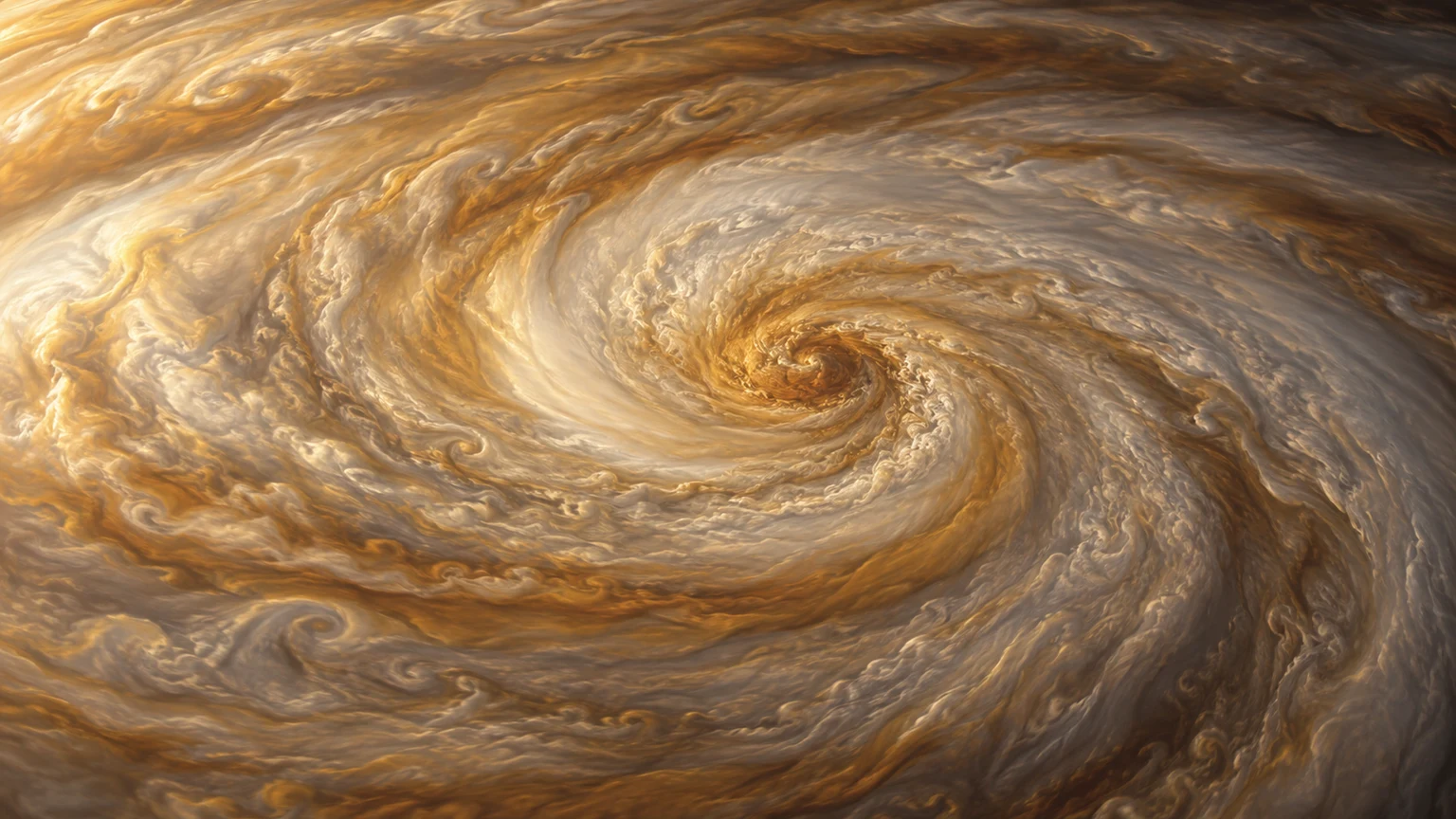
An invented atmospheric eddy illustrates moving gas on a hot giant. Its size and weather pattern are artistic choices, not an observed storm.

A whirl in the flowing gas

An invented atmospheric eddy illustrates moving gas on a hot giant. Its size and weather pattern are artistic choices, not an observed storm.

Planet and landscape images are hypothetical artistic interpretations.