55 CANCRI A SYSTEM / PLANETARY DOSSIER

55 Cancri e

A transiting super-Earth with a year under eighteen hours and evidence for an atmosphere above intensely heated rock.
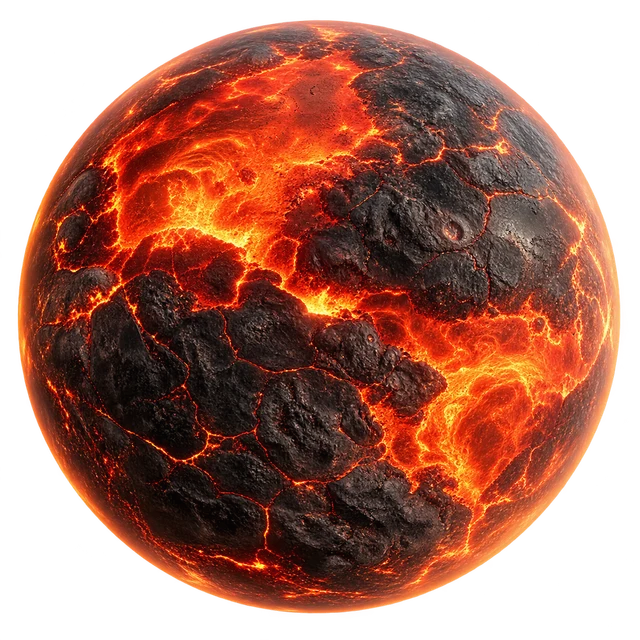
Artist’s impression of 55 Cancri e; appearance is hypothetical; diameter is inferred from transits
Ultra-hot rocky super-Earth

A rocky world at the edge of melting.

Environment ↗

02
ATMOSPHERE

Evidence for a secondary atmosphere

DIAMETER
1.875 × Earth
POSSIBILITY FOR LIFE
Incompatible with known life
WITHOUT PROTECTION
Not survivable

Mass comparison ↗

04
DYNAMICAL MASS7.99 × Earth

+0.32 / −0.33 Earth masses

Stellar radial velocities combined with the transit inclination constrain the planetary mass.
55 CANCRI E

Instrument detail

Artist’s impression of 55 Cancri e

Artist’s impression · appearance is hypothetical; diameter is inferred from transits.

Seventeen and a half hours around a star.

This world crosses its star repeatedly on an extremely short orbit. A transit constrains its size; radial velocities and orbital inclination constrain its mass. The reference measurements describe a planet substantially larger and more massive than Earth.

Gas above intensely heated rock.

Webb observed the infrared light lost when the planet passed behind its star. The resulting spectrum favors an atmosphere containing volatiles over a thin veil of vaporized rock alone. Carbon-bearing gases are plausible constituents, while abundances and pressure remain uncertain.

A surface that may feed its own air.

Magma can store and release gases. Outgassing provides a possible route to sustaining an atmosphere despite strong irradiation. The glowing seas shown here explore that physical picture; they do not establish a specific coastline, magma depth or mineral recipe.

Super-Earth describes size, not comfort.

The name super-Earth marks a range of planetary sizes and masses. It does not imply an Earth-like climate. This close, intensely heated world is useful for studying rocky-planet atmospheres precisely because its environment is so different from home.

Size, mass and atmosphere

DIAMETER / EARTH1.875 ×

+0.029 / −0.029 · Earth-relative ratio

Optical transit radius from Bourrier et al. (2018), Table 4; inferred using the adopted stellar radius. Radius and diameter ratios are equal.

DYNAMICAL MASS / EARTH
  • 55 Cancri e7.99 (+0.32 / −0.33) M⊕
  • Earth · reference mass1.00 M⊕

Shared scale: 0–10 Earth masses. Stellar radial velocities combined with the transit inclination constrain the planetary mass. Adopted reference fit: Bourrier et al. (2018), Table 4. Later studies use somewhat different stellar and planetary parameters; this page keeps the mass and radius from one consistent fit.

ATMOSPHERE / COMPOSITION

Evidence for a secondary atmosphere

Webb thermal spectra support a volatile atmosphere, with carbon monoxide or carbon dioxide among the favored ingredients. Outgassing from molten rock could replenish it. The precise composition and surface pressure remain model-dependent.

Habitability

NATURAL CONDITIONSIncompatible with known life

The intensely heated environment described here does not provide conditions compatible with life as we know it. No life has been detected.

HUMANS / WITHOUT PROTECTIONNot survivable

Extreme heat and the absence of breathable conditions make this environment unsurvivable without protection. A precise survival timer would depend on location and is not assigned.

THERMAL ENVIRONMENT
Extreme heat; silicate melting is plausible
SURFACE PRESSURE
Not uniquely determined
LIQUID WATER OCEANS
Not supported by the observed conditions
SURFACE GRAVITY
≈ 2.27 × Earth · adopted mass/radius

A year around 55 Cancri A

≈ 0.737 Earth days

Semimajor axis: 0.01544 AU. One astronomical unit is approximately the mean Earth–Sun distance.

The overview is a schematic: sizes, orbital shape and the planet’s position are illustrative. It does not show a measured eccentricity, the orbit’s orientation or a live position.

This world crosses its star repeatedly on an extremely short orbit. A transit constrains its size; radial velocities and orbital inclination constrain its mass. The reference measurements describe a planet substantially larger and more massive than Earth.

Bourrier et al. (2018) · orbital measurements ↗
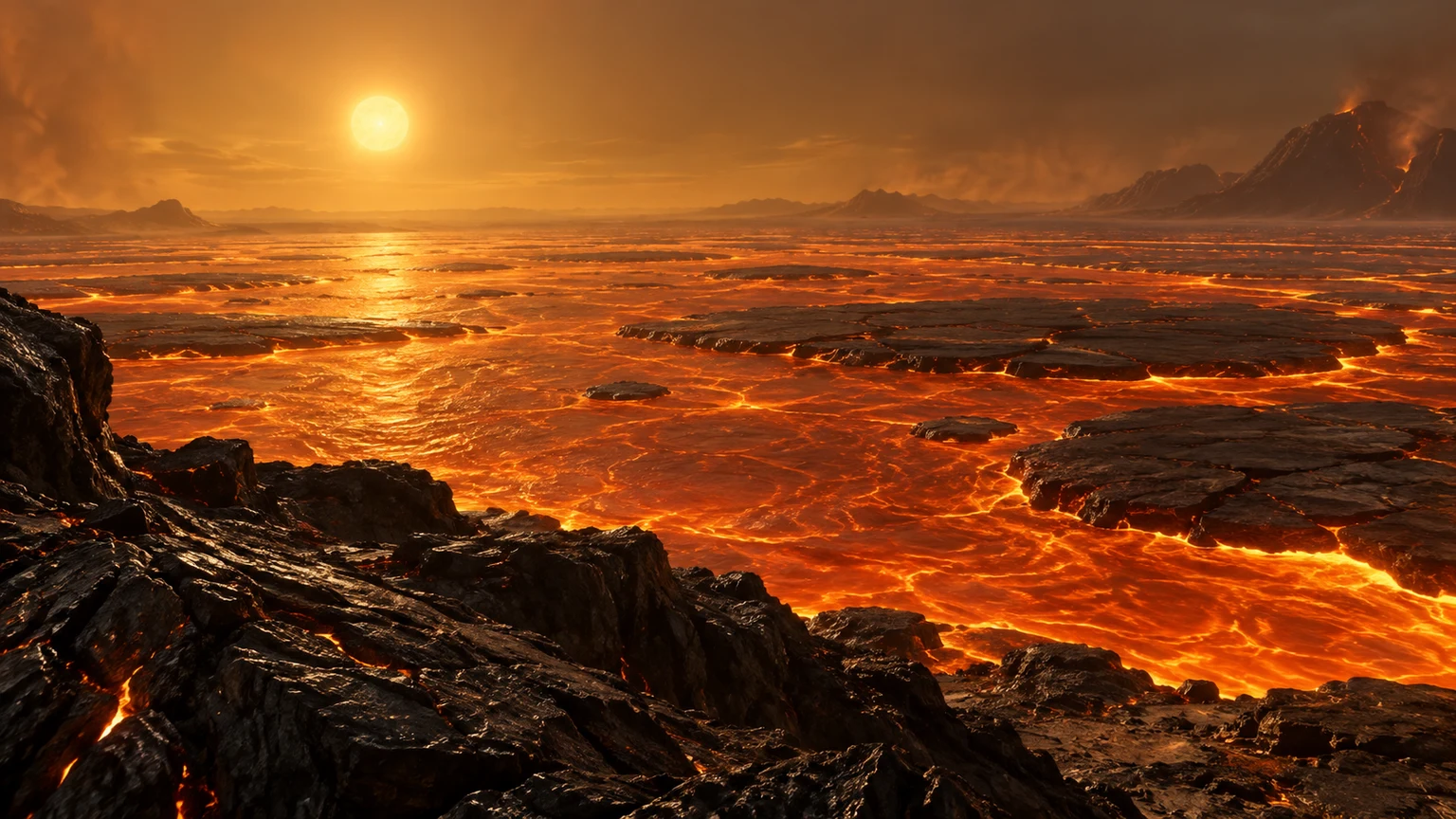
A hypothetical silicate melt with dark crust rafts. The distribution of molten rock, haze and solid material is invented, not a mapped surface.

Rafts on a molten sea

A hypothetical silicate melt with dark crust rafts. The distribution of molten rock, haze and solid material is invented, not a mapped surface.

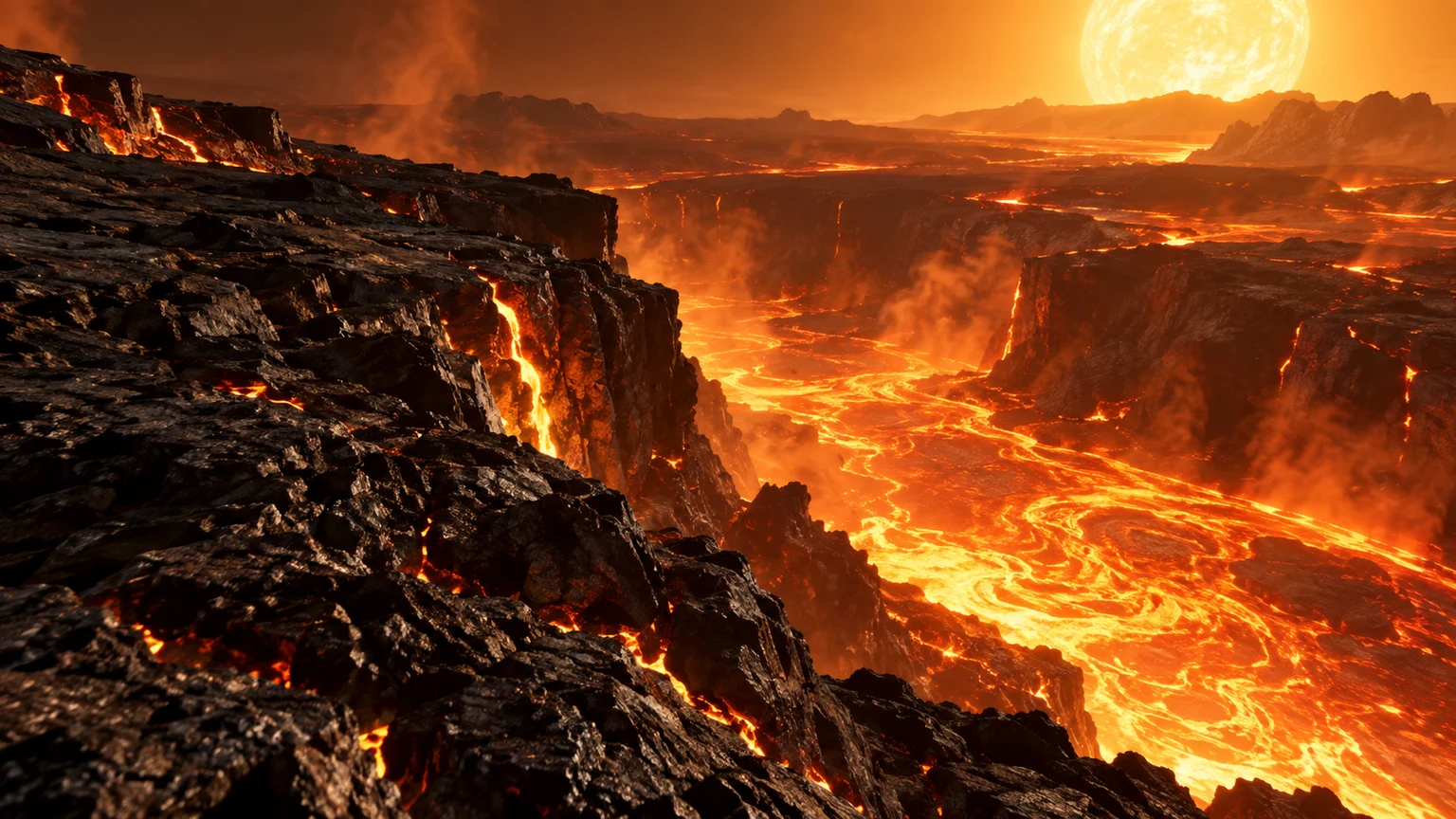
An imagined rocky escarpment and molten channel under extreme heating. These landforms and their colors are artistic interpretations.

Along an incandescent channel

An imagined rocky escarpment and molten channel under extreme heating. These landforms and their colors are artistic interpretations.

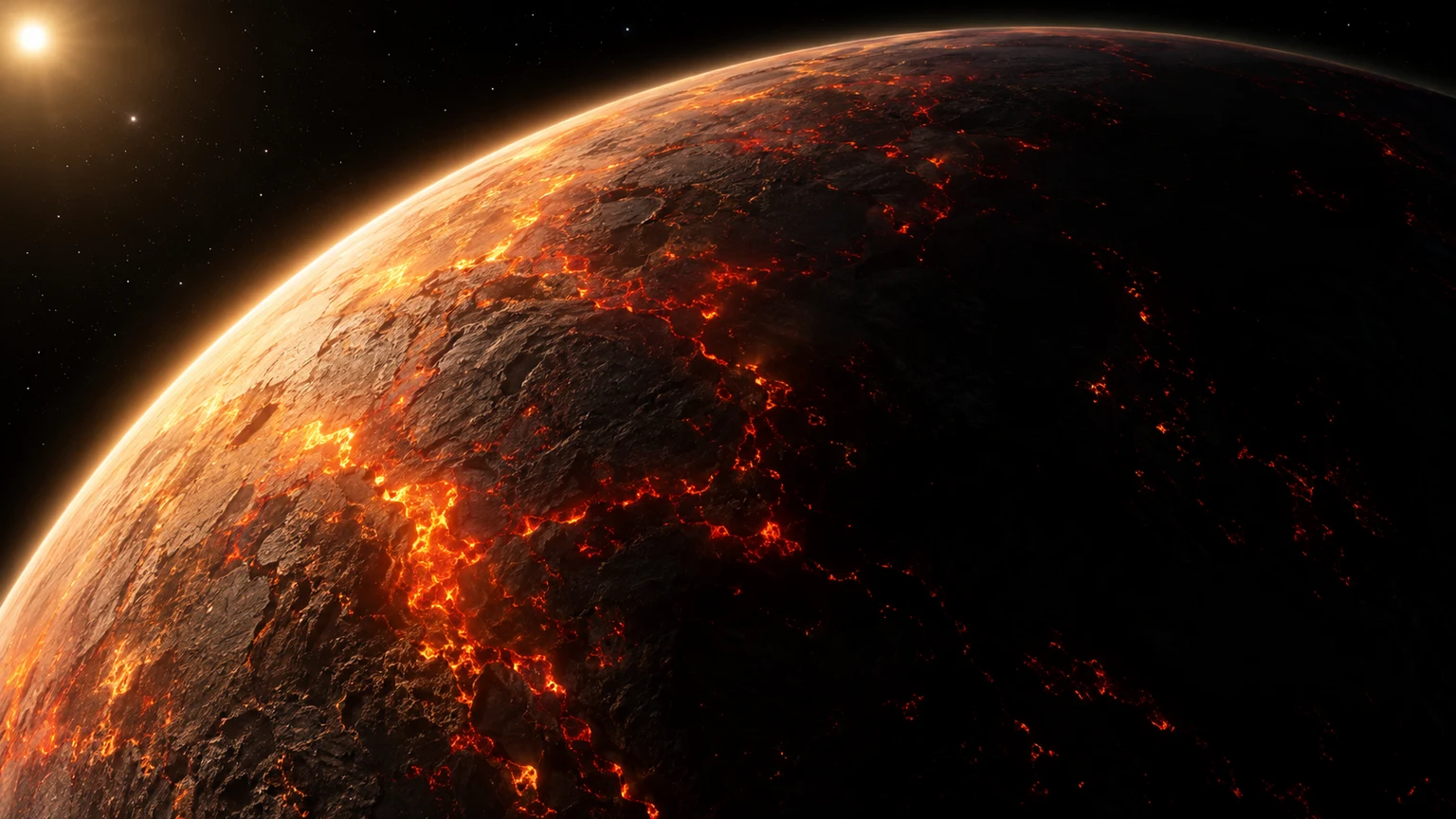
A fictional orbital view of hot crust and glowing melt near a day-night boundary. The pattern does not reconstruct a measured temperature map.

Where the glow meets the night

A fictional orbital view of hot crust and glowing melt near a day-night boundary. The pattern does not reconstruct a measured temperature map.

Planet and landscape images are hypothetical artistic interpretations.