SOL SYSTEM / PLANETARY DOSSIER

Ceres

Ceres is a dwarf planet orbiting between Mars and Jupiter, with a rocky interior and a water-rich crust. Bright salt deposits on its surface record the movement of brines from below.
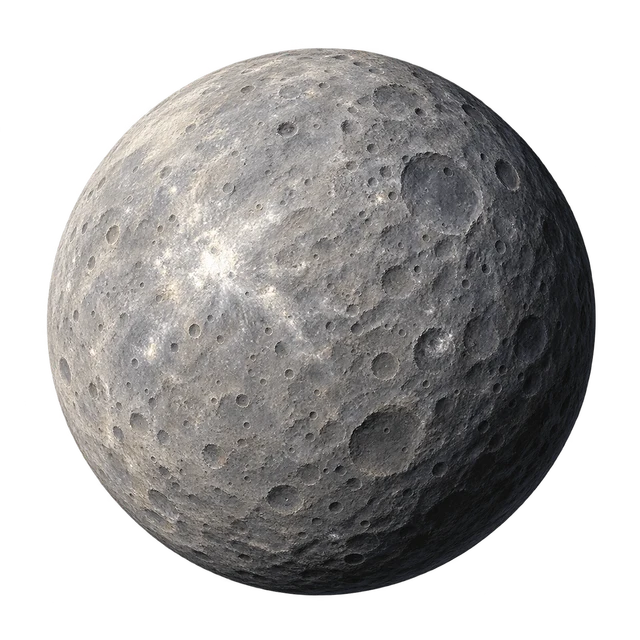
Artist’s impression of Ceres

Dwarf planetA small world between Mars and Jupiter, with bright traces of a watery past.

DIAMETER / EARTH0.07×
EARTHCERES
ATMOSPHERE
A tenuous envelope, with water vaporWater vapor detected
SURFACE TEMPERATURE
Cold · varies with sunlight
SURFACE PRESSURE
Very tenuous envelope
HABITABILITYBrine chemistry
UNPROTECTED HUMANSNot survivable
Interior ↗

03
Ceres interiorCeres's internal structure is unresolved.Unresolved

System ↗

04
No known moonsSYSTEM OVERVIEW · NOT TO SCALE
CERES

Instrument detail

Ceres orbitElliptical orbit viewed along the orbital axis, relative to Sun. Motion is accelerated, not a live position. Distances are center to center.SUNCERES2.99 AU2.55 AU
ONE ORBIT4.6 Earth years
Closest to the Sun
2.55 AU
Farthest from the Sun
2.99 AU

The Sun sits at a focus of the orbit. Ceres moves faster near the Sun and more slowly farther away.

A simplified ellipse from rounded JPL orbital elements at epoch JD 2461200.5. The moving marker is illustrative, not a current position. Orbital inclination and perturbations are omitted.

Ceres rotation compared with EarthThe markers follow equal elapsed time on both worlds. Equal elapsed time and sidereal rotation rates. Polar schematic: sizes, axial tilt and seasons are not shown. Illumination uses a circular mean orbit, not a live sky prediction.SAME ELAPSED TIME · POLAR SCHEMATICCERES9.1 hoursSIDEREAL ROTATIONPrograde spinEARTH23.9 hoursSIDEREAL ROTATION≈ 24 h · solar day
Marked longitude · equal time on both worlds
ONE SIDEREAL ROTATION9.1 hours

Turning through space

Ceres turns in about 9.1 hours. This comparison shows the rotation rate; axial tilt and shape are omitted.

0 Earth hoursShared clock

Spin comparison only; no solar day is inferred. Sizes and starting longitudes are schematic, not live positions.

Satellite atlasMoons
No known moonsSYSTEM OVERVIEW · NOT TO SCALE

Ceres and its surroundings

Ceres has no moons. It travels around the Sun in the main asteroid belt.

The illustration identifies companions without assigning orbital periods, distances or present-day positions. Body sizes and spacing are schematic.

Ceres gravityEqual launches at 2 m/s; shared metre scale; air resistance ignored.0 m5 m10 m15 mEARTH9.80 m/s²CERES0.28 m/s²NOMINAL ESTIMATE
CERES / EARTH GRAVITY0.03 ×

A spherical GM/r² estimate from Dawn’s GM and mean diameter. Rotation, shape and local terrain change the effective surface gravity.

Same push, different gravity

Both balls launch at 2 m/s, using the same height and time scales. Weaker gravity gives a higher jump and a longer time in the air. Air resistance is ignored.

Earth · height / airtime
0.20 m / 0.41 s
Ceres · height / airtime
7.05 m / 14.09 s
Ceres interiorCeres's internal structure is unresolved.Unresolved

Beyond the surface

Gravity and terrain measurements point to a differentiated interior, with denser rock beneath a water-rich crust. Ceres is small, yet its history includes the sorting and movement of materials we associate with larger worlds.

    Artist’s impression of Ceres

    Bright spots with a salty story.

    The pale deposits inside Occator stand out against Ceres’ dark ground. Dawn identified carbonates and other salts in these bright areas. They reflect sunlight; they are not lights shining from within the crater.

    A world that separated into layers.

    Gravity and terrain measurements point to a differentiated interior, with denser rock beneath a water-rich crust. Ceres is small, yet its history includes the sorting and movement of materials we associate with larger worlds.

    Cold does not mean inactive.

    Salts lower the freezing point of water. Dawn found evidence for geologically recent activity, making brines an important part of Ceres’ story. The bright deposits are clues to processes beneath a surface that looks quiet from afar.

    A different kind of belt object.

    Ceres circles Sol between Mars and Jupiter and rotates in roughly nine hours. It has no moons. This is the closest dwarf planet to Earth’s orbit, a reminder that small planetary worlds are not confined to the distant Kuiper Belt.

    DIAMETER / EARTH0.07×
    EARTHCERES
    EARTH
    12,756 km
    CERES
    940 km
    mean planet diameter / equatorial Earth diameter · rings excluded

    Rounded mean diameter of about 940 km.

    ATMOSPHERE
    A tenuous envelope, with water vaporWater vapor detected

    Evidence for water vapor points to a very sparse envelope. It does not provide breathable air or Earth-like weather.

    SURFACE TEMPERATURE
    Cold · varies with sunlight
    SURFACE PRESSURE
    Very tenuous envelope
    HABITABILITYBrine chemistry

    Water, salts and past geological activity make Ceres interesting for habitability research. Those ingredients do not establish that life exists.

    UNPROTECTED HUMANSNot survivable

    The distant, cold environment offers no known breathable air or protective surface pressure. Human exploration would require a sealed, thermally controlled habitat.

    Planet and landscape images are artistic interpretations.

    • NASA ↗
      • Classification and orbital data
      • Natural conditions and human survival
      • Orbit
    • NASA / JPL ↗
      • Rounded heliocentric orbital elements
      • Rotation measurements and uncertainty
      • GM and mean diameter; spherical gravity estimate
    • NASA ↗
      • Size, physical data and atmospheric constraints
      • Landscape
      • Interior
      • Activity
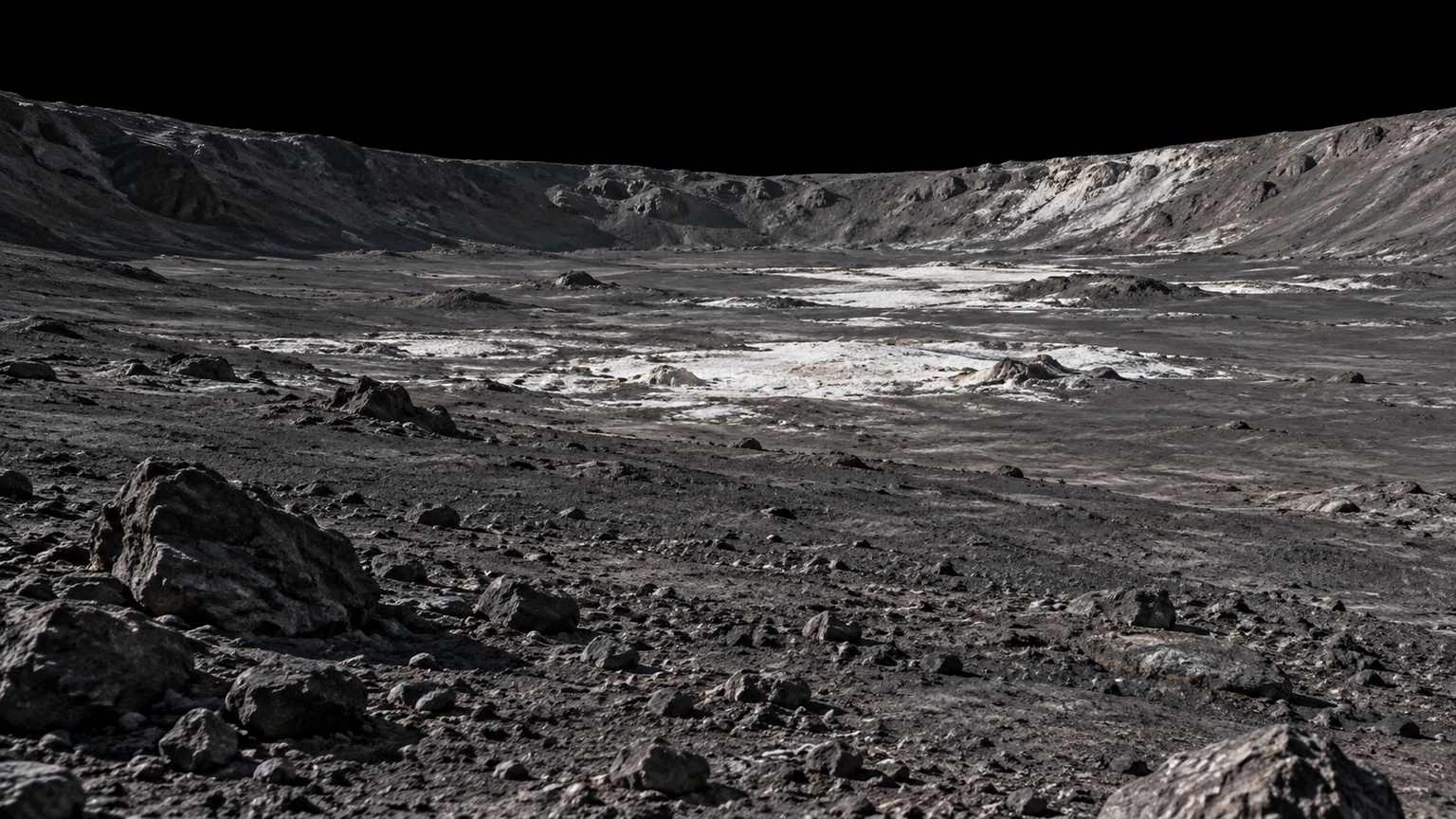
    Reconstructed view inspired by the bright salt deposits of Occator crater. The white material reflects sunlight; it does not glow. This is an imagined visitor viewpoint.

    Salt on dark ground

    Reconstructed view inspired by the bright salt deposits of Occator crater. The white material reflects sunlight; it does not glow. This is an imagined visitor viewpoint.

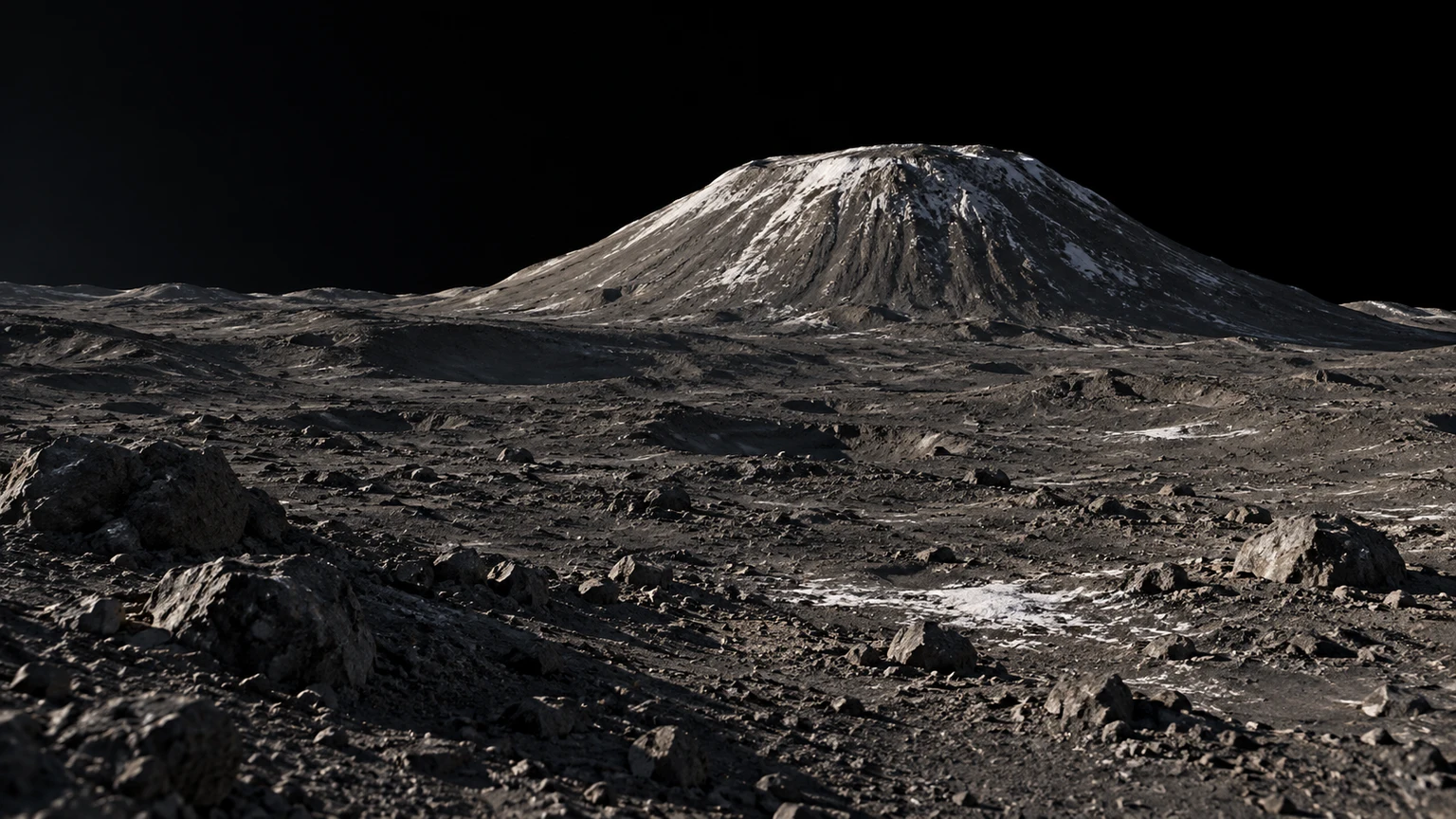
    A ground-level reconstruction inspired by Ahuna Mons and the surrounding cratered plains. Dawn informs the overall geology; the exact viewpoint and foreground are illustrative.

    A solitary dome

    A ground-level reconstruction inspired by Ahuna Mons and the surrounding cratered plains. Dawn informs the overall geology; the exact viewpoint and foreground are illustrative.

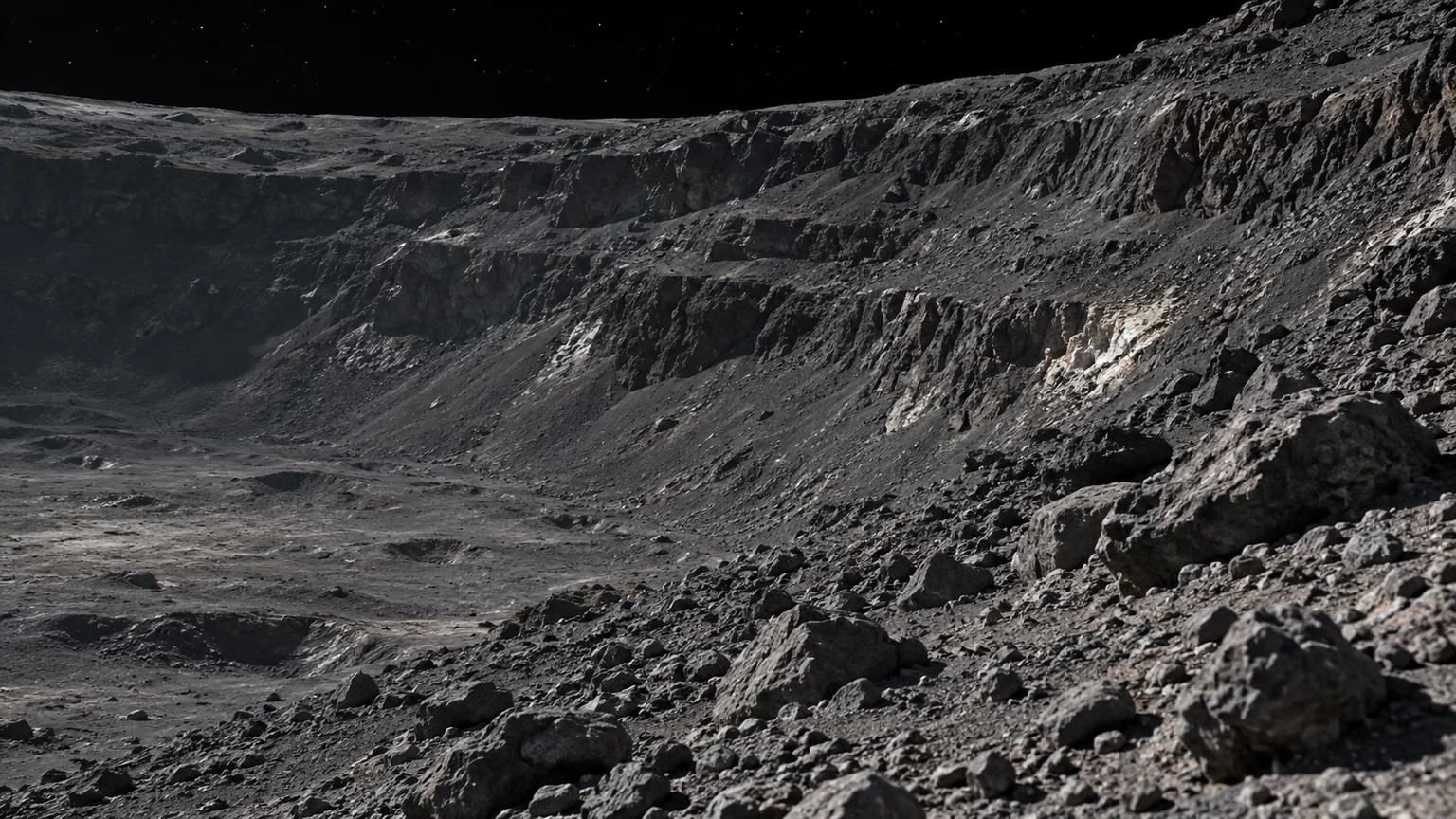
    Dark gray crater wall terraces and rubble with a few small reflective pale mineral exposures. An artistic reconstruction of Ceres; local detail, lighting and viewpoint are imagined.

    Inside weathered crater walls

    Dark gray crater wall terraces and rubble with a few small reflective pale mineral exposures. An artistic reconstruction of Ceres; local detail, lighting and viewpoint are imagined.