SOL SYSTEM / PLANETARY DOSSIER

Eris

Eris is a highly reflective dwarf planet close to Pluto in size, with an icy surface and a moon called Dysnomia. Its discovery helped prompt the 2006 redefinition of planets.
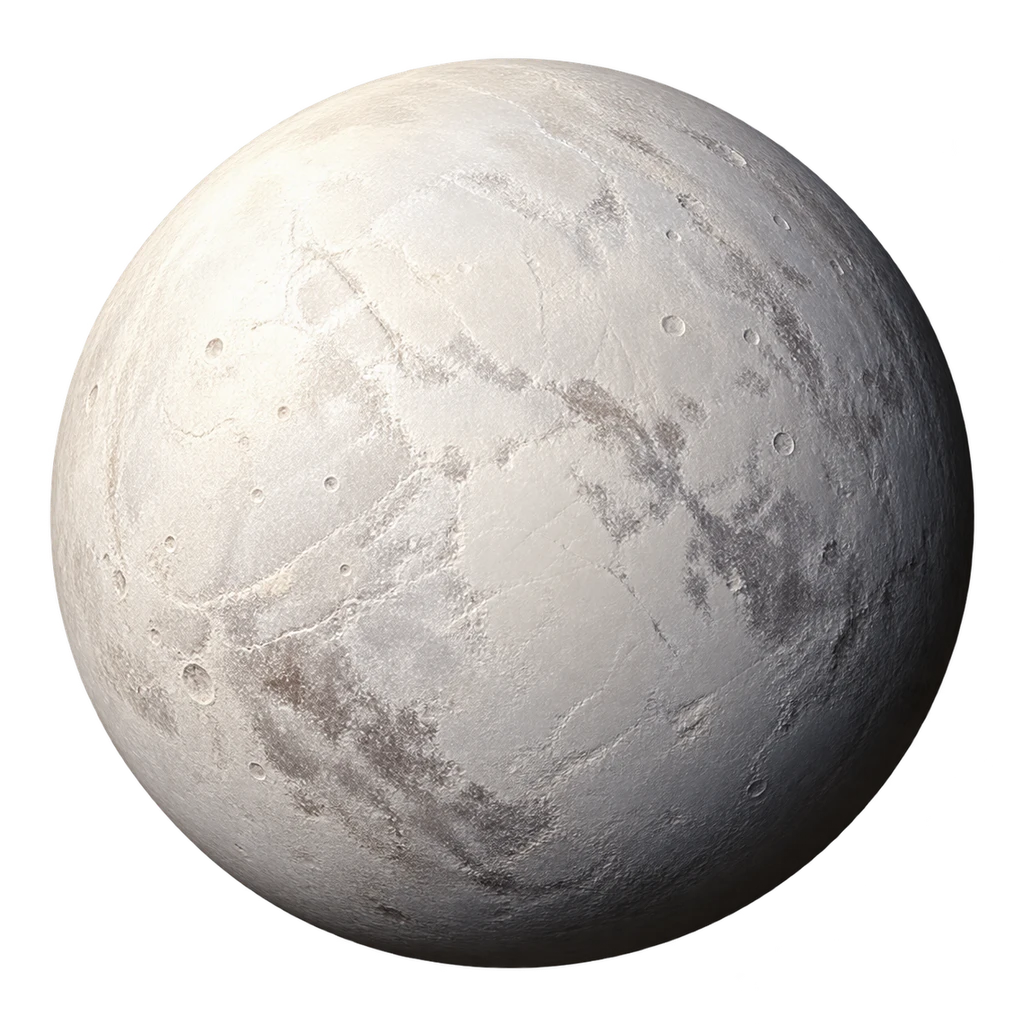
Artist’s impression of Eris

Dwarf planetClose to Pluto in size, yet central to a much larger change in how we name worlds.

DIAMETER / EARTH0.18×
EARTHERIS
ATMOSPHERE
Volatiles mostly held as frostNo substantial atmosphere in occultation data
SURFACE TEMPERATURE
Extreme cold · varies around orbit
SURFACE PRESSURE
Very low · observation-dependent
HABITABILITYNo life detected
UNPROTECTED HUMANSNot survivable

Interior ↗

03
Eris interiorEris's internal structure is unresolved.Unresolved

System ↗

04
Dysnomia1 companionSYSTEM OVERVIEW · NOT TO SCALE
ERIS

Instrument detail

Eris orbitElliptical orbit viewed along the orbital axis, relative to Sun. Motion is accelerated, not a live position. Distances are center to center.SUNERIS97.70 AU38.20 AU
ONE ORBIT≈ 560 Earth years
Closest to the Sun
38.20 AU
Farthest from the Sun
97.70 AU

The Sun sits at a focus of the orbit. Eris moves faster near the Sun and more slowly farther away.

A simplified ellipse from rounded JPL orbital elements at epoch JD 2461200.5. The moving marker is illustrative, not a current position. Orbital inclination and perturbations are omitted.

Eris rotation compared with EarthThe markers follow equal elapsed time on both worlds. Equal elapsed time and sidereal rotation rates. Polar schematic: sizes, axial tilt and seasons are not shown. Illumination uses a circular mean orbit, not a live sky prediction. The spin direction is illustrative, not measured.SAME ELAPSED TIME · POLAR SCHEMATICERIS15.8 daysSIDEREAL ROTATIONDirection illustrativeEARTH23.9 hoursSIDEREAL ROTATION≈ 24 h · solar day
Marked longitude · equal time on both worlds
ONE SIDEREAL ROTATION15.8 days

Turning through space

Long-term photometry gives a rotation period of about 15.8 days, consistent with Dysnomia’s orbital period and synchronous rotation. Spin direction is illustrative.

0 Earth hoursShared clock

Spin comparison only; no solar day is inferred. Sizes and starting longitudes are schematic, not live positions.

Satellite atlasMoons
Dysnomia1 companionSYSTEM OVERVIEW · NOT TO SCALE

Eris and its surroundings

Following the motion of Dysnomia lets astronomers calculate the system’s mass. Combined with Eris’ size, that information constrains its density. A faint moon can tell us something that the brightness of the main body alone cannot.

The illustration identifies companions without assigning orbital periods, distances or present-day positions. Body sizes and spacing are schematic.

GRAVITY CONSTRAINTSMODEL-DEPENDENT
SURFACE GRAVITYModel-dependent

Mass, size and shape

Surface gravity requires the body’s own mass and radius. Size estimates and the division of mass between binary components introduce model assumptions. No single numerical jump comparison is adopted here.

Eris interiorEris's internal structure is unresolved.Unresolved

Beyond the surface

Remote observations constrain surface materials and bulk properties, but do not map internal layer boundaries. A precise core, shell thickness or present-day ocean is not established by this view.

    Artist’s impression of Eris

    The discovery that changed the list.

    Eris helped force a fresh definition of a planet. The 2006 decision placed both it and Pluto in the dwarf-planet category.

    A remarkably reflective face.

    An occultation measurement showed Eris to be close to Pluto in size and exceptionally reflective. A bright veneer of frozen volatiles offers an explanation. The white terrain shown here is an interpretation of that icy surface, not a surveyed scene.

    Dysnomia provides the scales.

    Following the motion of Dysnomia lets astronomers calculate the system’s mass. Combined with Eris’ size, that information constrains its density. A faint moon can tell us something that the brightness of the main body alone cannot.

    A sky that may change with distance.

    At great distance from Sol, volatile material can remain frozen on the ground. A changing atmosphere nearer the Sun is a possibility rather than a permanently breathable sky. Temperature and orbit are inseparable parts of this world’s story.

    DIAMETER / EARTH0.18×
    EARTHERIS
    EARTH
    12,756 km
    ERIS
    2,326 km
    approximate planet diameter / equatorial Earth diameter · rings excluded

    Approximate occultation-derived diameter of 2,326 km.

    ATMOSPHERE
    Volatiles mostly held as frostNo substantial atmosphere in occultation data

    Observations constrain a thin atmosphere. Freezing and sublimation could change it around the orbit; a permanent gas mixture is not established.

    SURFACE TEMPERATURE
    Extreme cold · varies around orbit
    SURFACE PRESSURE
    Very low · observation-dependent
    HABITABILITYNo life detected

    There is no evidence of life here. Remote measurements do not establish a liquid-water habitat; the interior remains poorly constrained.

    UNPROTECTED HUMANSNot survivable

    The distant, cold environment offers no known breathable air or protective surface pressure. Human exploration would require a sealed, thermally controlled habitat.

    Planet and landscape images are artistic interpretations.

    • NASA ↗
      • Classification and orbital data
      • Natural conditions and human survival
      • History
      • Companion
    • NASA / JPL ↗
      • Rounded heliocentric orbital elements
    • arxiv.org ↗
      • Rotation measurements and uncertainty
    • Research ↗
      • Size, physical data and atmospheric constraints
      • Surface
      • Seasons
    Hypothetical ground-level landscape of Eris. Color and broad material choices follow remote observations; terrain, lighting and local details are artistic interpretation, not a mapped or photographed site.

    A bright, frozen plain

    Hypothetical ground-level landscape of Eris. Color and broad material choices follow remote observations; terrain, lighting and local details are artistic interpretation, not a mapped or photographed site.

    Hypothetical ground-level landscape of Eris. Color and broad material choices follow remote observations; terrain, lighting and local details are artistic interpretation, not a mapped or photographed site.

    At a low icy escarpment

    Hypothetical ground-level landscape of Eris. Color and broad material choices follow remote observations; terrain, lighting and local details are artistic interpretation, not a mapped or photographed site.

    A fine branching crack in subdued pale frosted ground with small ice fragments. An artistic reconstruction of Eris; local detail, lighting and viewpoint are imagined. The depicted environment is a possibility, not an observed surface or weather map.

    Cracks beneath pale frost

    A fine branching crack in subdued pale frosted ground with small ice fragments. An artistic reconstruction of Eris; local detail, lighting and viewpoint are imagined. The depicted environment is a possibility, not an observed surface or weather map.