HD 209458 SYSTEM / PLANETARY DOSSIER

HD 209458 b

A transiting gas giant that made exoplanet atmospheres measurable.
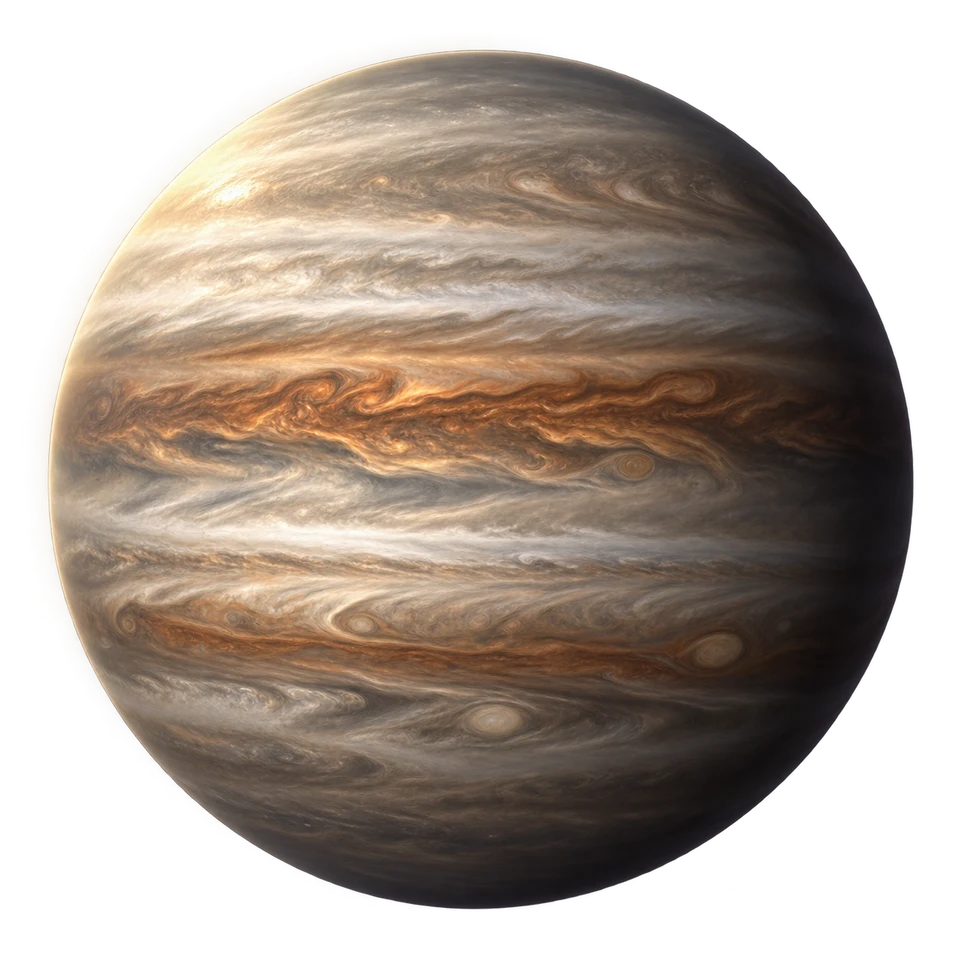
Artist’s impression of HD 209458 b; appearance is hypothetical; diameter is inferred from transits
Hot Jupiter

A hot giant losing gas to space.

Environment ↗

02
ATMOSPHERE

Detected · escaping gas

DIAMETER
15.822 × Earth
POSSIBILITY FOR LIFE
Incompatible with known life
WITHOUT PROTECTION
Not survivable

Mass comparison ↗

04
DYNAMICAL MASS0.74 × Jupiter

± 0.06 Jupiter masses

Transit geometry and radial velocities constrain gravity; the adopted radius sets the mass.
HD 209458 B

Instrument detail

Artist’s impression of HD 209458 b

Artist’s impression · appearance is hypothetical; diameter is inferred from transits.

A new kind of atmospheric observation.

This was the first exoplanet whose atmosphere was directly detected. Sodium absorbed a little of the star’s light during transit, showing that a distant world could be studied through the gas around it.

A year in three and a half days.

The period is about 3.52475 Earth days. The adopted 2016 reference solution places the semimajor axis at 0.0490 ± 0.0020 AU; other published fits differ slightly.

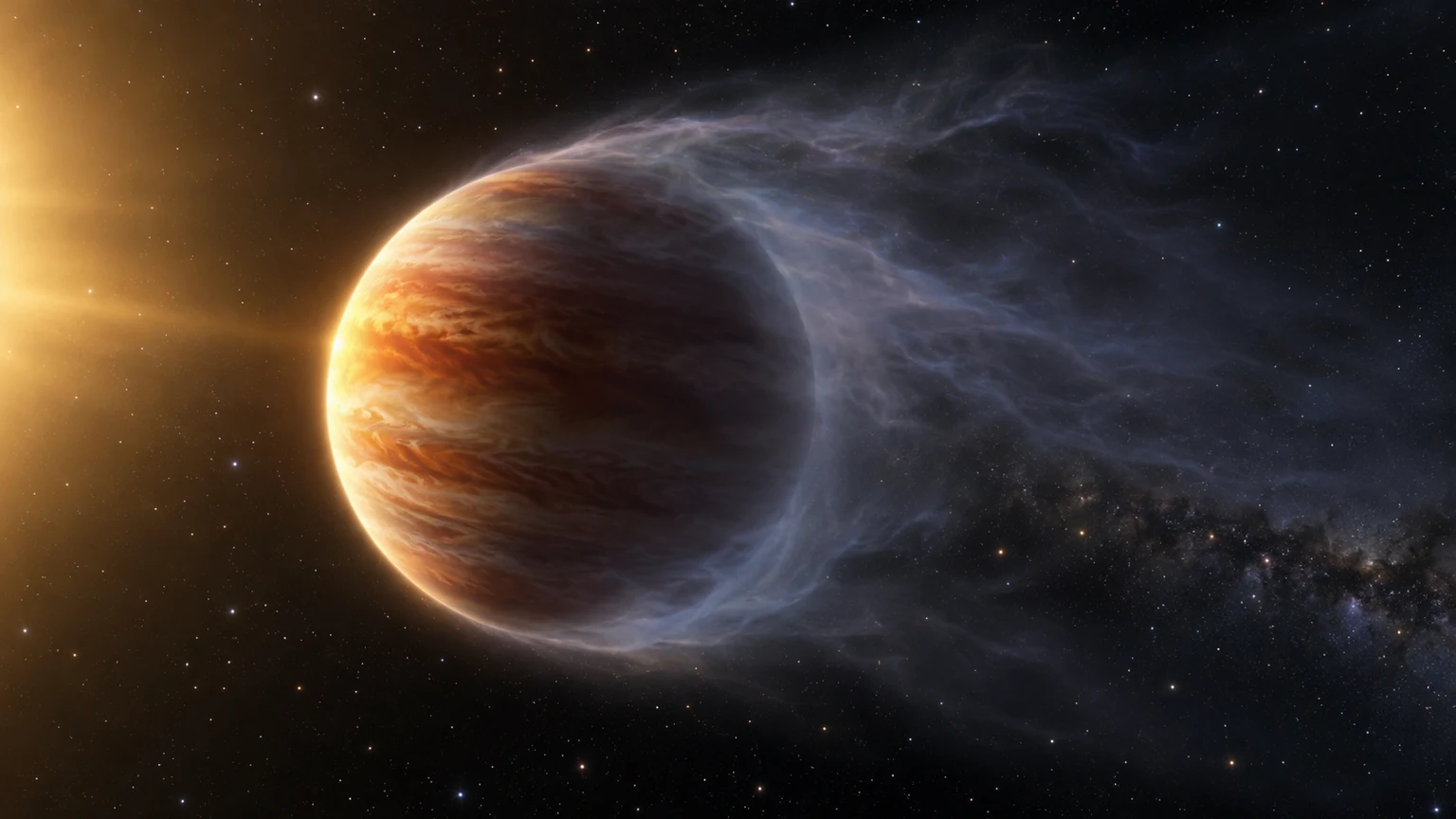
The atmosphere extends beyond the visible disk.

Hubble’s ultraviolet observations revealed an extended hydrogen envelope and atmospheric escape. The phenomenon describes gas leaving the planet, not a solid surface burning or the entire world disappearing immediately.

Wide does not mean heavy.

The adopted radius is larger than Jupiter’s while the mass is lower. Combining both quantities reveals an inflated giant. Atmospheric drawings cannot substitute for the transit and velocity measurements.

Size, mass and atmosphere

DIAMETER / EARTH15.822 ×

+0.673 / −0.673 · Earth-relative ratio

Radius 1.41 ± 0.06 Jupiter equatorial radii from the same 2016 solution; converted using 71,492 km for Jupiter and 6,371 km for Earth. Diameter shares the radius ratio.

DYNAMICAL MASS / JUPITER
  • HD 209458 b0.74 ± 0.06 M♃
  • Jupiter · reference mass1.00 M♃

Shared scale: 0–1.2 Jupiter masses. Transit geometry and radial velocities constrain gravity; the adopted radius sets the mass. 0.74 ± 0.06 Jupiter masses, del Burgo & Allende Prieto (2016), Table 3. Published reference solution.

ATMOSPHERE / COMPOSITION

Detected · escaping gas

Hubble detected sodium absorption in the atmosphere and an extended escaping hydrogen envelope. These measurements do not establish the colors or cloud patterns shown here.

Habitability

NATURAL CONDITIONSIncompatible with known life

An intensely irradiated gas giant offers no established habitat for known life. No life has been detected.

HUMANS / WITHOUT PROTECTIONNot survivable

Extreme heat, unbreathable gas and pressure that rises with depth make an unprotected encounter unsurvivable.

SOLID SURFACE
No accessible solid surface
TEMPERATURE
Intensely heated; varies with altitude
PRESSURE
Depends on atmospheric depth
ATMOSPHERIC ESCAPE
Extended hydrogen envelope detected

A year around HD 209458

3.52475 Earth days

Semimajor axis: 0.049 AU. One astronomical unit is approximately the mean Earth–Sun distance.

The overview is a schematic: sizes, orbital shape and the planet’s position are illustrative. It does not show a measured eccentricity, the orbit’s orientation or a live position.

The period is about 3.52475 Earth days. The adopted 2016 reference solution places the semimajor axis at 0.0490 ± 0.0020 AU; other published fits differ slightly.

del Burgo & Allende Prieto (2016) · orbital measurements ↗
Hypothetical bronze-gray bands and high haze near the limb. Colors and cloud structures are artistic choices.

Above a hot atmosphere

Hypothetical bronze-gray bands and high haze near the limb. Colors and cloud structures are artistic choices.

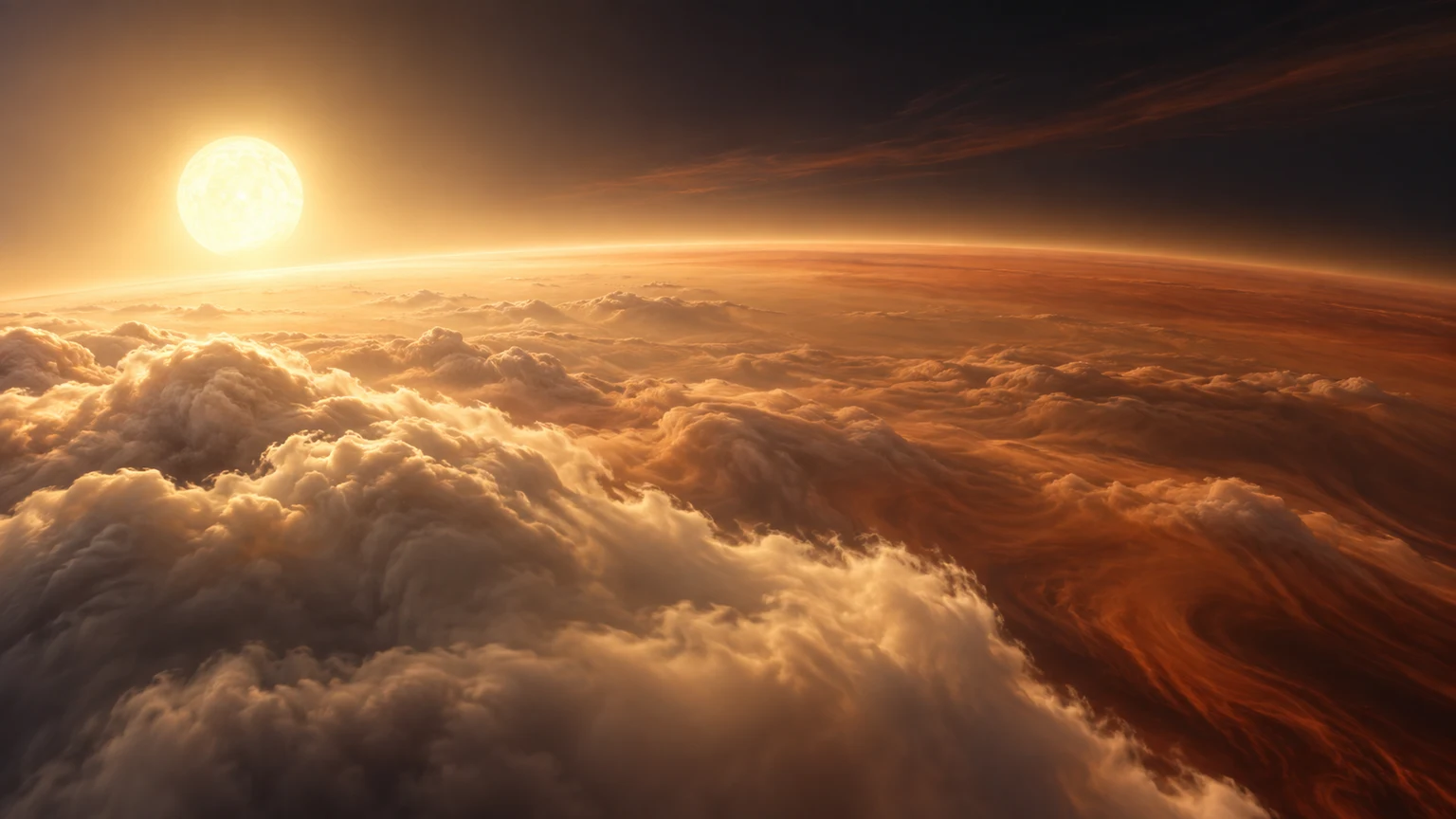
An imagined atmospheric view with no solid ground. These specific cloud banks have not been observed.

Among the high clouds

An imagined atmospheric view with no solid ground. These specific cloud banks have not been observed.

A conceptual extended envelope escaping into space. Its visible brightness and shape are illustrative, not a measured map.

Gas beyond the planet

A conceptual extended envelope escaping into space. Its visible brightness and shape are illustrative, not a measured map.

Planet and landscape images are hypothetical artistic interpretations.