HR 8799 SYSTEM / PLANETARY DOSSIER

HR 8799 c

An infrared-bright giant whose light carries clues to the chemistry of a young atmosphere.

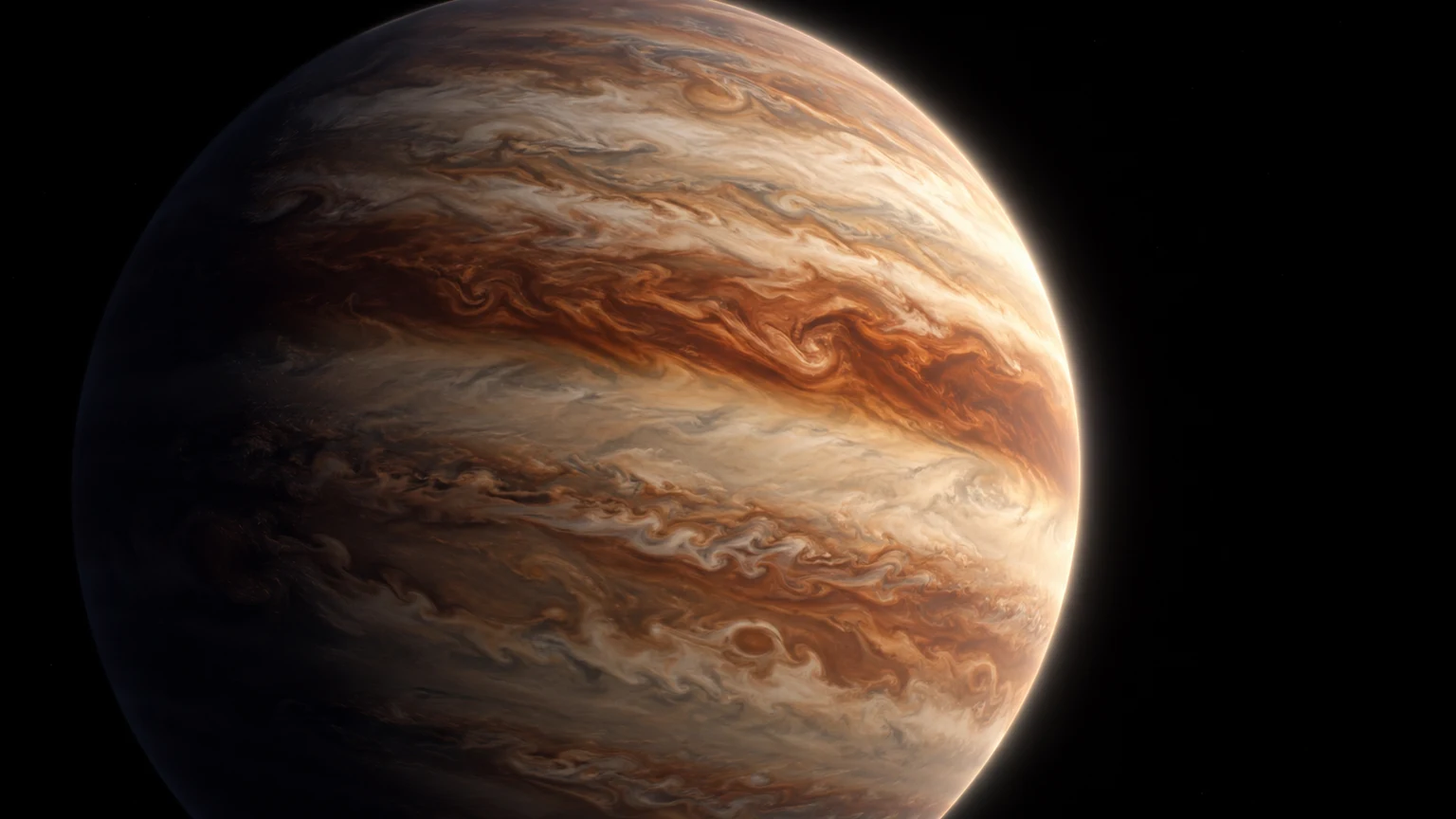
Artist’s impression of HR 8799 c; appearance and diameter are unconfirmed
Directly imaged · young gas giant

A warm giant seen beside its star.

Environment ↗

02
ATMOSPHERE

Spectra reveal atmospheric chemistry

DIAMETER
Not measured
POSSIBILITY FOR LIFE
Hot gas giant · no known habitable surface
WITHOUT PROTECTION
Not survivable without protection

Mass comparison ↗

04
MODEL MASS10 × Jupiter

+3 / −3 Jupiter masses

Atmospheric/evolutionary model estimate; not a radial-velocity minimum mass.
HR 8799 C

Instrument detail

Artist’s impression of HR 8799 c

Artist’s impression · appearance and diameter are unconfirmed.

A long year from a short observed arc.

The displayed period is a rounded published estimate of 69,000 days, not a complete orbit watched from beginning to end. The semimajor axis is an adopted literature value of 38 AU. Different fits and dynamical assumptions give different solutions; this sketch is not a live orbital ephemeris.

A point of light is already a spectrum.

Direct imaging separates planetary light from the host. Observations across wavelengths can identify molecular absorption and test cloud models, even though the disk itself is not resolved into the swirling structures shown in these scenes.

Brightness needs a model.

A younger, lower-mass planet can resemble an older, more massive object in emitted light. Atmospheric spectra and cooling models help break that ambiguity, but the number in this dossier remains an explicitly model-dependent estimate.

Size, mass and atmosphere

DIAMETER / EARTH

Not measured.

The radius has not been measured; the illustration does not establish its size.

SIZE UNKNOWN
MODEL MASS / JUPITER
  • HR 8799 c · model10.00 (+3.00 / −3.00) M♃
  • Jupiter · reference mass1.00 M♃

Shared scale: 0–20 Jupiter masses. Atmospheric/evolutionary model estimate; not a radial-velocity minimum mass. Marois et al. (2008), adopted illustrative published mass range. Age, cooling history and atmosphere assumptions affect the inferred mass.

ATMOSPHERE / COMPOSITION

Spectra reveal atmospheric chemistry

Infrared measurements probe emitted light from hot atmospheric layers. Cloud patterns in these illustrations are hypothetical. Spectral detections do not provide a resolved weather map or atmospheric percentages.

Habitability

NATURAL CONDITIONSHot gas giant · no known habitable surface

The observed thermal emission comes from hot atmospheric layers. A solid, accessible surface suitable for known life is not established. Large distance from the star does not make a young, internally heated giant Earth-like.

HUMANS / WITHOUT PROTECTIONNot survivable without protection

There is no established breathable environment or stable ground to stand on. Hot gas and increasing pressure prevent an unprotected descent.

SIZE
No direct radius measurement adopted
HEAT SOURCE
Residual internal heat and contraction
CLOUD MAP
Not resolved
SURFACE PRESSURE
No defined land surface

A year around HR 8799

≈ 189 Earth years

Semimajor axis: 38 AU. One astronomical unit is approximately the mean Earth–Sun distance.

The overview is a schematic: sizes, orbital shape and the planet’s position are illustrative. It does not show a measured eccentricity, the orbit’s orientation or a live position.

The displayed period is a rounded published estimate of 69,000 days, not a complete orbit watched from beginning to end. The semimajor axis is an adopted literature value of 38 AU. Different fits and dynamical assumptions give different solutions; this sketch is not a live orbital ephemeris.

Published research / NASA Exoplanet Archive · orbital measurements ↗
Artist’s impression of HR 8799 c. An imagined curved atmosphere under distant starlight. The cloud map, visible colors and viewpoint are hypothetical; no moons or rings are established by this scene.

Above the cloud deck

Artist’s impression of HR 8799 c. An imagined curved atmosphere under distant starlight. The cloud map, visible colors and viewpoint are hypothetical; no moons or rings are established by this scene.

Artist’s impression of HR 8799 c. A fictional close study of bands and vortices. The cloud map, visible colors and viewpoint are hypothetical; no moons or rings are established by this scene.

Weather without a map

Artist’s impression of HR 8799 c. A fictional close study of bands and vortices. The cloud map, visible colors and viewpoint are hypothetical; no moons or rings are established by this scene.

Artist’s impression of HR 8799 c. A whole-world view with compressed exposure and an illustrative glow. The cloud map, visible colors and viewpoint are hypothetical; no moons or rings are established by this scene.

A warm world in darkness

Artist’s impression of HR 8799 c. A whole-world view with compressed exposure and an illustrative glow. The cloud map, visible colors and viewpoint are hypothetical; no moons or rings are established by this scene.

Planet and landscape images are hypothetical artistic interpretations.