LHS 1140 SYSTEM / PLANETARY DOSSIER

LHS 1140 b

A transiting planet larger than Earth whose mass, radius and debated atmospheric signals leave several possible interiors.
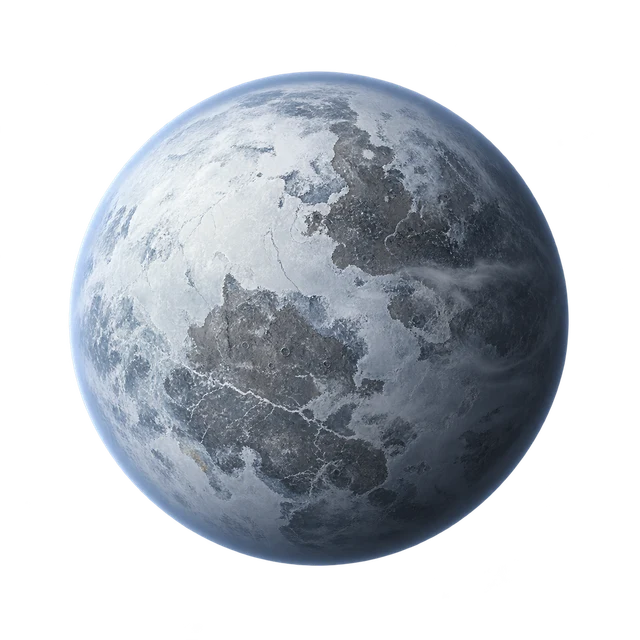
Artist’s impression of LHS 1140 b; appearance is hypothetical; diameter is inferred from transits
Temperate transiting planet

A temperate world with an unresolved atmosphere.

Environment ↗

02
ATMOSPHERE

Atmospheric evidence debated

DIAMETER
1.730 × Earth
POSSIBILITY FOR LIFE
Potential conditions remain uncertain
WITHOUT PROTECTION
Not established as survivable

Mass comparison ↗

04
DYNAMICAL MASS5.6 × Earth

± 0.19 Earth masses

Radial velocities combined with the transit inclination.
LHS 1140 B

Instrument detail

Artist’s impression of LHS 1140 b

Artist’s impression · appearance is hypothetical; diameter is inferred from transits.

Two measurements, several interiors.

The adopted mass and radius rule out a simple assumption that every super-Earth is a scaled-up Earth. Interior models allow volatile-rich alternatives. A water-rich body is one possibility; a gas envelope changes the interpretation substantially.

A short year around a faint star.

At 0.0946 AU, a year takes about 24.7 Earth days. The adopted irradiation is around 43% of Earth’s. An equilibrium-temperature calculation describes a radiative balance under assumptions, not a measured surface climate.

A disputed helium signal.

A July 2026 study reported escaping helium in one transit. Later analyses of four NIRISS transits did not reproduce a significant persistent absorption signal. Stellar variability and data treatment matter; the dossier therefore leaves the atmospheric interpretation open.

Reading both sides of the evidence.

The helium claim and subsequent non-detections are distinct published analyses of a difficult signal. An absence of a repeatable helium feature does not prove that the planet has no atmosphere.

Size, mass and atmosphere

DIAMETER / EARTH1.730 ×

+0.025 / −0.025 · Earth-relative ratio

Cadieux et al. (2024): 1.730 ± 0.025 Earth radii from transits and the adopted stellar radius. Radius and diameter share the same relative ratio.

DYNAMICAL MASS / EARTH
  • LHS 1140 b5.60 ± 0.19 M⊕
  • Earth · reference mass1.00 M⊕

Shared scale: 0–7 Earth masses. Radial velocities combined with the transit inclination. Cadieux et al. (2024), joint transit and radial-velocity solution.

ATMOSPHERE / COMPOSITION

Atmospheric evidence debated

A July 2026 helium report was followed by independent JWST analyses finding no significant or persistent helium absorption. A secure atmospheric composition and pressure are not established. Water-rich and gas-envelope interpretations must remain hypotheses.

Habitability

NATURAL CONDITIONSPotential conditions remain uncertain

Temperate irradiation makes this an important target, but no ocean or inhabited surface has been observed. Climate depends on atmospheric composition, pressure, clouds and internal structure.

HUMANS / WITHOUT PROTECTIONNot established as survivable

There is no evidence of breathable air or a safe surface pressure. The icy landscape is a hypothesis, not a destination with known conditions.

IRRADIATION
≈ 0.43 × Earth
SURFACE TEMPERATURE
Not measured
LIQUID WATER
Hypothesis · not detected
ATMOSPHERIC PRESSURE
Unknown

A year around LHS 1140

24.73723 Earth days

Semimajor axis: 0.0946 AU. One astronomical unit is approximately the mean Earth–Sun distance.

The overview is a schematic: sizes, orbital shape and the planet’s position are illustrative. It does not show a measured eccentricity, the orbit’s orientation or a live position.

At 0.0946 AU, a year takes about 24.7 Earth days. The adopted irradiation is around 43% of Earth’s. An equilibrium-temperature calculation describes a radiative balance under assumptions, not a measured surface climate.

Published research / NASA Exoplanet Archive · orbital measurements ↗
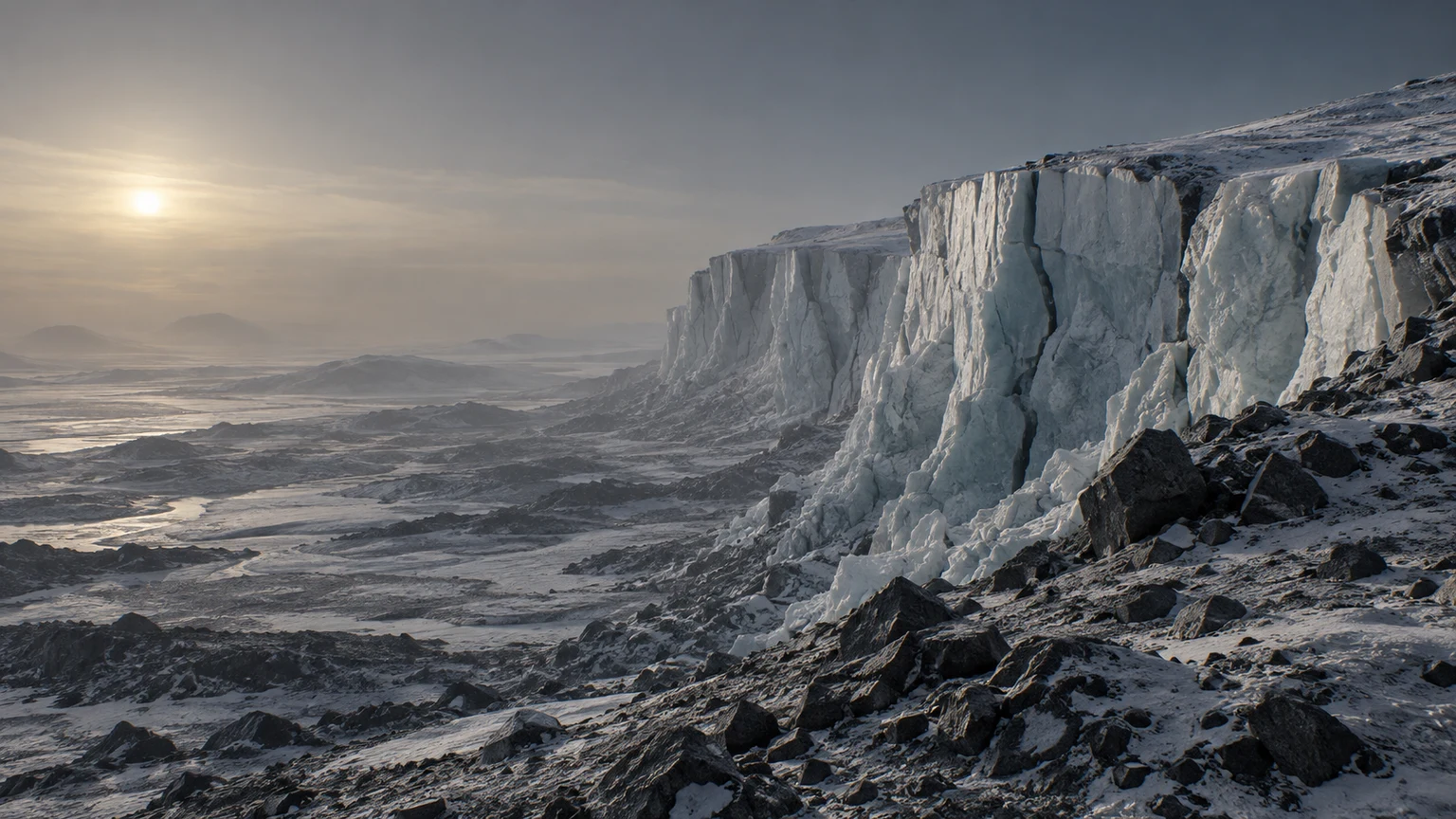
Hypothetical artist’s impression of LHS 1140 b. Low ridges cross an imagined frozen landscape. Ice, exposed rock, haze and surface lighting are unconfirmed; this is one imagined volatile-rich scenario, not an observed surface.

Across an icy plain

Hypothetical artist’s impression of LHS 1140 b. Low ridges cross an imagined frozen landscape. Ice, exposed rock, haze and surface lighting are unconfirmed; this is one imagined volatile-rich scenario, not an observed surface.

Hypothetical artist’s impression of LHS 1140 b. An imagined transition between ice and darker material. Ice, exposed rock, haze and surface lighting are unconfirmed; this is one imagined volatile-rich scenario, not an observed surface.

A fractured boundary

Hypothetical artist’s impression of LHS 1140 b. An imagined transition between ice and darker material. Ice, exposed rock, haze and surface lighting are unconfirmed; this is one imagined volatile-rich scenario, not an observed surface.

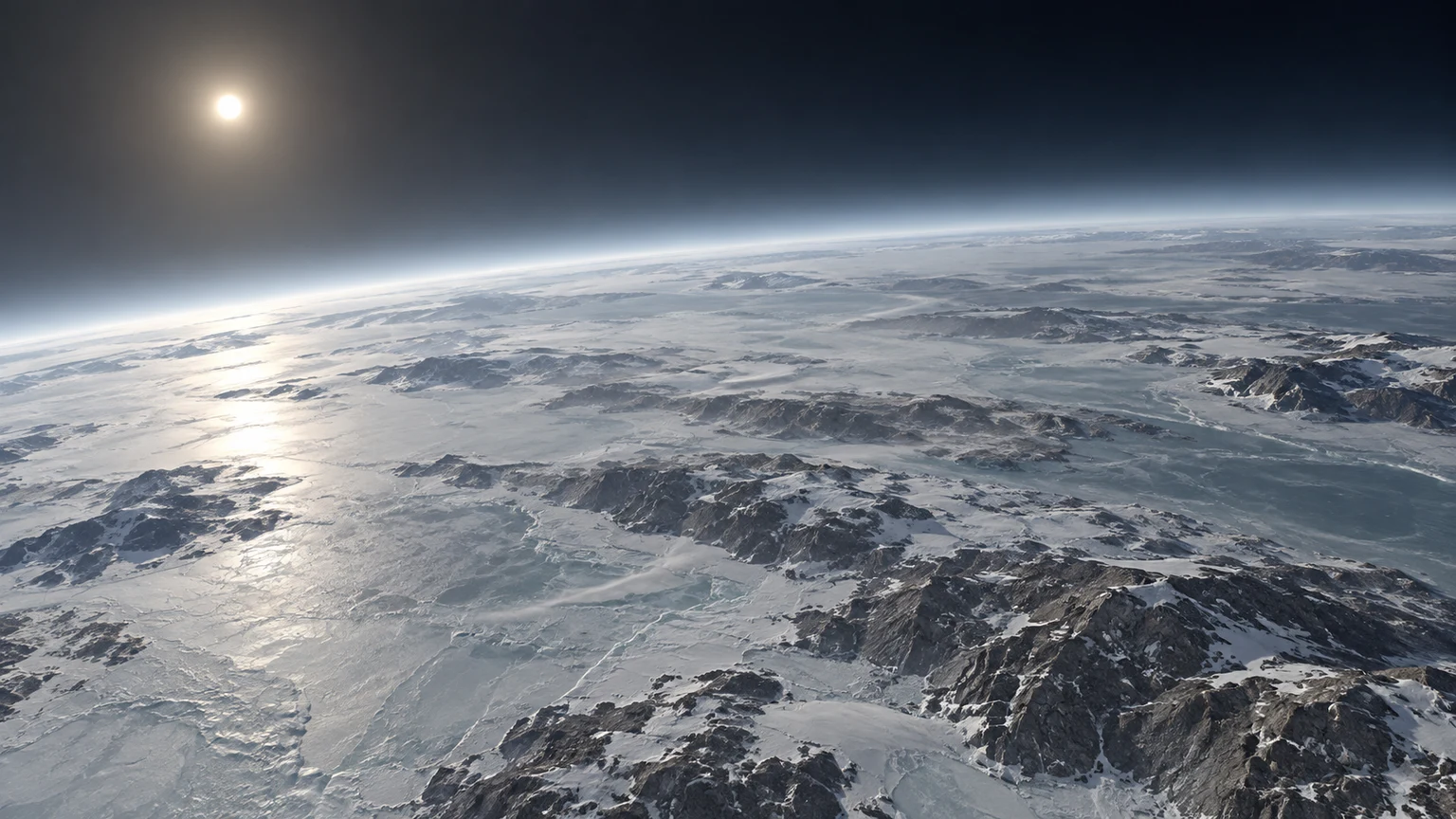
Hypothetical artist’s impression of LHS 1140 b. A wider perspective explores the same speculative setting. Ice, exposed rock, haze and surface lighting are unconfirmed; this is one imagined volatile-rich scenario, not an observed surface.

A distant horizon

Hypothetical artist’s impression of LHS 1140 b. A wider perspective explores the same speculative setting. Ice, exposed rock, haze and surface lighting are unconfirmed; this is one imagined volatile-rich scenario, not an observed surface.

Planet and landscape images are hypothetical artistic interpretations.