SOL SYSTEM / PLANETARY DOSSIER

Neptune

Neptune is a distant ice giant with powerful winds in its deep atmosphere.

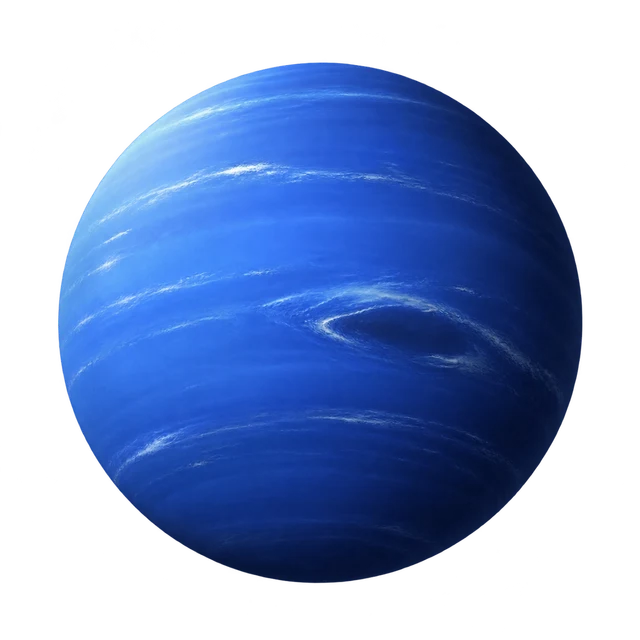
Artist’s impression of Neptune

At the last major planet, a long year meets a restless atmosphere.

DIAMETER / EARTH3.88×
EARTHNEPTUNE
ATMOSPHERE / COMPOSITION
H₂Hydrogen≈ 80%
HeHelium≈ 19%
CH₄Methane≈ 1.5%
TEMPERATURE / 1 BAR
≈ −201°C at 1 bar
PRESSURE
Rises with depth
HABITABILITYNo known habitat
UNPROTECTED HUMANSNot survivable

Interior ↗

03
Neptune interiorSchematic material regions · transitions and depths are illustrative. Atmosphere, Dense fluids, Rocky core.AtmosphereDense fluidsRocky core

Moons Orbit ↗

04
Neptune moon orbitsSelected moons, ordered outward. Orbit sizes and positions are schematic; relative periods are preserved.NEPTUNENAIADTHALASSADESPINAGALATEALARISSAHIPPOCAMPPROTEUSTRITONNEREID
NEPTUNE

Instrument detail

Neptune orbitElliptical orbit viewed along the orbital axis, relative to Sun. Motion is accelerated, not a live position. Distances are center to center.SUNNEPTUNE30.47 AU29.89 AU
ONE ORBIT165 Earth years
Closest to the Sun
29.89 AU
Farthest from the Sun
30.47 AU

The Sun sits at a focus of the orbit. Neptune moves faster near the Sun and more slowly farther away.

Neptune rotation compared with EarthA marked longitude moves between the day and night sides. Equal elapsed time and sidereal rotation rates. Polar schematic: sizes, axial tilt and seasons are not shown. Illumination uses a circular mean orbit, not a live sky prediction.SAME ELAPSED TIME · POLAR SCHEMATICNEPTUNE16.1 hoursSIDEREAL ROTATION16.1 hours · solar dayEARTH23.9 hoursSIDEREAL ROTATION≈ 24 h · solar day
Marked longitude in a reference rotation frame · equal time on both worlds
ONE SIDEREAL ROTATION16.1 hours

Turning through space

Neptune completes a rotation in about 16.1 hours. Winds carry clouds at different speeds around this rapidly spinning ice giant.

Mean solar day
≈ 16.1 hours
One orbit
165 Earth years

A sidereal rotation is one turn relative to the stars. A solar day follows the Sun: the marked longitude crosses the illuminated and dark halves as rotation and orbital motion combine.

0 Earth hoursMarker · daylight

Mean clock model with a circular orbit. Axial tilt, seasons and local sunrise times are omitted. The marker is a reference longitude, not a solid surface feature. Sizes and starting longitudes are schematic, not live positions.

Satellite atlasMoons
Neptune moon orbitsSelected moons, ordered outward. Orbit sizes and positions are schematic; relative periods are preserved.NEPTUNENAIADTHALASSADESPINAGALATEALARISSAHIPPOCAMPPROTEUSTRITONNEREID
FEATURED MOONS09
  1. 01Naiad ↗0.29398 days
  2. 02Thalassa ↗0.311078 days
  3. 03Despina ↗0.334656 days
  4. 04Galatea ↗0.428744 days
  5. 05Larissa ↗0.554989 days
  6. 06Hippocamp ↗0.95039 days
  7. 07Proteus ↗1.1223 days
  8. 08Triton ↗5.88 days
  9. 09Nereid ↗360.133039 days

A family of moons circles the planet.

Triton travels in the opposite direction to Neptune’s rotation. Naiad and Thalassa have a three-dimensional resonant relationship; this flat schematic does not show their orbital inclinations or vertical separation.

Neptune gravityEqual launches at 2 m/s; shared metre scale; air resistance ignored. Hypothetical comparison at the 1-bar level, not a solid surface.0.0 m0.1 m0.2 m0.3 mEARTH9.8 m/s²NEPTUNE11.0 m/s²1 BAR
NEPTUNE / EARTH GRAVITY1.12 ×

Same push, different gravity

Both balls launch at 2 m/s, using the same height and time scales. This is a hypothetical comparison at the 1-bar atmospheric level; there is no solid ground. Air resistance is ignored.

Earth · height / airtime
0.20 m / 0.41 s
Neptune · height / airtime
0.18 m / 0.36 s
Neptune interiorSchematic material regions · transitions and depths are illustrative. Atmosphere, Dense fluids, Rocky core. Select a layer below to highlight it.010203
Schematic material regions · transitions and depths are illustrative.
EXPLORE THE LAYERS
  1. 01

    An outer envelope of hydrogen and helium, with methane.

  2. 02

    Models place hot, dense water-rich material beneath the atmosphere, mixed with ammonia and methane. This is not a frozen surface.

  3. 03

    A rocky central region is inferred. Its size and the boundaries between layers remain uncertain.

Select a material to connect its description with the cutaway. Colors and textures identify regions; they do not show measured temperature.

Artist’s impression of Neptune

Four hours from sunlight.

Neptune lies roughly 30 times farther from the Sun than Earth. Sunlight takes about four hours to reach it. Even midday illumination is faint compared with home, yet this distant ice giant is far from still.

What fills the distant sky.

Hydrogen and helium make up most of that air. Methane is a much smaller component, yet affects the visible color.

A restless blue horizon.

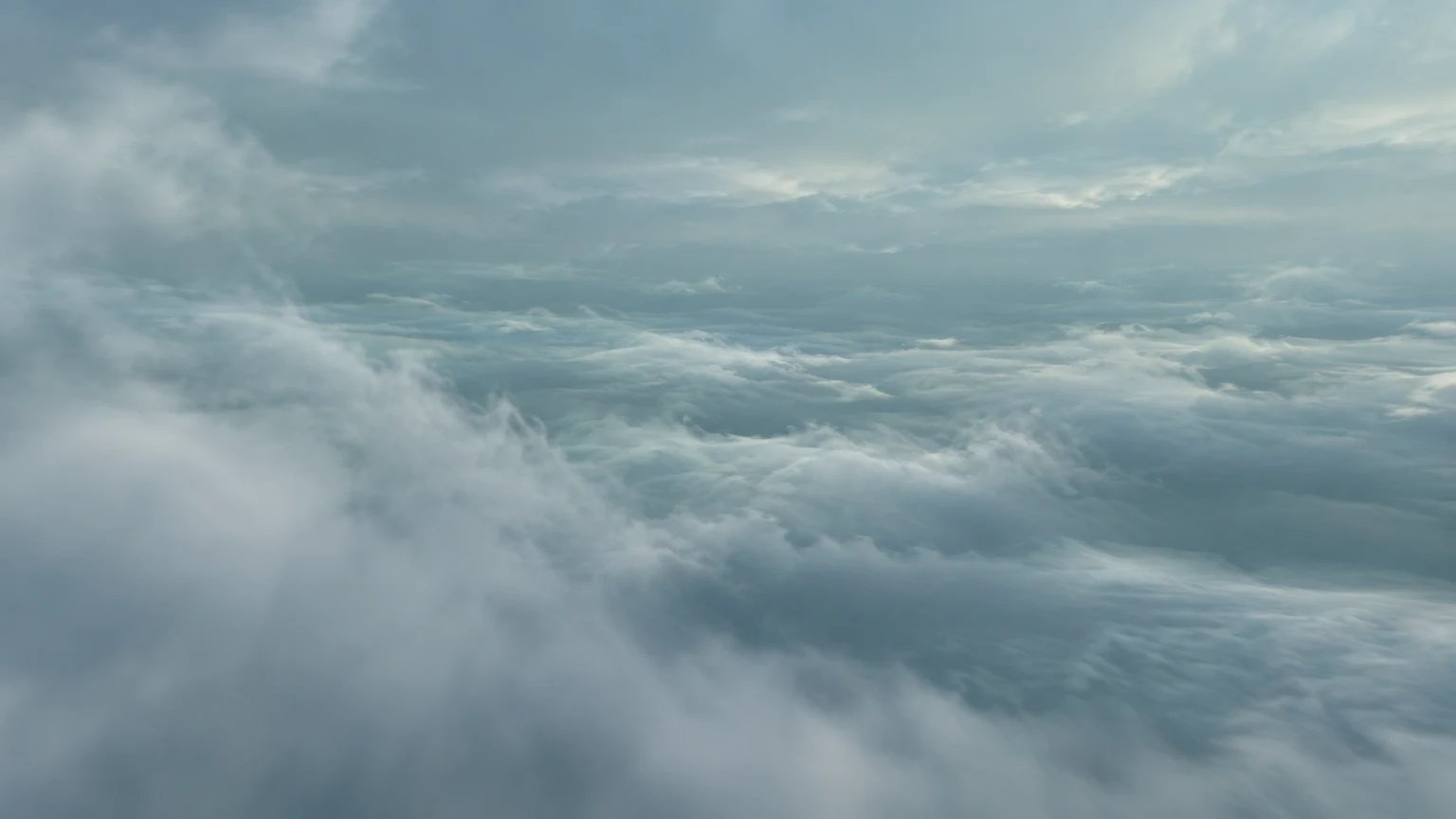
Powerful winds sweep through Neptune’s atmosphere. There is no solid surface to stand on: an imagined approach follows clouds and haze above a deep interior. The illustrations emphasize that atmosphere rather than inventing a rocky landing place.

A year beyond a lifetime.

Neptune takes about 165 Earth years to circle the Sun. It was located in 1846 after mathematical predictions pointed astronomers toward it. Triton, its largest moon, was discovered only days later: another destination beyond the cloud tops.
DIAMETER / EARTH3.88×
EARTHNEPTUNE
EARTH
12,756 km
NEPTUNE
49,528 km
equatorial planet diameter / equatorial Earth diameter · rings excluded
ATMOSPHERE / COMPOSITION
H₂Hydrogen≈ 80%
HeHelium≈ 19%
CH₄Methane≈ 1.5%

Approximate volume fractions. Estimates have uncertainty and may not sum to exactly 100%; bars show the published values without renormalizing them. Trace gases and variations with depth are omitted.

TEMPERATURE / 1 BAR
≈ −201°C at 1 bar
PRESSURE
Rises with depth
HABITABILITYNo known habitat

No life has been detected. Cold upper layers, powerful weather and extreme conditions deeper inside offer no established habitat for known life. An ice-rich interior is not evidence of a mild ocean capable of supporting organisms.

UNPROTECTED HUMANSNot survivable

Hydrogen-rich air cannot support human breathing. There is no solid surface, and pressure and temperature change strongly with depth. The cloud views are imagined viewpoints, not places a person could visit without protection.

Planet and landscape images are artistic interpretations.

  • NASA ↗
    • Classification and orbital data
    • Simplified interior model
    • Natural conditions and human survival
    • Distance
    • Composition
    • Atmosphere
    • Time
  • NASA ↗
    • Rotation, gravity and orbital distances
  • NASA ↗
    • Gravity reference level and diagram definitions
  • NASA / JPL ↗
    • Satellite orbital periods
  • NASA ↗
    • Size, physical data and atmospheric constraints
An orbital reconstruction using a restrained blue-green palette. Neptune is less intensely blue than many enhanced images suggest; individual cloud features here are imagined.

A distant blue-green horizon

An orbital reconstruction using a restrained blue-green palette. Neptune is less intensely blue than many enhanced images suggest; individual cloud features here are imagined.

An imagined floating viewpoint near Neptune’s upper clouds. Subdued blue-green haze surrounds soft cloud layers; exposure reveals detail in faint illumination. No exact altitude is claimed.

Between cloud and haze

An imagined floating viewpoint near Neptune’s upper clouds. Subdued blue-green haze surrounds soft cloud layers; exposure reveals detail in faint illumination. No exact altitude is claimed.

A subdued blue-green atmospheric vortex with a narrow pale companion cloud. An artistic reconstruction of Neptune; local detail, lighting and viewpoint are imagined.

A dark atmospheric swirl

A subdued blue-green atmospheric vortex with a narrow pale companion cloud. An artistic reconstruction of Neptune; local detail, lighting and viewpoint are imagined.

Open moon atlas ↗