SOL SYSTEM / PLANETARY DOSSIER

Pluto

Pluto is an icy dwarf planet in the Kuiper Belt beyond Neptune.

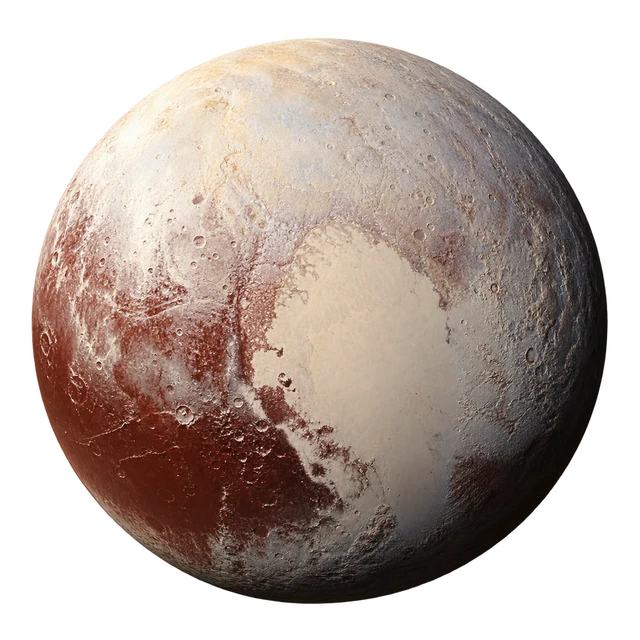
Artist’s impression of Pluto

Mountains of water ice rise above vast plains of slowly moving nitrogen glaciers.

DIAMETER / EARTH0.19×
EARTHPLUTO
ATMOSPHERE / COMPOSITION
N₂ NitrogenDOMINANT
CH₄ MethaneDETECTED
CO Carbon monoxideDETECTED
SURFACE TEMPERATURE
−240 to −226 °C
SURFACE PRESSURE
Extremely low
HABITABILITYUncertain
UNPROTECTED HUMANSNot survivable

Interior ↗

03
Pluto interiorSchematic cutaway · layer thicknesses are not to scale. Surface ice, Water-ice shell, Possible ocean (uncertain), Rocky core.Surface iceWater-ice shellPossible ocean ?Rocky core

Moons Orbit ↗

04
Pluto and its five moonsPluto and Charon circle a shared center outside Pluto. The four smaller moons orbit farther out.PLUTO / FIVE MOONSPLUTOCHARONSHARED CENTERSTYXNIXKERBEROSHYDRA
PLUTO

Instrument detail

Orbit
Pluto’s orbit around the SunAn ellipse with the Sun at one focus. Pluto is about 29.7 AU from the Sun at its closest and 49.3 AU at its farthest, moving faster when nearer the Sun.VIEW ALONG THE ORBITAL AXISSUNPLUTO49.3 AU29.7 AUFARTHESTCLOSESTSCALE · ≈ 16.6 AU
ONE ORBIT248 Earth years
Closest to the Sun
29.7 AU
Farthest from the Sun
49.3 AU

The Sun lies off-center, at one focus of the ellipse. Pluto moves faster near the Sun and slower farther away.

Along this long orbit, surface ices exchange material with Pluto’s thin atmosphere as the seasons change.

Pluto rotation compared with EarthA marked longitude moves between the day and night sides. Equal elapsed time and sidereal rotation rates. Polar schematic: sizes, axial tilt and seasons are not shown. Illumination uses a circular mean orbit, not a live sky prediction.SAME ELAPSED TIME · POLAR SCHEMATICPLUTO6.39 daysSIDEREAL ROTATION6.39 days · solar dayEARTH≈ 24 hoursSIDEREAL ROTATION≈ 24 h · solar day
Marked longitude · equal time on both worlds
ONE SIDEREAL ROTATION6.39 days

A slow, reverse spin

Pluto rotates from east to west, opposite to Earth. During one Pluto rotation, Earth turns about 6.4 times.

Mean solar day
≈ 6.39 days
One orbit
248 Earth years

A sidereal rotation is one turn relative to the stars. A solar day follows the Sun: the marked longitude crosses the illuminated and dark halves as rotation and orbital motion combine.

Always the same side toward Charon

In the 6.39 days it takes Pluto to turn once, its moon Charon completes one orbit around it. Pluto’s turn keeps pace with its moon, so the same side of Pluto always faces Charon.

0 Earth hoursMarker · daylight

Mean clock model with a circular orbit. Axial tilt, seasons and local sunrise times are omitted. Sizes and starting longitudes are schematic, not live positions.

CompanionsSatellite atlasMoons
Pluto and its five moonsPluto and Charon circle a shared center outside Pluto. The four smaller moons orbit farther out.PLUTO / FIVE MOONSPLUTOCHARONSHARED CENTERSTYXNIXKERBEROSHYDRA
ONE SHARED ORBIT6.39 Earth days

Charon is large enough that the pair’s center of mass lies outside Pluto. Both worlds orbit that point, keeping the same sides turned toward each other.

Five moons, outward from the pair

  1. 01Charon ↗6.39 days
  2. 02Styx ↗20.16 days
  3. 03Nix ↗24.85 days
  4. 04Kerberos ↗32.17 days
  5. 05Hydra ↗38.20 days
A ball jumping on Earth and Pluto under different gravityTwo balls launch upward at 2 metres per second. With the same height and time scales, the Pluto ball rises about 15.8 times higher and stays airborne about 15.8 times longer. Air resistance is ignored.SAME LAUNCH SPEED · 2 M/S0 m1 m2 m3 mEARTH9.81 m/s²PLUTO0.62 m/s²
PLUTO / EARTH GRAVITY≈ 6.3 %

Same push. A much higher jump.

Both balls launch upward together at 2 m/s. Pluto’s weaker gravity lets its ball rise about 15.8 times higher and stay in the air about 15.8 times longer.

Earth · height / airtime
0.20 m / 0.41 s
Pluto · height / airtime
3.23 m / 6.45 s
Pluto interiorSchematic cutaway · layer thicknesses are not to scale. Surface ice, Water-ice shell, Possible ocean (uncertain), Rocky core. Select a layer below to highlight it.01020304
Schematic cutaway · layer thicknesses are not to scale.
EXPLORE THE LAYERS
  1. 01
    OBSERVED

    Nitrogen and methane ice cover parts of the surface; water ice forms the mountains.

  2. 02
    INFERRED

    A thick shell of solid water ice is thought to surround the interior.

  3. 03
    UNCONFIRMED

    Liquid water may persist beneath the ice. Its presence and depth are uncertain.

  4. 04
    INFERRED

    A dense, rocky interior is likely. Its boundary has not been directly measured.

Select a material to connect its description with the cutaway. Colors and textures identify regions; they do not show measured temperature.

Artist’s impression of Pluto

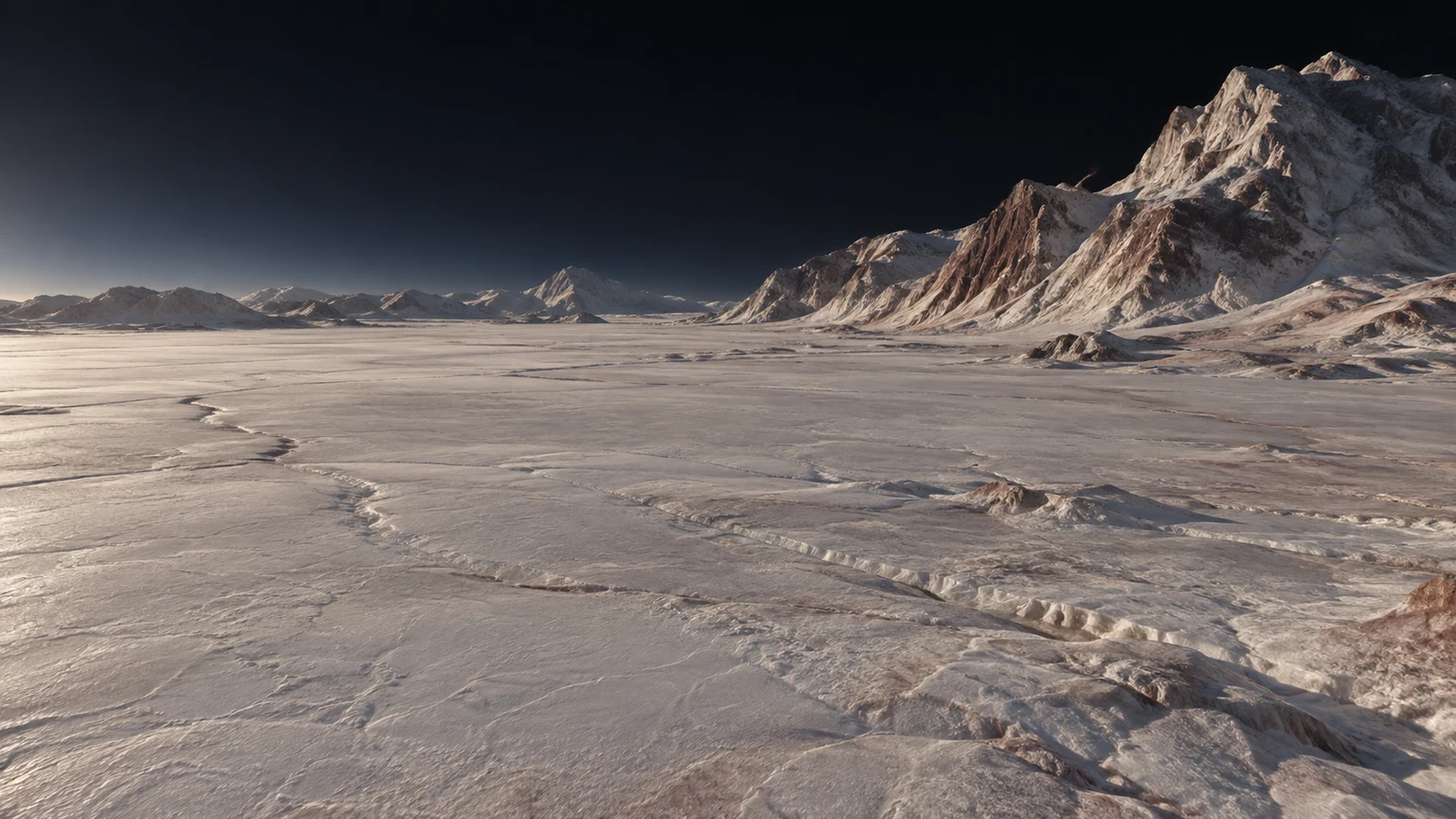
Mountains of water ice

On Pluto, water ice plays the role that rock does on Earth: it forms the rigid foundations of the landscape and mountains several kilometres high. Nitrogen and methane freeze here too, creating a surface where different kinds of ice behave very differently.

The moving heart

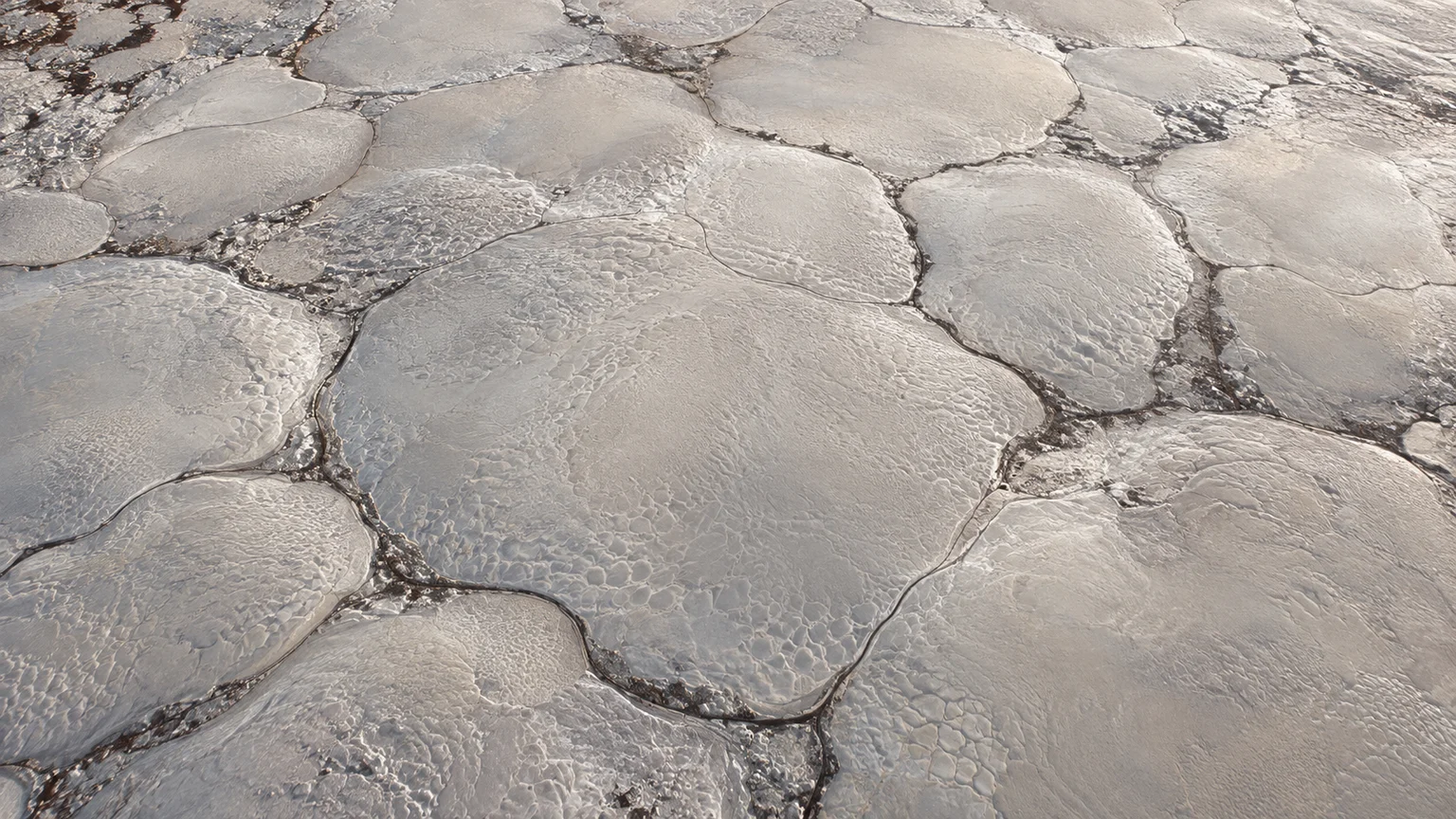
The bright western half of Pluto’s heart, Sputnik Planitia, is a vast plain of nitrogen ice. Its patterned surface is remarkably free of impact craters. Models suggest that slow convection brings warmer ice upward and carries cooler ice down, continually renewing the terrain.

A shifting atmosphere

Pluto’s ground and atmosphere exchange material. Nitrogen ice can turn directly into gas when warmed, then settle back as frost when conditions cool. With seasons unfolding over a 248-year orbit, this cycle links changes in sunlight to changes across the frozen surface.

New Horizons, new discoveries

New Horizons flew past Pluto in July 2015, revealing mountains, glaciers and sharply contrasting landscapes in a world once seen mainly as a distant point of light. That brief encounter transformed our understanding of Pluto, while leaving the workings of its deep interior open to investigation.
Size, atmosphere and habitability

DIAMETER / EARTH0.19×
EARTHPLUTO
EARTH
12,756 km
PLUTO
2,377 km

Pluto is about 19% of Earth’s width.

Equatorial diameters · circles use the same scale
ATMOSPHERE / COMPOSITION
N₂ NitrogenDOMINANT
CH₄ MethaneDETECTED
CO Carbon monoxideDETECTED

Nitrogen dominates, with methane and carbon monoxide also detected. Composition is shown qualitatively; no fixed percentages are implied.

HABITABILITYUncertainHostile surface · interior uncertain

No life is known. A possible deep ocean remains an open question, not evidence of a habitable environment.

UNPROTECTED HUMANSNot survivableProtection required

Extreme cold, very low pressure and unbreathable gas make protection essential.

SURFACE TEMPERATURE−240 to −226 °C
SURFACE PRESSUREExtremely low

Planet and landscape images are artistic interpretations.

  • NASA ↗
    • Classification and orbital data
    • Surface ices and inferred internal structure
    • Size, physical data and atmospheric constraints
    • Natural conditions and human survival
    • Landscape
    • Orbit
  • NASA ↗
    • New Horizons and the 2015 Pluto flyby
  • NASA ↗
    • Pluto orbital distances
  • NASA ↗
    • Rotation and mutual tidal locking
    • Companions
  • NASA ↗
    • Moon orbital periods and surface gravity
  • NASA ↗
    • Pluto–Charon shared center of mass
  • NASA ↗
    • Possible subsurface ocean and interior models
  • www.nasa.gov ↗
    • Glaciers
An imagined ground-level view near Sputnik Planitia: pale nitrogen ice meets mountains of water ice. Earthin is informed by New Horizons; this is not a photographed or precisely mapped viewpoint.

At the edge of the heart

An imagined ground-level view near Sputnik Planitia: pale nitrogen ice meets mountains of water ice. Earthin is informed by New Horizons; this is not a photographed or precisely mapped viewpoint.

A reconstruction of rough, reddish icy terrain and frost-coated slopes. Surface texture, haze and lighting are illustrative; no exact location is claimed.

Across the older uplands

A reconstruction of rough, reddish icy terrain and frost-coated slopes. Surface texture, haze and lighting are illustrative; no exact location is claimed.

Pale nitrogen-ice polygon patterns and dark shallow boundary troughs inspired by Sputnik Planitia. An artistic reconstruction of Pluto; local detail, lighting and viewpoint are imagined.

Patterns across the frozen plain

Pale nitrogen-ice polygon patterns and dark shallow boundary troughs inspired by Sputnik Planitia. An artistic reconstruction of Pluto; local detail, lighting and viewpoint are imagined.