SOL SYSTEM / PLANETARY DOSSIER

Saturn

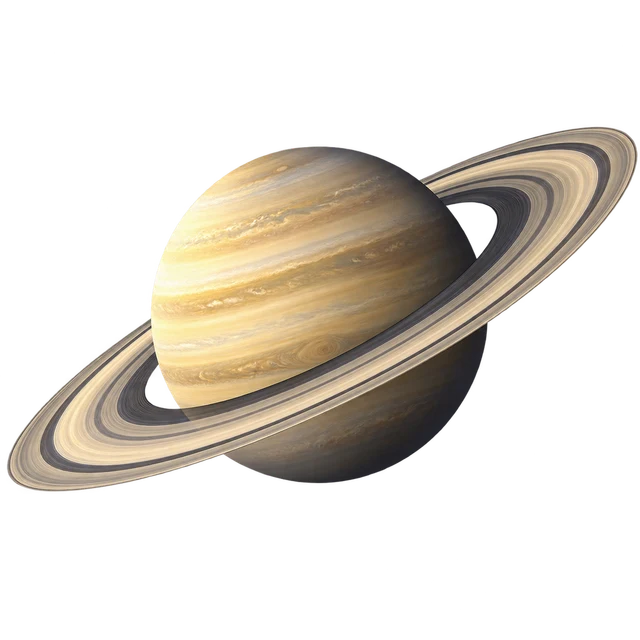
Saturn is a pale gas giant encircled by broad rings of ice and rock.

Artist’s impression of Saturn

Pale clouds, sweeping rings and a family of distant moons.

DIAMETER / EARTH9.45×
EARTHSATURN
ATMOSPHERE / COMPOSITION
H₂Hydrogen≈ 96.3%
HeHelium≈ 3.25%
CH₄Methane≈ 0.45%
TEMPERATURE / 1 BAR
≈ −139°C at 1 bar
PRESSURE
Rises rapidly with depth
HABITABILITYNo known habitat
UNPROTECTED HUMANSNot survivable

Interior ↗

03
Saturn interiorSchematic material regions · transitions and depths are illustrative. Atmosphere, Liquid hydrogen, Metallic hydrogen, Deep core.AtmosphereLiquid hydrogenMetallic hydrogenDeep core

Moons Orbit ↗

04
Saturn moon orbitsSelected moons, ordered outward. Orbit sizes and positions are schematic; relative periods are preserved.SATURNPANDAPHNISATLASPROMETHEUSPANDORAEPIMETHEUSJANUSMIMASENCELADUSTETHYSTELESTOCALYPSODIONEHELENERHEATITANHYPERIONIAPETUSPHOEBE
SATURN

Instrument detail

Saturn orbitElliptical orbit viewed along the orbital axis, relative to Sun. Motion is accelerated, not a live position. Distances are center to center.SUNSATURN10.07 AU9.07 AU
ONE ORBIT29.4 Earth years
Closest to the Sun
9.07 AU
Farthest from the Sun
10.07 AU

The Sun sits at a focus of the orbit. Saturn moves faster near the Sun and more slowly farther away.

Saturn rotation compared with EarthA marked longitude moves between the day and night sides. Equal elapsed time and sidereal rotation rates. Polar schematic: sizes, axial tilt and seasons are not shown. Illumination uses a circular mean orbit, not a live sky prediction.SAME ELAPSED TIME · POLAR SCHEMATICSATURN10.7 hoursSIDEREAL ROTATION10.7 hours · solar dayEARTH23.9 hoursSIDEREAL ROTATION≈ 24 h · solar day
Marked longitude in a reference rotation frame · equal time on both worlds
ONE SIDEREAL ROTATION10.7 hours

Turning through space

Saturn completes a turn in roughly 10.7 hours. A deep atmosphere and moving cloud bands make its rotation harder to measure than that of a rocky planet.

Mean solar day
≈ 10.7 hours
One orbit
29.4 Earth years

A sidereal rotation is one turn relative to the stars. A solar day follows the Sun: the marked longitude crosses the illuminated and dark halves as rotation and orbital motion combine.

0 Earth hoursMarker · daylight

Mean clock model with a circular orbit. Axial tilt, seasons and local sunrise times are omitted. The marker is a reference longitude, not a solid surface feature. Sizes and starting longitudes are schematic, not live positions.

Satellite atlasMoons
Saturn moon orbitsSelected moons, ordered outward. Orbit sizes and positions are schematic; relative periods are preserved.SATURNPANDAPHNISATLASPROMETHEUSPANDORAEPIMETHEUSJANUSMIMASENCELADUSTETHYSTELESTOCALYPSODIONEHELENERHEATITANHYPERIONIAPETUSPHOEBE
FEATURED MOONS19
  1. 01Pan ↗0.575051 days
  2. 02Daphnis ↗0.59408 days
  3. 03Atlas ↗0.604602 days
  4. 04Prometheus ↗0.615878 days
  5. 05Pandora ↗0.631369 days
  6. 06Epimetheus ↗0.697012 days
  7. 07Janus ↗0.697353 days
  8. 08Mimas ↗0.9424 days
  9. 09Enceladus ↗1.37 days
  10. 10Tethys ↗1.8878 days
  11. 11Telesto ↗1.887802 days
  12. 12Calypso ↗1.887803 days
  13. 13Dione ↗2.7369 days
  14. 14Helene ↗2.736916 days
  15. 15Rhea ↗4.5175 days
  16. 16Titan ↗15.95 days
  17. 17Hyperion ↗21.2767 days
  18. 18Iapetus ↗79.331 days
  19. 19Phoebe ↗550.3039 days

Saturn’s moon system includes hazy Titan and icy Enceladus. Methane lakes on Titan and water jets from Enceladus make these worlds compelling destinations in their own right. Saturn itself takes about 29.4 Earth years to complete an orbit.
Janus and Epimetheus share nearly the same orbital distance and exchange inner and outer positions. Their separated tracks here are schematic; this view does not simulate that exchange. Telesto and Calypso share Tethys’s orbit, roughly 60 degrees ahead and behind. Their tracks and positions are also separated schematically here; co-orbital libration is not simulated. Helene similarly shares Dione’s orbit in the leading region.

Saturn gravityEqual launches at 2 m/s; shared metre scale; air resistance ignored. Hypothetical comparison at the 1-bar level, not a solid surface.0.0 m0.1 m0.2 m0.3 mEARTH9.8 m/s²SATURN9.0 m/s²1 BAR
SATURN / EARTH GRAVITY0.92 ×

Same push, different gravity

Both balls launch at 2 m/s, using the same height and time scales. This is a hypothetical comparison at the 1-bar atmospheric level; there is no solid ground. Air resistance is ignored.

Earth · height / airtime
0.20 m / 0.41 s
Saturn · height / airtime
0.22 m / 0.44 s
Saturn interiorSchematic material regions · transitions and depths are illustrative. Atmosphere, Liquid hydrogen, Metallic hydrogen, Deep core. Select a layer below to highlight it.01020304
Schematic material regions · transitions and depths are illustrative.
EXPLORE THE LAYERS
  1. 01

    Hydrogen and helium dominate the outer envelope. There is no solid surface.

  2. 02

    Increasing pressure gradually compresses hydrogen into a dense fluid.

  3. 03

    At greater depths, hydrogen becomes electrically conducting.

  4. 04

    Heavy elements become concentrated toward the center. This simplified model shows regions rather than precisely measured boundaries.

Select a material to connect its description with the cutaway. Colors and textures identify regions; they do not show measured temperature.

Artist’s impression of Saturn

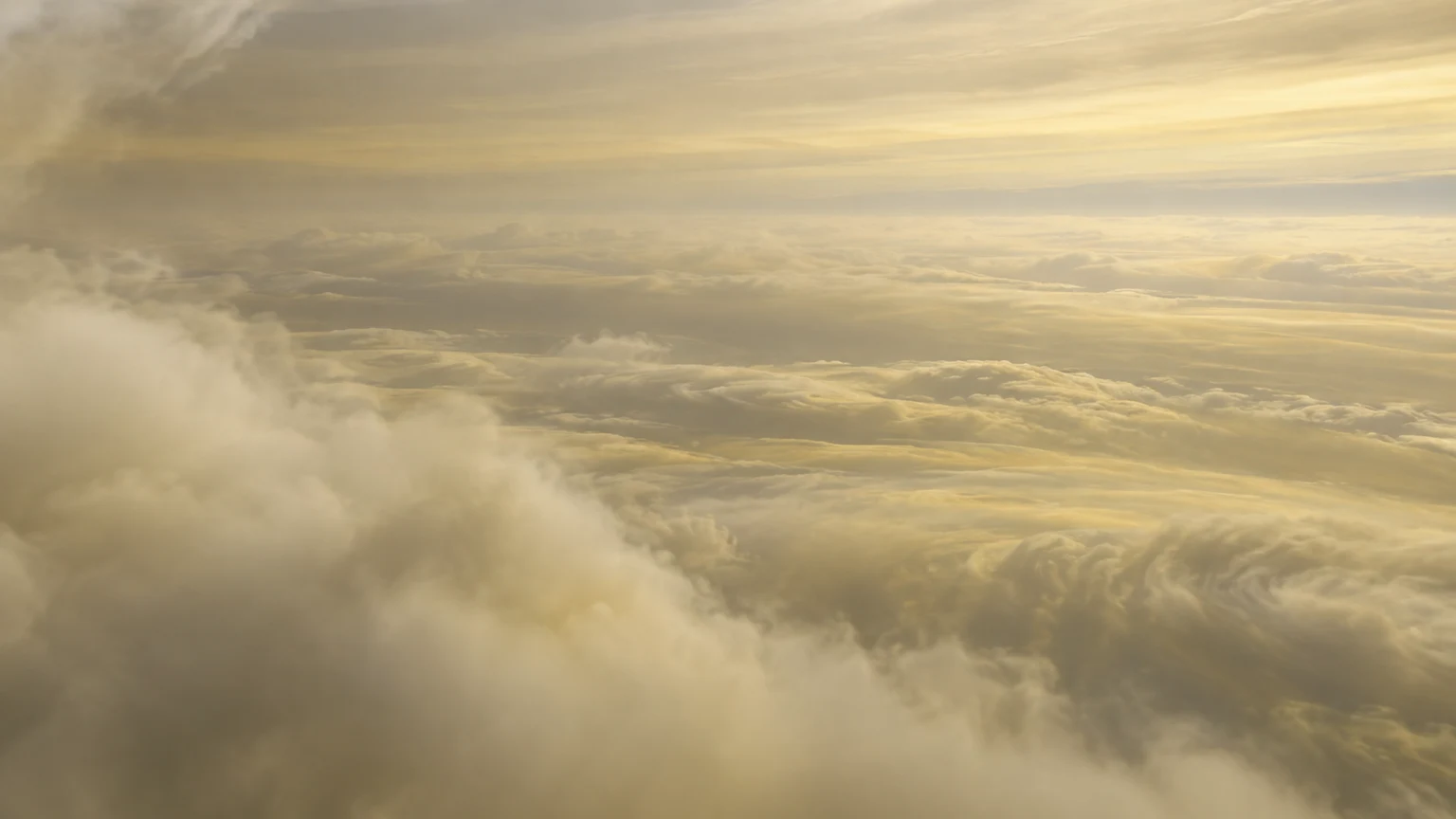
Clouds without a shore.

Saturn is made mostly of hydrogen and helium. There is no solid surface on which to land. Its visible clouds belong to a deep atmosphere, so a close encounter is a journey through gas rather than a walk across a landscape.

What the clouds conceal.

Its pale appearance can hide how different this air is from ours. Hydrogen dominates, while helium and small amounts of other gases complete the mixture. Visible clouds are only one part of a much deeper environment whose pressure changes with depth.

Countless pieces of a single silhouette.

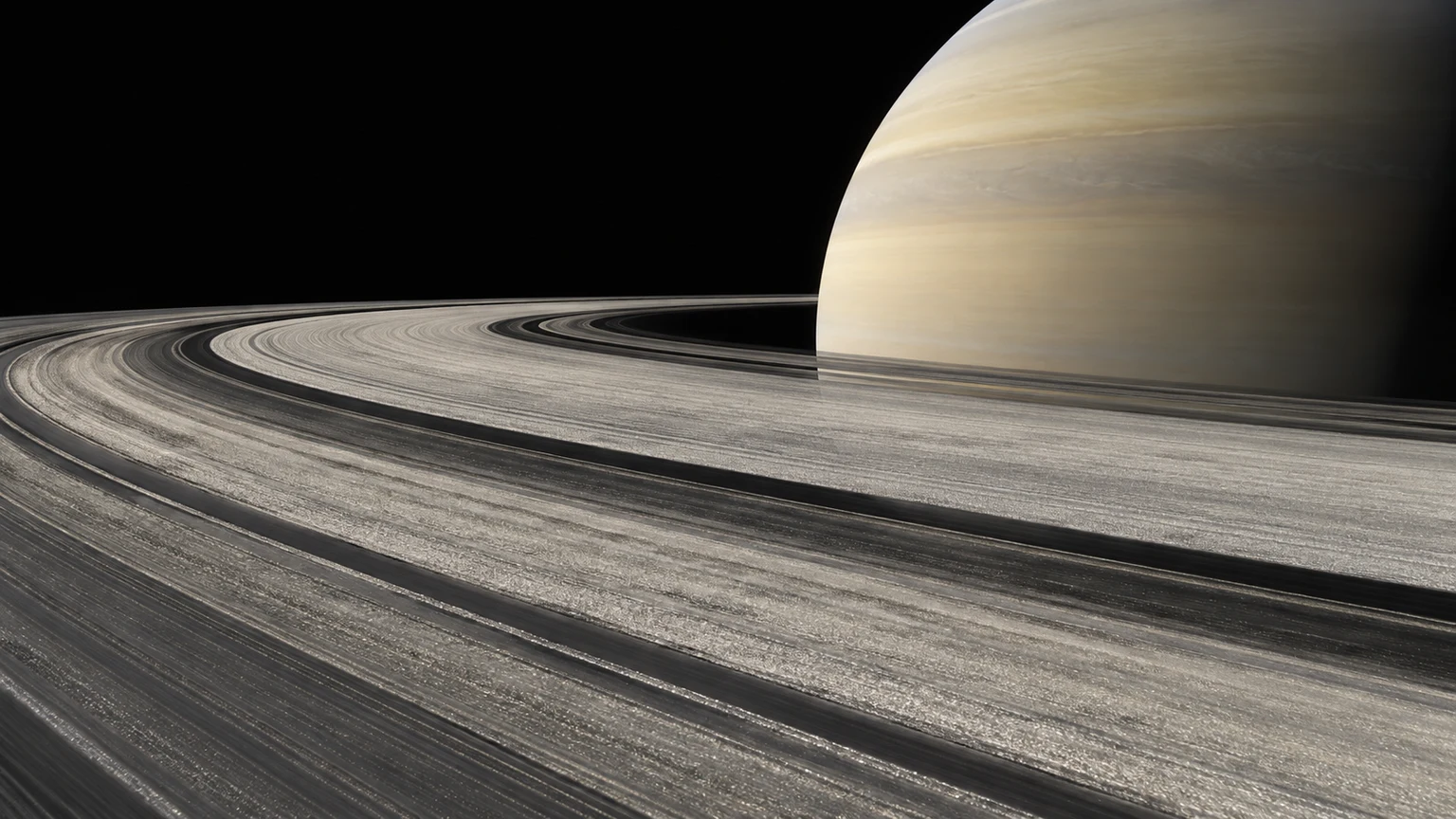
The rings are not a solid disk. They contain enormous numbers of ice and rock particles, ranging from tiny grains to much larger chunks. Together, their separate orbits create the broad bands that make Saturn instantly recognizable.

Beyond the rings.

Saturn’s moon system includes hazy Titan and icy Enceladus. Methane lakes on Titan and water jets from Enceladus make these worlds compelling destinations in their own right. Saturn itself takes about 29.4 Earth years to complete an orbit.
DIAMETER / EARTH9.45×
EARTHSATURN
EARTH
12,756 km
SATURN
120,500 km
equatorial planet diameter / equatorial Earth diameter · rings excluded
ATMOSPHERE / COMPOSITION
H₂Hydrogen≈ 96.3%
HeHelium≈ 3.25%
CH₄Methane≈ 0.45%

Approximate gas volume fractions. These estimates carry substantial uncertainty, especially for helium. Trace gases and cloud particles are not a full part of this inventory; composition can change with atmospheric depth.

TEMPERATURE / 1 BAR
≈ −139°C at 1 bar
PRESSURE
Rises rapidly with depth
HABITABILITYNo known habitat

No life has been detected on Saturn. Extreme conditions and the absence of a known stable habitat make the planet an unlikely home for life as we know it. Questions about Titan and Enceladus concern those moons, not Saturn’s atmosphere.

UNPROTECTED HUMANSNot survivable

The atmosphere has no breathable oxygen supply and no solid ground. Cold upper layers give way to increasing pressure and heat below. Earth-like pressure at one level would not make the environment survivable.

Planet and landscape images are artistic interpretations.

  • NASA ↗
    • Classification and orbital data
    • Simplified interior model
    • Natural conditions and human survival
    • Overview
    • Atmosphere
    • Rings
    • Companions
  • NASA ↗
    • Rotation, gravity and orbital distances
  • NASA ↗
    • Gravity reference level and diagram definitions
  • NASA / JPL ↗
    • Satellite orbital periods
  • NASA ↗
    • Size, physical data and atmospheric constraints
An imagined floating viewpoint among Saturn’s pale upper cloud layers. Haze limits the view; lighting, altitude and small cloud forms are interpretive. There is no solid ground.

Among the upper clouds

An imagined floating viewpoint among Saturn’s pale upper cloud layers. Haze limits the view; lighting, altitude and small cloud forms are interpretive. There is no solid ground.

An imagined orbital view across Saturn’s finely banded rings toward the pale planet. Ring geometry and ice-rich material guide this reconstruction; it is not a spacecraft photograph.

Along the rings

An imagined orbital view across Saturn’s finely banded rings toward the pale planet. Ring geometry and ice-rich material guide this reconstruction; it is not a spacecraft photograph.

Widely separated ice fragments in Saturn’s ring plane, with the ring band receding into space. An artistic reconstruction of Saturn; local detail, lighting and viewpoint are imagined.

Ice along the ring plane

Widely separated ice fragments in Saturn’s ring plane, with the ring band receding into space. An artistic reconstruction of Saturn; local detail, lighting and viewpoint are imagined.

Open moon atlas ↗