TEEGARDEN’S STAR SYSTEM / PLANETARY DOSSIER

Teegarden’s Star b

A close companion receiving roughly Earth-like starlight, with an atmosphere still unknown.
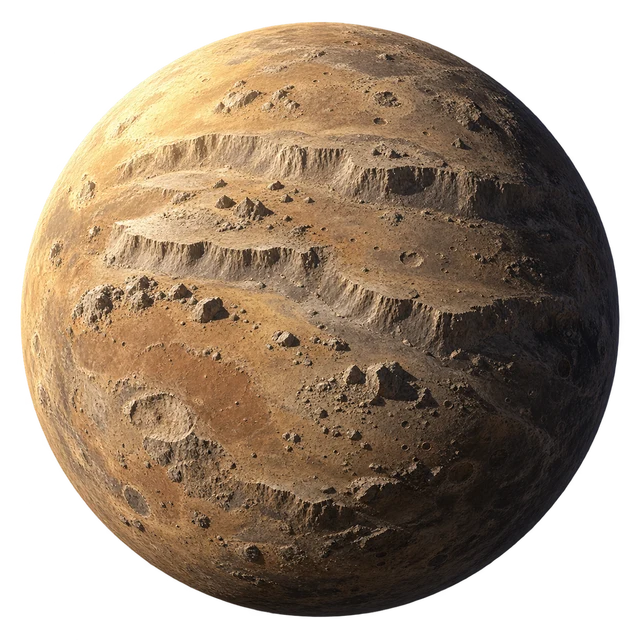
Artist’s impression of Teegarden’s Star b; appearance and diameter are unconfirmed
Terrestrial-mass exoplanet

Earth-like mass. An unanswered climate.

Environment ↗

02
ATMOSPHERE

Not measured

DIAMETER
Not measured
POSSIBILITY FOR LIFE
Unknown · potentially temperate
WITHOUT PROTECTION
Not established as survivable

Mass comparison ↗

04
MINIMUM MASS1.16 × Earth

+0.12 / −0.11 Earth masses

Measured m sin i · true mass may be larger.
TEEGARDEN’S STAR B

Instrument detail

Artist’s impression of Teegarden’s Star b

Artist’s impression · appearance and diameter are unconfirmed.

A year shorter than a week.

Planet b circles its small host in about 4.906 days at a semimajor axis of 0.0259 astronomical units. The adopted study estimates incoming starlight at about 1.08 times Earth’s. A close orbit around a faint star can therefore receive an energy supply comparable to a much wider orbit around Sol.

The number comes with a lower bound.

The stellar motion gives a minimum mass of about 1.16 Earth masses. Unknown orbital inclination permits a larger true mass. Without a measured radius, the planet’s density and surface gravity remain undetermined. The apparent size of its atlas portrait is a design choice, not an additional measurement.

Similar light does not promise similar weather.

Receiving roughly Earth-like starlight makes this planet interesting for climate studies. It does not demonstrate oceans, breathable air or life. An atmosphere can redistribute heat and change the surface temperature; its existence and properties remain open questions here. The console deliberately leaves those quantities unknown.

Three views of one possible world.

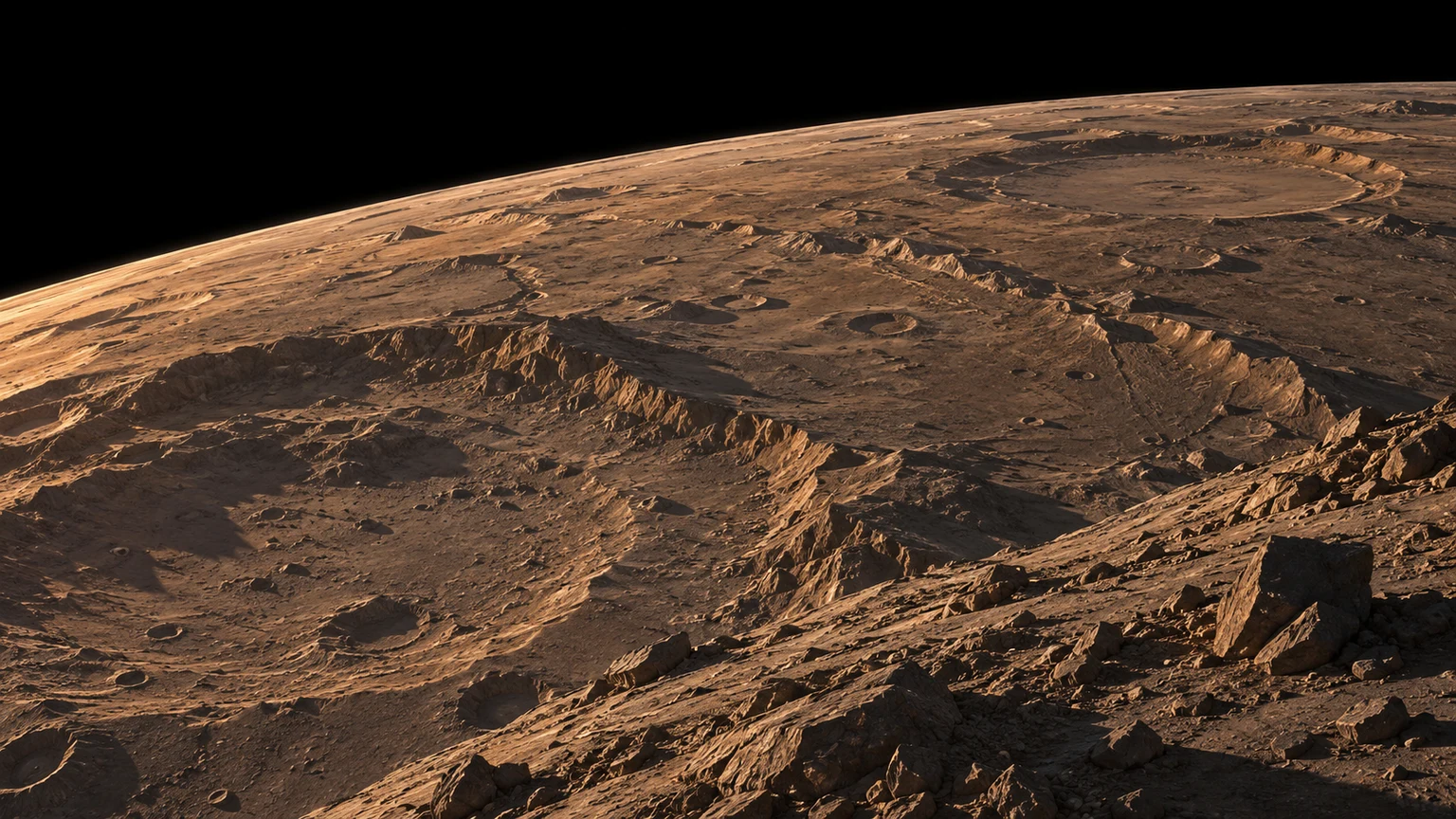
Pale stone, terraces and craters give this imagined planet a distinct visual identity. The scenes progress from an impact basin to a fractured cliff and then an orbital horizon. All three assume an airless rocky setting. Their consistency is an artistic choice, not evidence that this terrain or an absence of atmosphere has been observed.

Size, mass and atmosphere

DIAMETER / EARTH

Not measured.

The radius has not been measured; the illustration does not establish its size.

SIZE UNKNOWN
MINIMUM MASS / EARTH
  • Teegarden’s Star b · minimum1.16 (+0.12 / −0.11) M⊕
  • Earth · reference mass1.00 M⊕

Shared scale: 0–2 Earth masses. The planetary measurement is m sin i, a minimum mass with measurement uncertainty. Unknown orbital inclination allows a larger true mass. Dreizler et al. (2024), adopted radial-velocity fit: minimum mass 1.16 (+0.12 / −0.11) Earth masses; inclination remains unknown.

ATMOSPHERE / COMPOSITION

Not measured

We cannot assign atmospheric percentages or surface pressure. An atmosphere has not been established here; that is different from proving the planet is airless.

Habitability

NATURAL CONDITIONSUnknown · potentially temperate

No atmosphere, liquid water or life has been established. Orbital measurements do not provide a surface temperature, and the airless landscapes here are one invented possibility.

HUMANS / WITHOUT PROTECTIONNot established as survivable

Breathable air, safe pressure and tolerable temperatures are not known. A survival time would be speculation.

SURFACE TEMPERATURE
Unknown · no measured climate
SURFACE PRESSURE
Unknown
LIQUID WATER
Not established
SURFACE GRAVITY
Unknown · radius required

A year around Teegarden’s Star

4.90634 Earth days

Semimajor axis: 0.0259 AU. One astronomical unit is approximately the mean Earth–Sun distance.

The overview is a schematic: sizes, orbital shape and the planet’s position are illustrative. It does not show a measured eccentricity, the orbit’s orientation or a live position.

Planet b circles its small host in about 4.906 days at a semimajor axis of 0.0259 astronomical units. The adopted study estimates incoming starlight at about 1.08 times Earth’s. A close orbit around a faint star can therefore receive an energy supply comparable to a much wider orbit around Sol.

Dreizler et al. (2024) · orbital measurements ↗
A hypothetical airless basin with regolith and distant crater walls. Terrain, mineral colors and the absence of air are artistic assumptions; no such landscape has been observed.

Across the impact basin

A hypothetical airless basin with regolith and distant crater walls. Terrain, mineral colors and the absence of air are artistic assumptions; no such landscape has been observed.

An imagined fractured cliff and fallen blocks under sharp starlight. These rocks do not establish the planet’s geology, atmosphere or surface conditions.

Beneath the escarpment

An imagined fractured cliff and fallen blocks under sharp starlight. These rocks do not establish the planet’s geology, atmosphere or surface conditions.

A hypothetical orbital view across overlapping craters and ridges. The curved horizon is an artist’s reconstruction, not a measured radius or terrain map.

Where the horizon curves

A hypothetical orbital view across overlapping craters and ridges. The curved horizon is an artist’s reconstruction, not a measured radius or terrain map.

Planet and landscape images are hypothetical artistic interpretations.