TRAPPIST-1 SYSTEM / PLANETARY DOSSIER

TRAPPIST-1 b

The innermost world races around its star in a day and a half, under intense stellar heating.
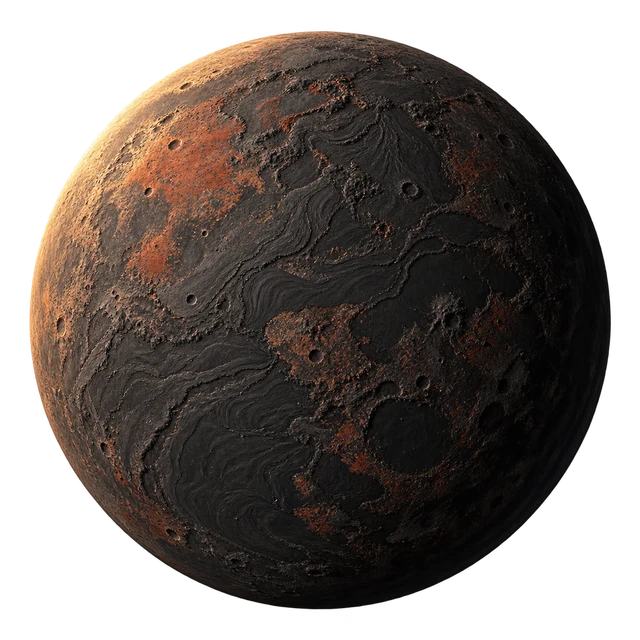
Artist’s impression of TRAPPIST-1 b; appearance is hypothetical; diameter is inferred from transits
Earth-sized rocky exoplanet

The quick heartbeat of a compact system.

Environment ↗

02
ATMOSPHERE

Strong constraints

DIAMETER
1.116 × Earth
POSSIBILITY FOR LIFE
Unknown · inner orbital region
WITHOUT PROTECTION
Not established as survivable

Mass comparison ↗

04
DYNAMICAL MASS1.374 × Earth

± 0.069 Earth masses

Mutual gravitational perturbations shift transit times, constraining planetary masses.
TRAPPIST-1 B

Instrument detail

Artist’s impression of TRAPPIST-1 b

Artist’s impression · appearance is hypothetical; diameter is inferred from transits.

A year in the seven-world chain.

The first planet in the sequence makes more than twelve circuits while h completes one. Such short periods give observers many repeat transits to compare. Close spacing also makes the planets tug on one another, so arrivals across the stellar disk are not the ticks of perfectly independent clocks.

A silhouette we can measure.

This world is slightly larger and more massive than Earth in the adopted fit. A transit measures the fraction of starlight blocked by the planetary silhouette; combining that with stellar size yields a radius. The resulting size measurement is real, even though the dark basalt in the portrait is entirely interpretive.

What the light can tell us.

Webb thermal observations favor a bare or weakly blanketed rocky world over a thick heat-redistributing atmosphere. This does not identify surface minerals or justify a precise global climate. The linked result describes observational limits, while the three scenes illustrate one possible setting.

An imagined place beyond the measurements.

Basins, cliffs and ridges provide three distinct viewpoints on a possible rocky world. No particular crater or mineral has been resolved. The illustrations deliberately leave out buildings and biological features. A compelling view is useful for exploration, but it does not fill the gaps in atmospheric or habitability evidence.

Size, mass and atmosphere

DIAMETER / EARTH1.116 ×

+0.014 / −0.012 · Earth-relative ratio

Agol et al. (2021), Table 6. Radius inferred from transit depth and stellar size. Radius and diameter have the same Earth-relative ratio; this does not resolve terrain.

DYNAMICAL MASS / EARTH
  • TRAPPIST-1 b1.374 ± 0.069 M⊕
  • Earth · reference mass1.00 M⊕

Shared scale: 0–1.5 Earth masses. Mutual gravitational perturbations shift transit times, constraining planetary masses. Agol et al. (2021), Table 6. Dynamical mass from transit-timing variations with an adopted stellar mass; not a radial-velocity minimum.

ATMOSPHERE / COMPOSITION

Strong constraints

Webb thermal observations favor a bare or weakly blanketed rocky world over a thick heat-redistributing atmosphere. This does not identify surface minerals or justify a precise global climate.

Habitability

NATURAL CONDITIONSUnknown · inner orbital region

No life or surface liquid water has been detected. Stellar heating is only one condition for a possible habitat; atmospheric retention, composition and climate also matter.

HUMANS / WITHOUT PROTECTIONNot established as survivable

Breathable air, safe pressure and tolerable temperatures are not known. A survival time would be speculation.

SURFACE TEMPERATURE
Not a measured global climate
SURFACE PRESSURE
Unknown
STELLAR IRRADIATION
≈ 4.153 × Earth
SURFACE GRAVITY
≈ 1.102 × Earth · mass/radius inference

A year around TRAPPIST-1

≈ 1.51 Earth days

Semimajor axis: 0.01154 AU. One astronomical unit is approximately the mean Earth–Sun distance.

The overview is a schematic: sizes, orbital shape and the planet’s position are illustrative. It does not show a measured eccentricity, the orbit’s orientation or a live position.

The first planet in the sequence makes more than twelve circuits while h completes one. Such short periods give observers many repeat transits to compare. Close spacing also makes the planets tug on one another, so arrivals across the stellar disk are not the ticks of perfectly independent clocks.

Agol et al. (2021) · orbital measurements ↗
An imagined view of dark basalt, cooled lava folds and jagged ridges. The terrain and mineral colors are invented. An airless sky is an illustration assumption, not a measured atmospheric state. No landing site has been mapped here.

Across the basalt plain

An imagined view of dark basalt, cooled lava folds and jagged ridges. The terrain and mineral colors are invented. An airless sky is an illustration assumption, not a measured atmospheric state. No landing site has been mapped here.

An imagined view of dark basalt, cooled lava folds and jagged ridges. The terrain and mineral colors are invented. An airless sky is an illustration assumption, not a measured atmospheric state. No landing site has been mapped here.

Inside the impact bowl

An imagined view of dark basalt, cooled lava folds and jagged ridges. The terrain and mineral colors are invented. An airless sky is an illustration assumption, not a measured atmospheric state. No landing site has been mapped here.

An imagined view of dark basalt, cooled lava folds and jagged ridges. The terrain and mineral colors are invented. An airless sky is an illustration assumption, not a measured atmospheric state. No landing site has been mapped here.

At the folded escarpment

An imagined view of dark basalt, cooled lava folds and jagged ridges. The terrain and mineral colors are invented. An airless sky is an illustration assumption, not a measured atmospheric state. No landing site has been mapped here.

Planet and landscape images are hypothetical artistic interpretations.