TRAPPIST-1 SYSTEM / PLANETARY DOSSIER

TRAPPIST-1 d

Sub-Earth size and a four-day year, with atmospheric possibilities narrowed by Webb.
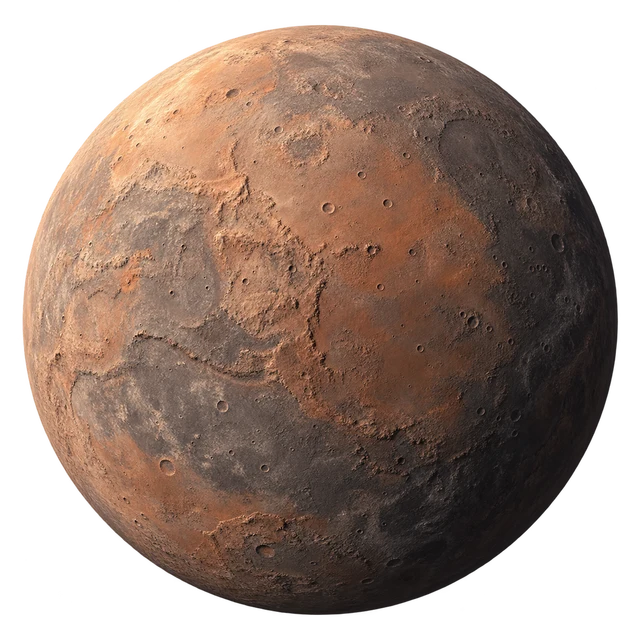
Artist’s impression of TRAPPIST-1 d; appearance is hypothetical; diameter is inferred from transits
Earth-sized rocky exoplanet

A smaller world in the inner trio.

Environment ↗

02
ATMOSPHERE

Models narrowed by Webb

DIAMETER
0.788 × Earth
POSSIBILITY FOR LIFE
Unknown · inner orbital region
WITHOUT PROTECTION
Not established as survivable

Mass comparison ↗

04
DYNAMICAL MASS0.388 × Earth

± 0.012 Earth masses

Mutual gravitational perturbations shift transit times, constraining planetary masses.
TRAPPIST-1 D

Instrument detail

Artist’s impression of TRAPPIST-1 d

Artist’s impression · appearance is hypothetical; diameter is inferred from transits.

A year in the seven-world chain.

The third known planet circles between c and e. Its four-day orbit is short by Solar System standards, but orbit length alone does not determine a climate. A dim star supplies far less energy than Sol at the same distance. The temperature of the ground still depends on atmospheric and surface properties.

A silhouette we can measure.

Planet d is smaller and lighter than Earth, with a radius about four fifths of ours. Pairing the radius with its dynamical mass constrains bulk density and an approximate surface gravity. Those global properties do not reveal the height of the invented cliff or the composition of an individual rock.

What the light can tell us.

Webb did not detect atmospheric molecules such as water, methane or carbon dioxide in the cited observations. A very thin atmosphere, obscuring high clouds or a bare rocky world remain possible; no Earth-like atmosphere was found. The linked result describes observational limits, while the three scenes illustrate one possible setting.

An imagined place beyond the measurements.

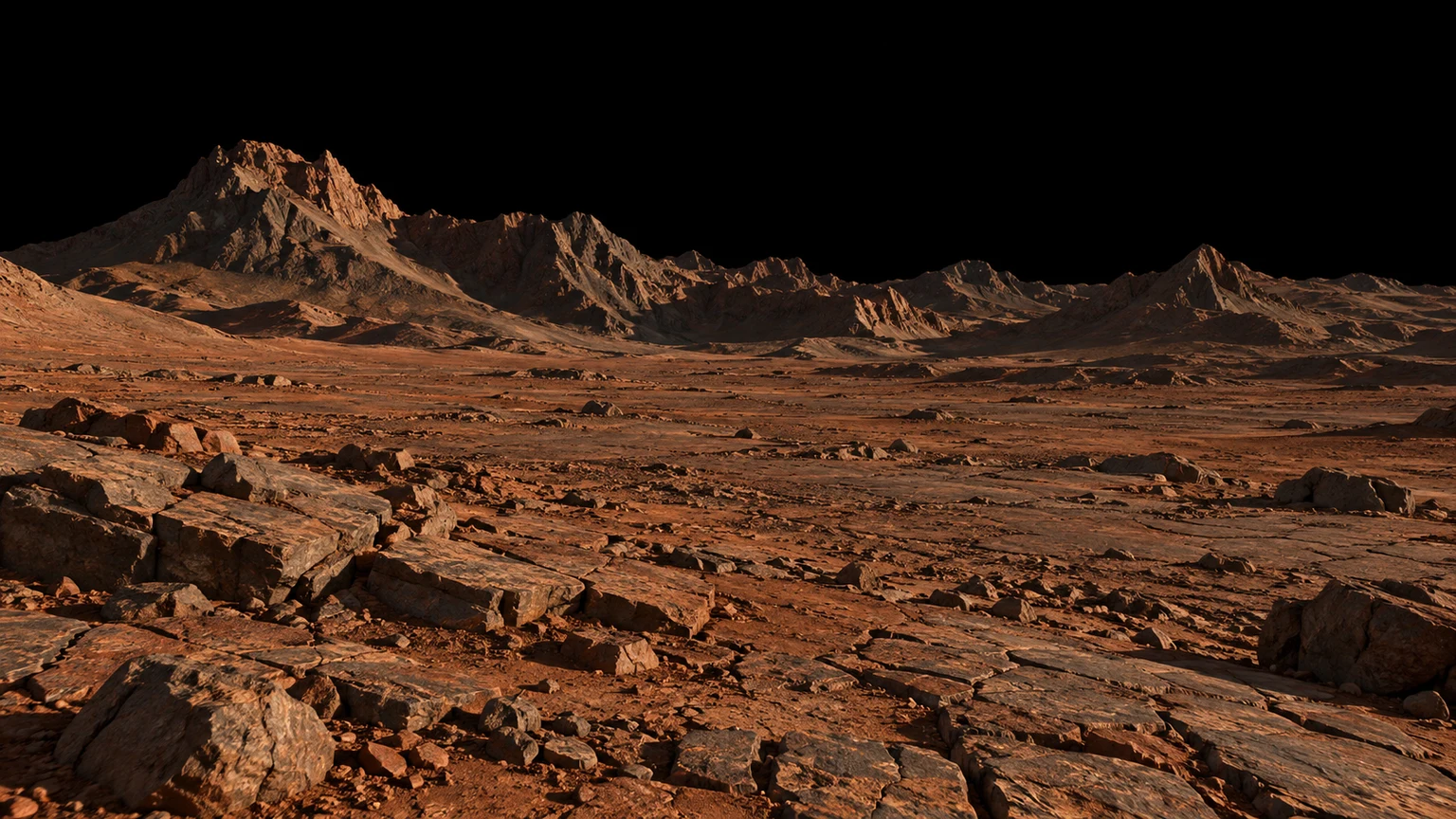
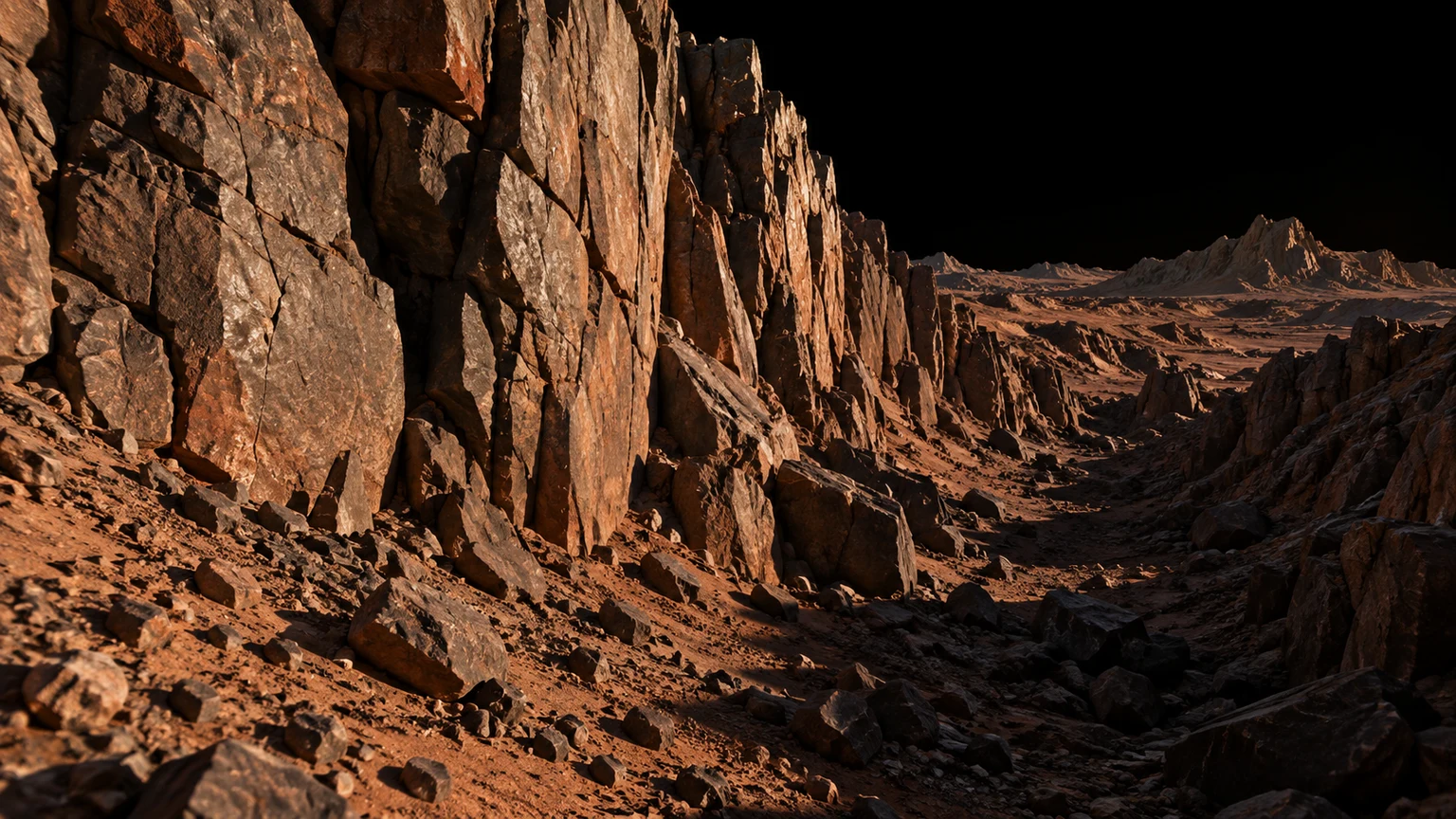
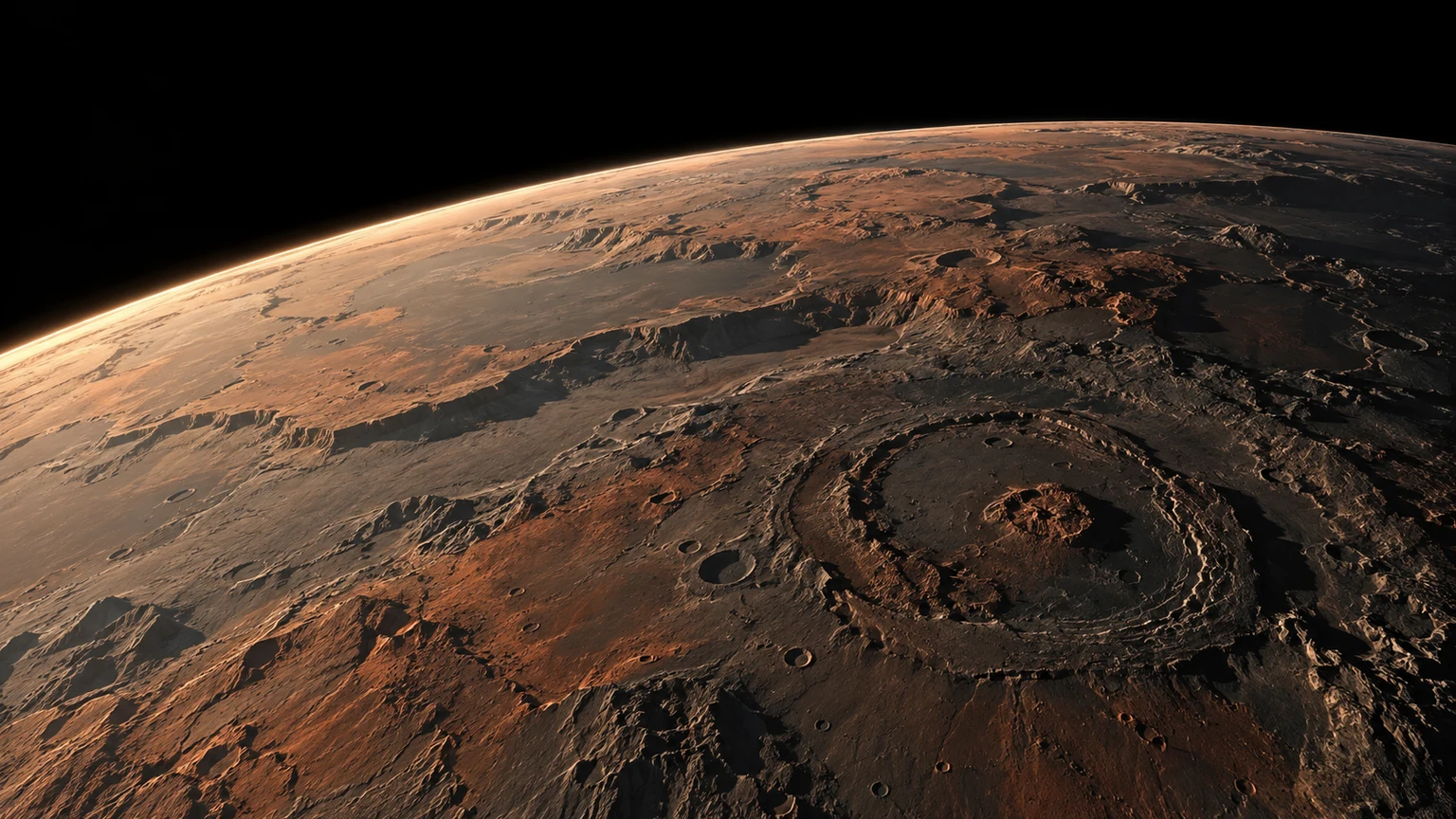
Basins, cliffs and ridges provide three distinct viewpoints on a possible rocky world. No particular crater or mineral has been resolved. The illustrations deliberately leave out buildings and biological features. A compelling view is useful for exploration, but it does not fill the gaps in atmospheric or habitability evidence.

Size, mass and atmosphere

DIAMETER / EARTH0.788 ×

+0.011 / −0.010 · Earth-relative ratio

Agol et al. (2021), Table 6. Radius inferred from transit depth and stellar size. Radius and diameter have the same Earth-relative ratio; this does not resolve terrain.

DYNAMICAL MASS / EARTH
  • TRAPPIST-1 d0.388 ± 0.012 M⊕
  • Earth · reference mass1.00 M⊕

Shared scale: 0–1.5 Earth masses. Mutual gravitational perturbations shift transit times, constraining planetary masses. Agol et al. (2021), Table 6. Dynamical mass from transit-timing variations with an adopted stellar mass; not a radial-velocity minimum.

ATMOSPHERE / COMPOSITION

Models narrowed by Webb

Webb did not detect atmospheric molecules such as water, methane or carbon dioxide in the cited observations. A very thin atmosphere, obscuring high clouds or a bare rocky world remain possible; no Earth-like atmosphere was found.

Habitability

NATURAL CONDITIONSUnknown · inner orbital region

No life or surface liquid water has been detected. Stellar heating is only one condition for a possible habitat; atmospheric retention, composition and climate also matter.

HUMANS / WITHOUT PROTECTIONNot established as survivable

Breathable air, safe pressure and tolerable temperatures are not known. A survival time would be speculation.

SURFACE TEMPERATURE
Not a measured global climate
SURFACE PRESSURE
Unknown
STELLAR IRRADIATION
≈ 1.115 × Earth
SURFACE GRAVITY
≈ 0.624 × Earth · mass/radius inference

A year around TRAPPIST-1

≈ 4.05 Earth days

Semimajor axis: 0.02227 AU. One astronomical unit is approximately the mean Earth–Sun distance.

The overview is a schematic: sizes, orbital shape and the planet’s position are illustrative. It does not show a measured eccentricity, the orbit’s orientation or a live position.

The third known planet circles between c and e. Its four-day orbit is short by Solar System standards, but orbit length alone does not determine a climate. A dim star supplies far less energy than Sol at the same distance. The temperature of the ground still depends on atmospheric and surface properties.

Agol et al. (2021) · orbital measurements ↗
An imagined view of terracotta-gray bedrock, impact debris and tectonic fissures. The terrain and mineral colors are invented. An airless sky is an illustration assumption, not a measured atmospheric state. No landing site has been mapped here.

Across the terracotta plain

An imagined view of terracotta-gray bedrock, impact debris and tectonic fissures. The terrain and mineral colors are invented. An airless sky is an illustration assumption, not a measured atmospheric state. No landing site has been mapped here.

An imagined view of terracotta-gray bedrock, impact debris and tectonic fissures. The terrain and mineral colors are invented. An airless sky is an illustration assumption, not a measured atmospheric state. No landing site has been mapped here.

Along the dark fissure

An imagined view of terracotta-gray bedrock, impact debris and tectonic fissures. The terrain and mineral colors are invented. An airless sky is an illustration assumption, not a measured atmospheric state. No landing site has been mapped here.

An imagined view of terracotta-gray bedrock, impact debris and tectonic fissures. The terrain and mineral colors are invented. An airless sky is an illustration assumption, not a measured atmospheric state. No landing site has been mapped here.

Over the ancient rings

An imagined view of terracotta-gray bedrock, impact debris and tectonic fissures. The terrain and mineral colors are invented. An airless sky is an illustration assumption, not a measured atmospheric state. No landing site has been mapped here.

Planet and landscape images are hypothetical artistic interpretations.