PEGASUS / STELLAR DOSSIER

51 Pegasi

50.45 light-years from Sol

The Sun-like host whose close giant planet helped transform the search for other worlds.

Artist’s impression of 51 Pegasi
G-type · Sun-like star

An ordinary-looking star with an extraordinary place in history.

Stellar conditions ↗

02
EFFECTIVE TEMPERATURE5,761 K

A photosphere close to Sol’s temperature.

51 Pegasi5,761 K
Sol5,770 K
Shared scale 0–10,000 K · effective, not core temperature

Evolution ↗

03
CURRENT PHASE

Main sequence.

  1. NOWHydrogen fusion
  2. LATERGiant phase
  3. REMNANTWhite dwarf
A broad evolutionary sequence, not a timescale or a prediction of remaining lifetime.
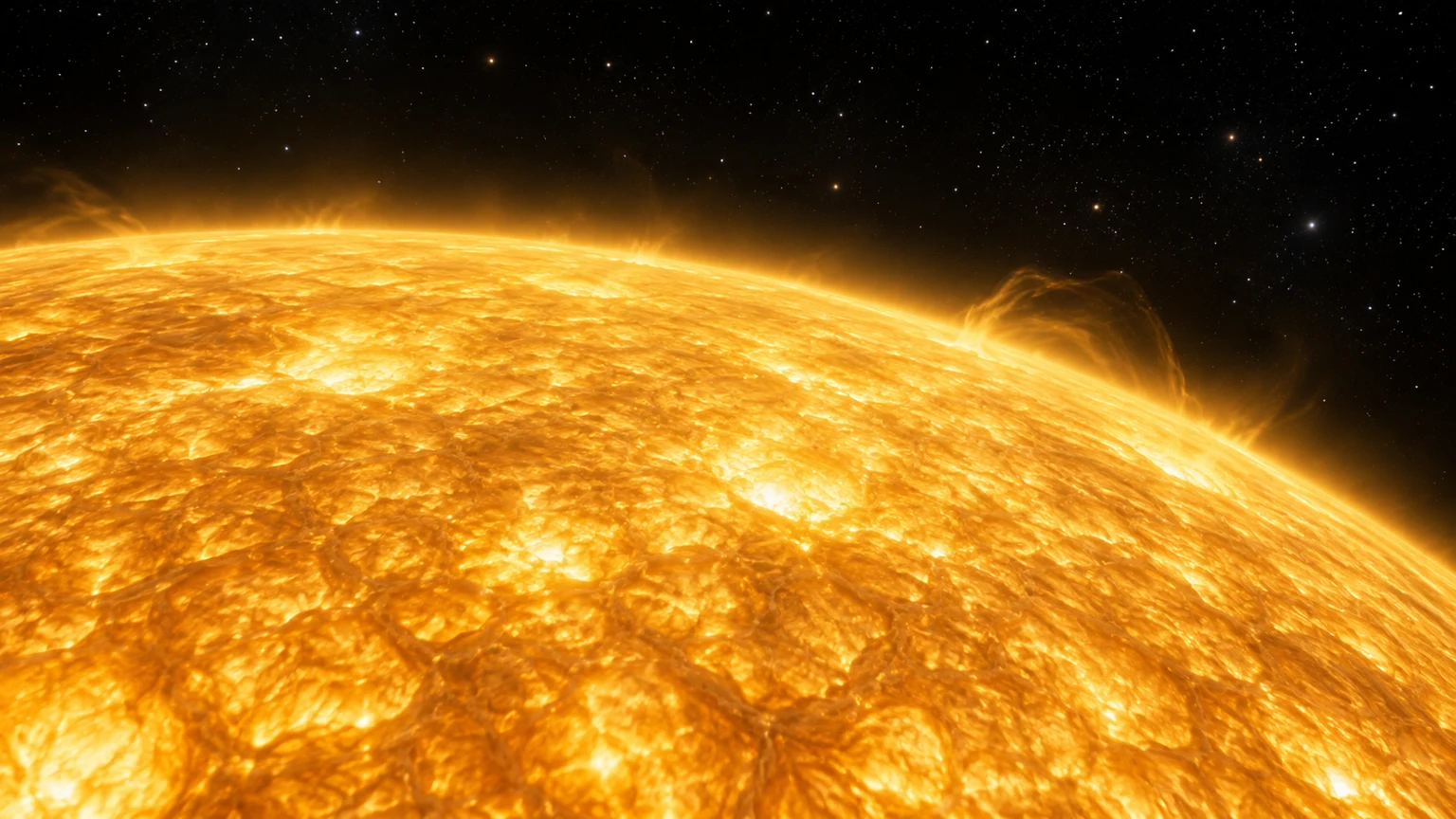
An imagined oblique view of a G-type photosphere. The convection pattern and warm filtered colors are illustrative, not a resolved map of 51 Pegasi.Above a golden sun ↗ ARTIST’S IMPRESSION · 3 VIEWS

Diameter comparison ↗

06
1.19 × Sol
51 PEGASI

Instrument detail

Artist’s impression of 51 Pegasi

Artist’s impression · structure and color are illustrative.

A small wobble changed the picture.

In 1995, Michel Mayor and Didier Queloz identified 51 Pegasi b through the repeating motion of this Sun-like star. The giant planet’s short orbit made the system a landmark: planetary families did not have to resemble our own.

Familiar temperature, different scale.

The adopted measurements describe a star somewhat wider than Sol, with a similar effective temperature. Those two quantities determine the approximate luminosity shown here. A bright granular illustration represents escaping light from hot gas, not a surface that could support a lander.

A star and planet in mutual motion.

A planet pulls on its star as both orbit their shared center of mass. Stellar radial velocities reveal that motion along our line of sight. Spectroscopy of the planet itself can add the second half of the orbital picture, allowing a mass estimate beyond the original minimum.

Fusion powers the present chapter.

Hydrogen fusion sustains a Sun-like star for much of its life. Later structural changes lead toward a giant phase and eventually a white dwarf. The sequence describes stellar physics; it does not specify when this particular star will leave its current phase.

A star in perspective.

DIAMETER / SOL1.19 ×

About 19% wider than our Sun.

Circles compare diameter, not mass or luminosity. Adopted radius 1.19 ± 0.03 solar radii, Cont et al. (2026), as tabulated in the NASA Exoplanet Archive. Radius and diameter share the same solar ratio.

EFFECTIVE TEMPERATURE

A photosphere close to Sol’s temperature.

  • 51 Pegasi≈ 5,761 K
  • Sol≈ 5,770 K

Shared scale: 0–10,000 K. Effective temperature describes total emitted energy per unit surface area; it is not the core temperature. Adopted effective temperature 5,761 ± 95 K from the same stellar parameter set.

LIFE PHASE

Main sequence.

  1. NOWHydrogen fusion
  2. LATERGiant phase
  3. REMNANTWhite dwarf

A broad evolutionary sequence, not a timescale or a prediction of remaining lifetime.

Research · size and temperature ↗
LIFE & HUMAN SURVIVAL / THE STAR ITSELF
POSSIBILITY FOR LIFEIncompatible with known life

The star’s hot gaseous layers cannot provide the cool, stable environment required by life as we know it. Conditions on any orbiting worlds are a separate question.

WITHOUT PROTECTIONNot survivable

No breathable air or solid ground. Extreme heat and radiation make a close encounter lethal; a meaningful survival timer depends on where you are.

NASA · stellar structure and evolution ↗

Main sequence.

  1. NOWHydrogen fusion
  2. LATERGiant phase
  3. REMNANTWhite dwarf

A broad evolutionary sequence, not a timescale or a prediction of remaining lifetime.

Research ↗

Hydrogen fusion sustains a Sun-like star for much of its life. Later structural changes lead toward a giant phase and eventually a white dwarf. The sequence describes stellar physics; it does not specify when this particular star will leave its current phase.

How much energy leaves the star?

≈ 1.41 × Sol

This compares total radiant power across all wavelengths, not just visible light or apparent brightness in our sky. The beams on the dashboard share a linear length scale.

The estimate combines this log’s diameter ratio (1.19 × Sol) and effective temperature (5,761 K): luminosity scales with radius squared and temperature to the fourth power. It is derived from rounded values, not an independent luminosity measurement.

Adopted radius 1.19 ± 0.03 solar radii, Cont et al. (2026), as tabulated in the NASA Exoplanet Archive. Radius and diameter share the same solar ratio.

Adopted effective temperature 5,761 ± 95 K from the same stellar parameter set.

Swinburne University · Stefan–Boltzmann law ↗

A small wobble changed the picture.

In 1995, Michel Mayor and Didier Queloz identified 51 Pegasi b through the repeating motion of this Sun-like star. The giant planet’s short orbit made the system a landmark: planetary families did not have to resemble our own.

Familiar temperature, different scale.

The adopted measurements describe a star somewhat wider than Sol, with a similar effective temperature. Those two quantities determine the approximate luminosity shown here. A bright granular illustration represents escaping light from hot gas, not a surface that could support a lander.

A star and planet in mutual motion.

A planet pulls on its star as both orbit their shared center of mass. Stellar radial velocities reveal that motion along our line of sight. Spectroscopy of the planet itself can add the second half of the orbital picture, allowing a mass estimate beyond the original minimum.

Fusion powers the present chapter.

Hydrogen fusion sustains a Sun-like star for much of its life. Later structural changes lead toward a giant phase and eventually a white dwarf. The sequence describes stellar physics; it does not specify when this particular star will leave its current phase.

An imagined oblique view of a G-type photosphere. The convection pattern and warm filtered colors are illustrative, not a resolved map of 51 Pegasi.

Above a golden sun

An imagined oblique view of a G-type photosphere. The convection pattern and warm filtered colors are illustrative, not a resolved map of 51 Pegasi.

A hypothetical magnetic patch in luminous gas. Its shape and location are invented; a starspot is neither a crater nor solid ground.

A darker magnetic island

A hypothetical magnetic patch in luminous gas. Its shape and location are invented; a starspot is neither a crater nor solid ground.

A fictional plasma arch above the stellar limb. It illustrates magnetic structure without reconstructing a measured eruption.

Beyond the luminous edge

A fictional plasma arch above the stellar limb. It illustrates magnetic structure without reconstructing a measured eruption.

Stellar images are artistic interpretations, not resolved photographs of this star.