55 CANCRI / STELLAR DOSSIER

55 Cancri A

41.05 light-years from Sol

A cool Sun-like star in a binary system, home to the intensely heated super-Earth 55 Cancri e.

Artist’s impression of 55 Cancri A
G8 V · Sun-like star

A quieter-colored sun with an extreme inner world.

Stellar conditions ↗

02
EFFECTIVE TEMPERATURE5,172 K

Smaller and cooler than Sol.

55 Cancri A5,172 K
Sol5,770 K
Shared scale 0–10,000 K · effective, not core temperature

Evolution ↗

03
CURRENT PHASE

Main sequence.

  1. NOWHydrogen fusion
  2. LATERGiant phase
  3. REMNANTWhite dwarf
A broad evolutionary sequence, not a timescale or a prediction of remaining lifetime.
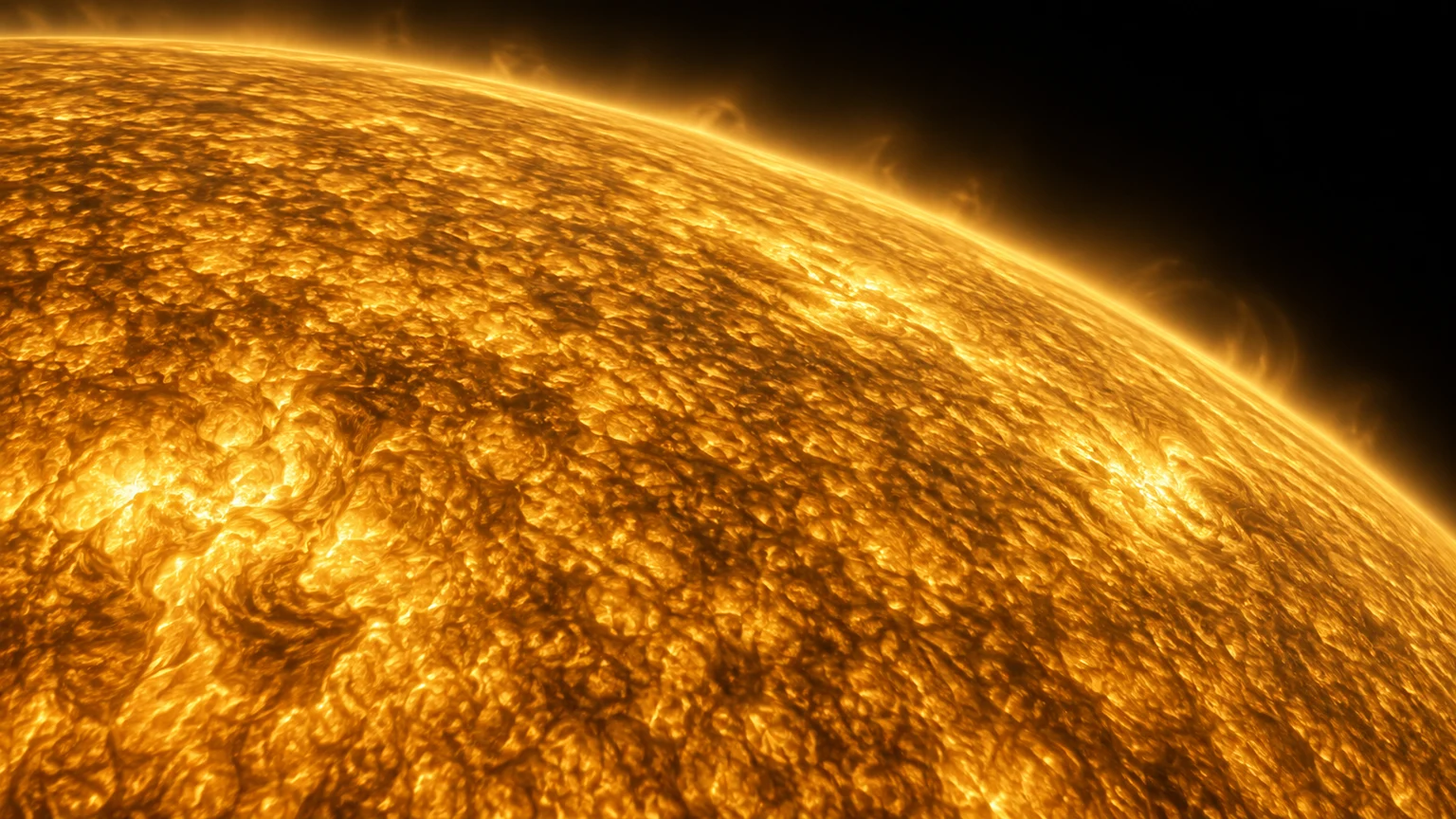
An imagined view of fine convection in glowing stellar gas. Warm colors and the exact cell pattern are illustrative.An amber photosphere ↗ ARTIST’S IMPRESSION · 3 VIEWS

Diameter comparison ↗

06
0.943 × Sol
55 CANCRI A

Instrument detail

Artist’s impression of 55 Cancri A

Artist’s impression · structure and color are illustrative.

The brighter member of a wider pair.

The letter A identifies the brighter star in the 55 Cancri binary; the distant companion B is a red dwarf. The close-in planet e belongs to A. Its short orbit lies within a larger planetary family, rather than around the faint companion.

Measuring the star helps measure the planet.

Interferometry combines light collected at separated telescopes to constrain the star’s angular size. Distance converts that angle into a physical radius. The adopted stellar reference set anchors the radius inferred when planet e crosses the disk.

The star leaves its own signatures.

Rotation and magnetic variability also change stellar spectra. The 2018 system analysis separated those effects from planetary signals. A measured velocity change therefore needs interpretation before it can be assigned to another orbiting world.

A long-lived source of light.

This cool Sun-like star is powered by nuclear fusion. Its future is described by the broad giant-to-white-dwarf pathway. The hot inner planet receives intense irradiation because it is so close, despite its host being cooler than the Sun.

A star in perspective.

DIAMETER / SOL0.94 ×

About 94.3% of our Sun’s diameter.

Circles compare diameter, not mass or luminosity. Adopted radius 0.943 ± 0.010 solar radii: von Braun et al. (2011), used by Bourrier et al. (2018). This reference set is also used for the planet’s mass and radius.

EFFECTIVE TEMPERATURE

Smaller and cooler than Sol.

  • 55 Cancri A≈ 5,172 K
  • Sol≈ 5,770 K

Shared scale: 0–10,000 K. Effective temperature describes total emitted energy per unit surface area; it is not the core temperature. Adopted effective temperature 5,172 ± 18 K from the stellar parameter table in Bourrier et al. (2018).

LIFE PHASE

Main sequence.

  1. NOWHydrogen fusion
  2. LATERGiant phase
  3. REMNANTWhite dwarf

A broad evolutionary sequence, not a timescale or a prediction of remaining lifetime.

Research · size and temperature ↗
LIFE & HUMAN SURVIVAL / THE STAR ITSELF
POSSIBILITY FOR LIFEIncompatible with known life

The star’s hot gaseous layers cannot provide the cool, stable environment required by life as we know it. Conditions on any orbiting worlds are a separate question.

WITHOUT PROTECTIONNot survivable

No breathable air or solid ground. Extreme heat and radiation make a close encounter lethal; a meaningful survival timer depends on where you are.

NASA · stellar structure and evolution ↗

Main sequence.

  1. NOWHydrogen fusion
  2. LATERGiant phase
  3. REMNANTWhite dwarf

A broad evolutionary sequence, not a timescale or a prediction of remaining lifetime.

Research ↗

This cool Sun-like star is powered by nuclear fusion. Its future is described by the broad giant-to-white-dwarf pathway. The hot inner planet receives intense irradiation because it is so close, despite its host being cooler than the Sun.

How much energy leaves the star?

≈ 0.574 × Sol

This compares total radiant power across all wavelengths, not just visible light or apparent brightness in our sky. The beams on the dashboard share a linear length scale.

The estimate combines this log’s diameter ratio (0.943 × Sol) and effective temperature (5,172 K): luminosity scales with radius squared and temperature to the fourth power. It is derived from rounded values, not an independent luminosity measurement.

Adopted radius 0.943 ± 0.010 solar radii: von Braun et al. (2011), used by Bourrier et al. (2018). This reference set is also used for the planet’s mass and radius.

Adopted effective temperature 5,172 ± 18 K from the stellar parameter table in Bourrier et al. (2018).

Swinburne University · Stefan–Boltzmann law ↗

The brighter member of a wider pair.

The letter A identifies the brighter star in the 55 Cancri binary; the distant companion B is a red dwarf. The close-in planet e belongs to A. Its short orbit lies within a larger planetary family, rather than around the faint companion.

Measuring the star helps measure the planet.

Interferometry combines light collected at separated telescopes to constrain the star’s angular size. Distance converts that angle into a physical radius. The adopted stellar reference set anchors the radius inferred when planet e crosses the disk.

The star leaves its own signatures.

Rotation and magnetic variability also change stellar spectra. The 2018 system analysis separated those effects from planetary signals. A measured velocity change therefore needs interpretation before it can be assigned to another orbiting world.

A long-lived source of light.

This cool Sun-like star is powered by nuclear fusion. Its future is described by the broad giant-to-white-dwarf pathway. The hot inner planet receives intense irradiation because it is so close, despite its host being cooler than the Sun.

An imagined view of fine convection in glowing stellar gas. Warm colors and the exact cell pattern are illustrative.

An amber photosphere

An imagined view of fine convection in glowing stellar gas. Warm colors and the exact cell pattern are illustrative.

A hypothetical close study of bright convection cells and darker lanes. No such detailed map of 55 Cancri A has been observed.

Between rising cells

A hypothetical close study of bright convection cells and darker lanes. No such detailed map of 55 Cancri A has been observed.

An invented magnetic plasma loop above the star’s edge. It is a gas structure, not a solid arch or a reconstruction of a recorded flare.

A loop over the limb

An invented magnetic plasma loop above the star’s edge. It is a gas structure, not a solid arch or a reconstruction of a recorded flare.

Stellar images are artistic interpretations, not resolved photographs of this star.