ALDEBARAN / STELLAR DOSSIER

Aldebaran

66.64 light-years from Sol

A cool, expanded star whose changing spectrum also illustrates the difficulty of finding planets around giants.
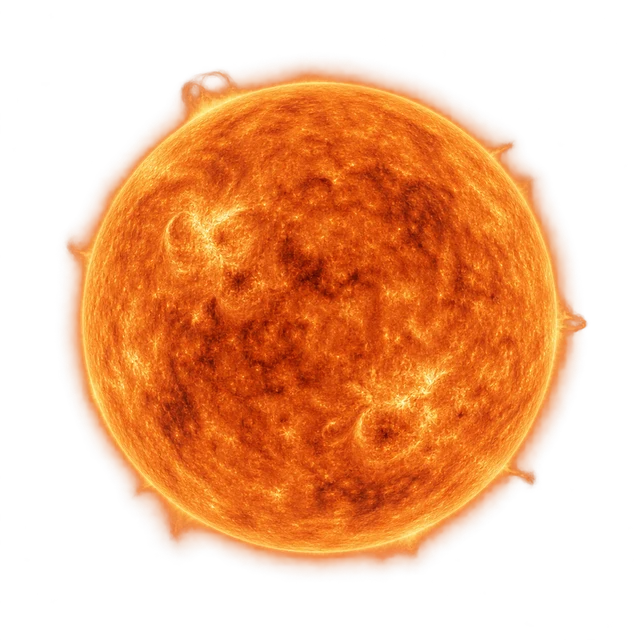
Artist’s impression of Aldebaran
K5 III · red giant

An amber giant with a restless signal.

Stellar conditions ↗

02
EFFECTIVE TEMPERATURE3,901 K

Light from the outer layers.

Aldebaran3,901 K
Sol5,770 K
Shared scale 0–10,000 K · effective, not core temperature

Evolution ↗

03
CURRENT PHASE

Red giant branch.

  1. NOWRed giant branch
  2. PROCESSChanging internal structure
  3. OUTLOOKModel-dependent evolution
A physical sequence, not a lifetime scale or a countdown.
Artist’s impression. The curved luminous layers and detailed gas texture are illustrative, not a measured surface map.Across the luminous edge ↗ ARTIST’S IMPRESSION · 3 VIEWS

Diameter comparison ↗

06
44.01 × Sol
ALDEBARAN

Instrument detail

Artist’s impression of Aldebaran

Artist’s impression · structure and color are illustrative.

Cooler light from a larger star.

Aldebaran’s adopted radius is about 44 times the Sun’s. Its lower temperature does not make it a cold object: a huge atmosphere radiates across a vast area. These orange views compress brightness to make gas structure visible.

A stellar signal can mimic a planet.

A proposed massive planet was based on long-period radial-velocity variations. The cited 2019 study found changes in the signal that weakened that interpretation. Stellar oscillations remain an alternative; this dossier does not add the disputed companion as an established planet.

Expansion after the main sequence.

The adopted model favors the red giant branch. This is an evolutionary inference, not a direct image of the core. Radius, temperature and luminosity are presented as a consistent model solution.

A star in perspective.

DIAMETER / SOL44.01 ×

About 4301% wider than our Sun.

Circles compare diameter, not mass or luminosity. Model radius 44.01 +0.74/−0.71 solar radii, adopted red-giant-branch solution of Reichert et al. (2019).

EFFECTIVE TEMPERATURE

Light from the outer layers.

  • Aldebaran≈ 3,901 K
  • Sol≈ 5,770 K

Shared scale: 0–10,000 K. Effective temperature describes total emitted energy per unit surface area; it is not the core temperature. Model effective temperature 3,901 ± 10 K; formal uncertainty within the adopted solution.

LIFE PHASE

Red giant branch.

  1. NOWRed giant branch
  2. PROCESSChanging internal structure
  3. OUTLOOKModel-dependent evolution

A physical sequence, not a lifetime scale or a countdown.

Research · size and temperature ↗
LIFE & HUMAN SURVIVAL / THE STAR ITSELF
POSSIBILITY FOR LIFEIncompatible with known life

The star’s hot gaseous layers cannot provide the cool, stable environment required by life as we know it. Conditions on any orbiting worlds are a separate question.

WITHOUT PROTECTIONNot survivable

No breathable air or solid ground. Extreme heat and radiation make a close encounter lethal; a meaningful survival timer depends on where you are.

NASA · stellar structure and evolution ↗

Red giant branch.

  1. NOWRed giant branch
  2. PROCESSChanging internal structure
  3. OUTLOOKModel-dependent evolution

A physical sequence, not a lifetime scale or a countdown.

Research ↗

The adopted model favors the red giant branch. This is an evolutionary inference, not a direct image of the core. Radius, temperature and luminosity are presented as a consistent model solution.

How much energy leaves the star?

≈ 405 × Sol

This compares total radiant power across all wavelengths, not just visible light or apparent brightness in our sky. The beams on the dashboard share a linear length scale.

The estimate combines this log’s diameter ratio (44.01 × Sol) and effective temperature (3,901 K): luminosity scales with radius squared and temperature to the fourth power. It is derived from rounded values, not an independent luminosity measurement.

Model radius 44.01 +0.74/−0.71 solar radii, adopted red-giant-branch solution of Reichert et al. (2019).

Model effective temperature 3,901 ± 10 K; formal uncertainty within the adopted solution.

Swinburne University · Stefan–Boltzmann law ↗

Cooler light from a larger star.

Aldebaran’s adopted radius is about 44 times the Sun’s. Its lower temperature does not make it a cold object: a huge atmosphere radiates across a vast area. These orange views compress brightness to make gas structure visible.

A stellar signal can mimic a planet.

A proposed massive planet was based on long-period radial-velocity variations. The cited 2019 study found changes in the signal that weakened that interpretation. Stellar oscillations remain an alternative; this dossier does not add the disputed companion as an established planet.

Expansion after the main sequence.

The adopted model favors the red giant branch. This is an evolutionary inference, not a direct image of the core. Radius, temperature and luminosity are presented as a consistent model solution.

Artist’s impression. The curved luminous layers and detailed gas texture are illustrative, not a measured surface map.

Across the luminous edge

Artist’s impression. The curved luminous layers and detailed gas texture are illustrative, not a measured surface map.

Artist’s impression. An imagined close view; geometry, fine structure and colors are illustrative.

Structure in perspective

Artist’s impression. An imagined close view; geometry, fine structure and colors are illustrative.

Artist’s impression. The expanded field places the object in an imagined setting. Exposure and apparent scale are adjusted for clarity.

A wider view

Artist’s impression. The expanded field places the object in an imagined setting. Exposure and apparent scale are adjusted for clarity.

Stellar images are artistic interpretations, not resolved photographs of this star.