BOÖTES / STELLAR DOSSIER

Arcturus

36.79 light-years from Sol

A nearby giant with a cool photosphere and a diameter far greater than Sol’s.
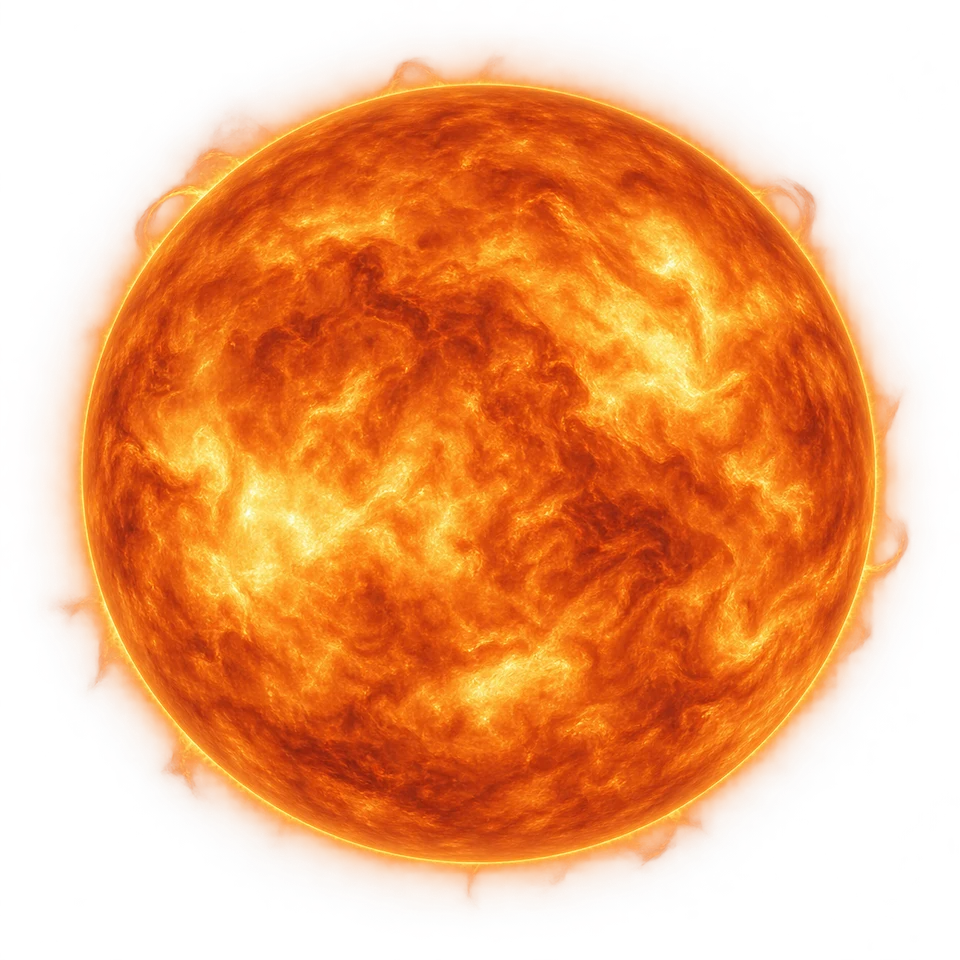
Artist’s impression of Arcturus
K1.5 III · red giant

A familiar orange light, enlarged by age.

Stellar conditions ↗

02
EFFECTIVE TEMPERATURE4,286 K

Cooler gas across a much larger star.

Arcturus4,286 K
Sol5,770 K
Shared scale 0–10,000 K · effective, not core temperature

Evolution ↗

03
H–R MAPBRIGHTER ↑
SOLHEREHOTTERCOOLER →
CURRENT PHASE

Giant branch.

  1. NOWExpanded giant
  2. LATERFurther giant evolution
  3. REMNANTWhite dwarf
A broad low-mass stellar pathway, not a countdown or a precise determination of the present core-burning stage.
An imagined panorama over a giant’s gaseous photosphere. Broad bright cells and warm filtered colors illustrate convection, not measured terrain.Across the amber glow ↗ ARTIST’S IMPRESSION · 3 VIEWS

Diameter comparison ↗

06
25.4 × Sol
ARCTURUS

Instrument detail

Artist’s impression of Arcturus

Artist’s impression · structure and color are illustrative.

A large star need not be hotter.

Arcturus has a cooler photosphere than Sol but about 25 times its diameter. Its much larger emitting area makes it substantially more luminous. Radius and temperature describe different aspects of the same star.

Light preserves a chemical record.

A detailed spectral analysis found less iron relative to hydrogen than in the Sun. Its element pattern and motion are consistent with membership in the Milky Way’s thick disk, offering clues to an older stellar population.

The edge has more than one layer.

Infrared interferometry resolves an extended region in carbon-monoxide lines. The outer atmosphere is not a single uniform-temperature shell, and its structure cannot be represented by a solid stellar surface.

An expanded envelope changes the view.

Low-mass stars expand after leaving the main sequence. Their eventual evolution sheds outer layers and leaves a white dwarf. The orange giant seen today is one chapter in that longer transformation.

A star in perspective.

DIAMETER / SOL25.40 ×

About 2440% wider than our Sun.

Circles compare diameter, not mass or luminosity. Adopted radius 25.4 ± 0.2 solar radii, Ramírez & Allende Prieto (2011).

EFFECTIVE TEMPERATURE

Cooler gas across a much larger star.

  • Arcturus≈ 4,286 K
  • Sol≈ 5,770 K

Shared scale: 0–10,000 K. Effective temperature describes total emitted energy per unit surface area; it is not the core temperature. Effective temperature 4,286 ± 30 K from the same analysis.

LIFE PHASE

Giant branch.

  1. NOWExpanded giant
  2. LATERFurther giant evolution
  3. REMNANTWhite dwarf

A broad low-mass stellar pathway, not a countdown or a precise determination of the present core-burning stage.

Research · size and temperature ↗
LIFE & HUMAN SURVIVAL / THE STAR ITSELF
POSSIBILITY FOR LIFEIncompatible with known life

The star’s hot gaseous layers cannot provide the cool, stable environment required by life as we know it. Conditions on any orbiting worlds are a separate question.

WITHOUT PROTECTIONNot survivable

No breathable air or solid ground. Extreme heat and radiation make a close encounter lethal; a meaningful survival timer depends on where you are.

NASA · stellar structure and evolution ↗
10⁵1,000100.10.00110⁻⁵30,00010,0005,0002,500LUMINOSITY / SOL · BRIGHTER →HOTTER ← EFFECTIVE TEMPERATURE (K) → COOLERSUPERGIANTSGIANTSWHITE DWARFSMAIN SEQUENCESOLArcturus
Arcturus4,286 K · ≈ 196 × Sol
Sol / reference5,770 K · 1 × Sol

Estimated from size & temperature. Both axes are logarithmic; equal steps represent equal ratios.

Small points are other worlds in this atlas. The soft band marks the main sequence; region labels are broad guides, not a path through time.

Giant branch.

  1. NOWExpanded giant
  2. LATERFurther giant evolution
  3. REMNANTWhite dwarf

A broad low-mass stellar pathway, not a countdown or a precise determination of the present core-burning stage.

Research ↗

Low-mass stars expand after leaving the main sequence. Their eventual evolution sheds outer layers and leaves a white dwarf. The orange giant seen today is one chapter in that longer transformation.

How much energy leaves the star?

≈ 196 × Sol

This compares total radiant power across all wavelengths, not just visible light or apparent brightness in our sky. The beams on the dashboard share a linear length scale.

The estimate combines this log’s diameter ratio (25.4 × Sol) and effective temperature (4,286 K): luminosity scales with radius squared and temperature to the fourth power. It is derived from rounded values, not an independent luminosity measurement.

Adopted radius 25.4 ± 0.2 solar radii, Ramírez & Allende Prieto (2011).

Effective temperature 4,286 ± 30 K from the same analysis.

Swinburne University · Stefan–Boltzmann law ↗

A large star need not be hotter.

Arcturus has a cooler photosphere than Sol but about 25 times its diameter. Its much larger emitting area makes it substantially more luminous. Radius and temperature describe different aspects of the same star.

Light preserves a chemical record.

A detailed spectral analysis found less iron relative to hydrogen than in the Sun. Its element pattern and motion are consistent with membership in the Milky Way’s thick disk, offering clues to an older stellar population.

The edge has more than one layer.

Infrared interferometry resolves an extended region in carbon-monoxide lines. The outer atmosphere is not a single uniform-temperature shell, and its structure cannot be represented by a solid stellar surface.

An expanded envelope changes the view.

Low-mass stars expand after leaving the main sequence. Their eventual evolution sheds outer layers and leaves a white dwarf. The orange giant seen today is one chapter in that longer transformation.

An imagined panorama over a giant’s gaseous photosphere. Broad bright cells and warm filtered colors illustrate convection, not measured terrain.

Across the amber glow

An imagined panorama over a giant’s gaseous photosphere. Broad bright cells and warm filtered colors illustrate convection, not measured terrain.

A hypothetical close view of rising bright gas and darker lanes. The pattern and scale are artistic choices, with no solid crust beneath them.

Between the convection cells

A hypothetical close view of rising bright gas and darker lanes. The pattern and scale are artistic choices, with no solid crust beneath them.

An interpretation of tenuous gas outside the visible limb. Colors and brightness are adjusted; no specific observed structure is reconstructed.

Beyond the orange edge

An interpretation of tenuous gas outside the visible limb. Colors and brightness are adjusted; no specific observed structure is reconstructed.

Stellar images are artistic interpretations, not resolved photographs of this star.