SOLAR NEIGHBORHOOD / STELLAR DOSSIER

Barnard’s Star

5.96 light-years from Sol

A small red neighbor whose apparent motion makes the night sky feel less permanent.
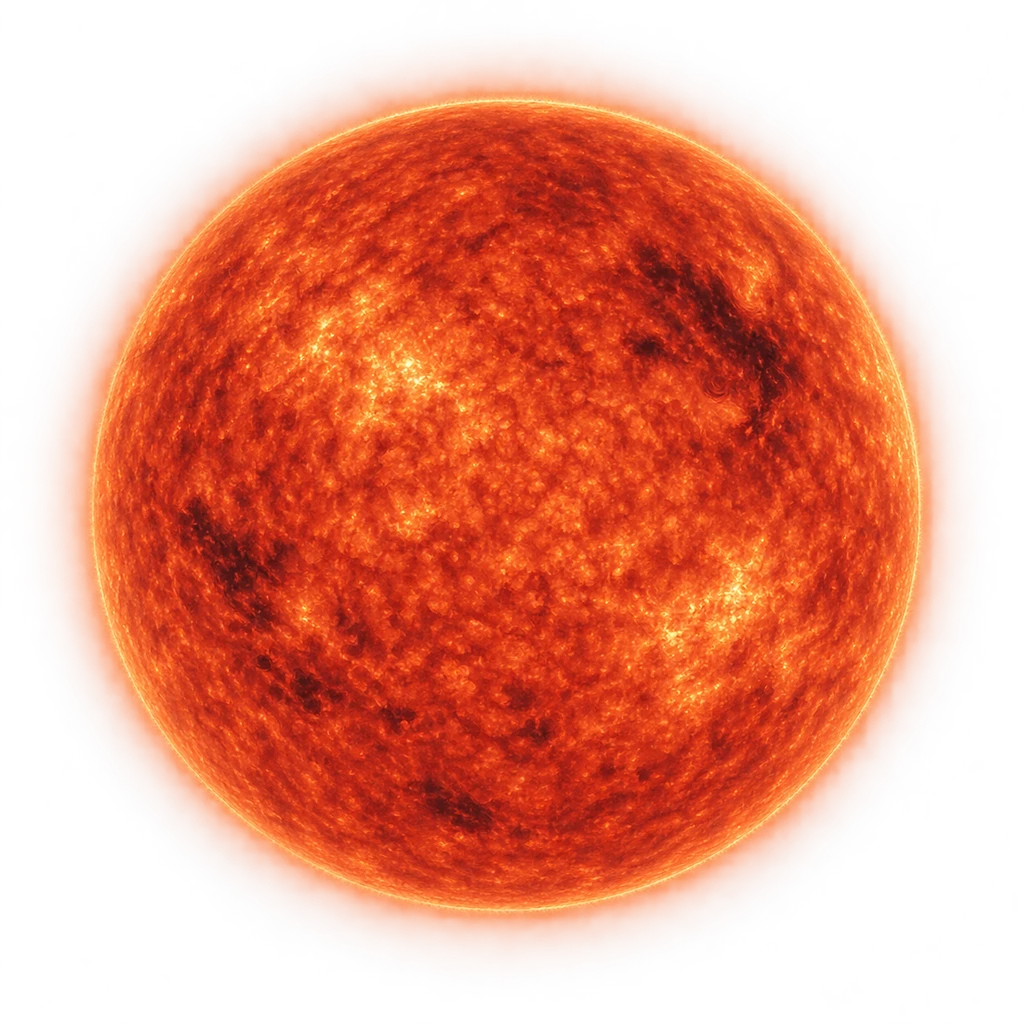
Artist’s impression of Barnard’s Star
M3.5–M4 V · red dwarf

A quiet light, moving through our sky.

Stellar conditions ↗

02
EFFECTIVE TEMPERATURE3,195 K

Faint does not mean cold.

Barnard’s Star3,195 K
Sol5,770 K
Shared scale 0–10,000 K · effective, not core temperature

Evolution ↗

03
H–R MAPBRIGHTER ↑
SOLHEREHOTTERCOOLER →
CURRENT PHASE

A long-lived red dwarf.

  1. NOWHydrogen fusion
  2. INTERIORDeep convection
  3. OUTLOOKA very long lifetime
Low-mass red dwarfs use their fuel slowly and mix it deeply. This is a broad evolutionary outlook, not an age estimate.
An imagined view over Barnard’s photosphere. The granular texture is inferred from stellar physics, not resolved on this star. Warm filtered colors and compressed exposure reveal the glowing gas.Along a red horizon ↗ ARTIST’S IMPRESSION · 3 VIEWS

Diameter comparison ↗

06
0.187 × Sol
BARNARD’S STAR

Instrument detail

Artist’s impression of Barnard’s Star

Artist’s impression · structure and color are illustrative.

The sky is not a still picture.

Barnard’s Star has the largest known proper motion of any star: its position shifts noticeably against more distant stars over the years. That is angular motion across our view, not a claim that it is the fastest star in space. Its proximity helps make the movement conspicuous. At about six light-years away, this modest red dwarf sits just beyond the Alpha Centauri neighborhood.

A small furnace without a floor.

The faint point hides a photosphere thousands of degrees above absolute zero. Light escapes from gaseous layers, not a solid crust. Like other main-sequence stars, Barnard’s Star is powered by hydrogen fusion; its low mass lets it spend that fuel slowly. The warm scenes here translate that physics into an imagined close view. A real visit would offer no ground to stand on beneath the glow.

Separating a planet from a restless star.

Even a relatively quiet star complicates a planet search. Rotation and magnetic activity can shift the spectrum and imitate parts of an orbital signal. Researchers studying Barnard’s Star compared those effects with the tiny repeated wobble expected from a planet. A 2024 study reported a close-in, sub-Earth-mass companion. That detection comes from precise measurements of starlight, not a photograph showing the planet beside its sun.

Patience on a stellar scale.

Small red dwarfs have a different relationship with time from bright, massive stars. Slow energy consumption and deep internal mixing give them exceptionally long lives. They can keep shining far beyond the main-sequence lifetime of a sunlike star. The profile above therefore follows fuel use and convection rather than borrowing Sol’s familiar giant-stage diagram. It describes a kind of star, not a clock counting down to Barnard’s end.

A star in perspective.

DIAMETER / SOL0.187 ×

About 18.7% of our Sun’s diameter.

Circles compare diameter, not mass or luminosity. Interferometric radius: 0.187 ± 0.001 solar radii, as compiled by González Hernández et al. (2024). Radius and diameter have the same relative ratio.

EFFECTIVE TEMPERATURE

Faint does not mean cold.

  • Barnard’s Star≈ 3,195 K
  • Sol≈ 5,770 K

Shared scale: 0–10,000 K. Effective temperature describes total emitted energy per unit surface area; it is not the core temperature. Effective temperature estimate: 3,195 ± 28 K, compiled in the 2024 study.

LIFE PHASE

A long-lived red dwarf.

  1. NOWHydrogen fusion
  2. INTERIORDeep convection
  3. OUTLOOKA very long lifetime

Low-mass red dwarfs use their fuel slowly and mix it deeply. This is a broad evolutionary outlook, not an age estimate.

Research · size and temperature ↗
LIFE & HUMAN SURVIVAL / THE STAR ITSELF
POSSIBILITY FOR LIFEIncompatible with known life

The star’s hot gaseous layers cannot provide the cool, stable environment required by life as we know it. Conditions on any orbiting worlds are a separate question.

WITHOUT PROTECTIONNot survivable

No breathable air or solid ground. Extreme heat and radiation make a close encounter lethal; a meaningful survival timer depends on where you are.

NASA · stellar structure and evolution ↗
10⁵1,000100.10.00110⁻⁵30,00010,0005,0002,500LUMINOSITY / SOL · BRIGHTER →HOTTER ← EFFECTIVE TEMPERATURE (K) → COOLERSUPERGIANTSGIANTSWHITE DWARFSMAIN SEQUENCESOLBarnard’s Star
Barnard’s Star3,195 K · ≈ 0.00329 × Sol
Sol / reference5,770 K · 1 × Sol

Estimated from size & temperature. Both axes are logarithmic; equal steps represent equal ratios.

Small points are other worlds in this atlas. The soft band marks the main sequence; region labels are broad guides, not a path through time.

A long-lived red dwarf.

  1. NOWHydrogen fusion
  2. INTERIORDeep convection
  3. OUTLOOKA very long lifetime

Low-mass red dwarfs use their fuel slowly and mix it deeply. This is a broad evolutionary outlook, not an age estimate.

Research ↗

Small red dwarfs have a different relationship with time from bright, massive stars. Slow energy consumption and deep internal mixing give them exceptionally long lives. They can keep shining far beyond the main-sequence lifetime of a sunlike star. The profile above therefore follows fuel use and convection rather than borrowing Sol’s familiar giant-stage diagram. It describes a kind of star, not a clock counting down to Barnard’s end.

How much energy leaves the star?

≈ 0.00329 × Sol

This compares total radiant power across all wavelengths, not just visible light or apparent brightness in our sky. The beams on the dashboard share a linear length scale.

The estimate combines this log’s diameter ratio (0.187 × Sol) and effective temperature (3,195 K): luminosity scales with radius squared and temperature to the fourth power. It is derived from rounded values, not an independent luminosity measurement.

Interferometric radius: 0.187 ± 0.001 solar radii, as compiled by González Hernández et al. (2024). Radius and diameter have the same relative ratio.

Effective temperature estimate: 3,195 ± 28 K, compiled in the 2024 study.

Swinburne University · Stefan–Boltzmann law ↗

The sky is not a still picture.

Barnard’s Star has the largest known proper motion of any star: its position shifts noticeably against more distant stars over the years. That is angular motion across our view, not a claim that it is the fastest star in space. Its proximity helps make the movement conspicuous. At about six light-years away, this modest red dwarf sits just beyond the Alpha Centauri neighborhood.

A small furnace without a floor.

The faint point hides a photosphere thousands of degrees above absolute zero. Light escapes from gaseous layers, not a solid crust. Like other main-sequence stars, Barnard’s Star is powered by hydrogen fusion; its low mass lets it spend that fuel slowly. The warm scenes here translate that physics into an imagined close view. A real visit would offer no ground to stand on beneath the glow.

Separating a planet from a restless star.

Even a relatively quiet star complicates a planet search. Rotation and magnetic activity can shift the spectrum and imitate parts of an orbital signal. Researchers studying Barnard’s Star compared those effects with the tiny repeated wobble expected from a planet. A 2024 study reported a close-in, sub-Earth-mass companion. That detection comes from precise measurements of starlight, not a photograph showing the planet beside its sun.

Patience on a stellar scale.

Small red dwarfs have a different relationship with time from bright, massive stars. Slow energy consumption and deep internal mixing give them exceptionally long lives. They can keep shining far beyond the main-sequence lifetime of a sunlike star. The profile above therefore follows fuel use and convection rather than borrowing Sol’s familiar giant-stage diagram. It describes a kind of star, not a clock counting down to Barnard’s end.

An imagined view over Barnard’s photosphere. The granular texture is inferred from stellar physics, not resolved on this star. Warm filtered colors and compressed exposure reveal the glowing gas.

Along a red horizon

An imagined view over Barnard’s photosphere. The granular texture is inferred from stellar physics, not resolved on this star. Warm filtered colors and compressed exposure reveal the glowing gas.

A fictional close-up of convection and a cooler magnetic region. These are gaseous layers, not lava or terrain. Neither the pattern nor the dark patch is an observed map of Barnard’s Star.

Texture beneath the light

A fictional close-up of convection and a cooler magnetic region. These are gaseous layers, not lava or terrain. Neither the pattern nor the dark patch is an observed map of Barnard’s Star.

An artistic view of Barnard’s Star against space. The luminous disk and fine gaseous texture are illustrative; color and exposure are adjusted for visibility, not a resolved stellar photograph.

The star against space

An artistic view of Barnard’s Star against space. The luminous disk and fine gaseous texture are illustrative; color and exposure are adjusted for visibility, not a resolved stellar photograph.

Stellar images are artistic interpretations, not resolved photographs of this star.