DENEB / STELLAR DOSSIER

Deneb

2615.77 light-years from Sol

A blue-white supergiant whose uncertain distance matters to every estimate of its true scale.
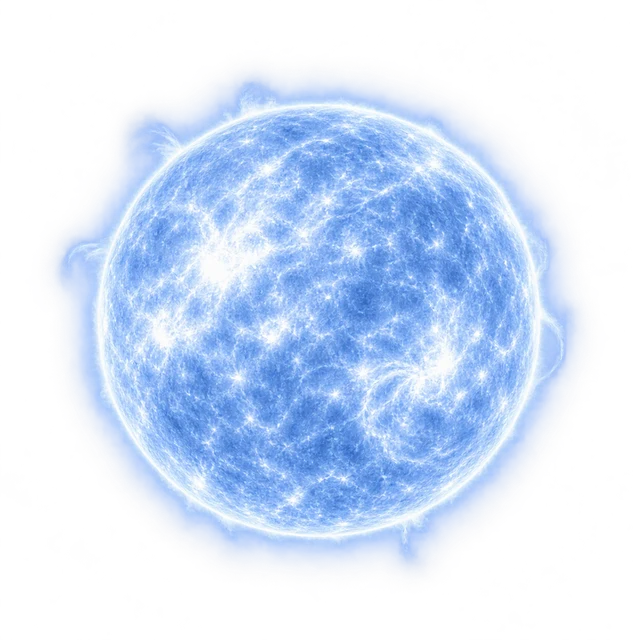
Artist’s impression of Deneb
A2 Ia · supergiant

A distant light on an enormous scale.

Stellar conditions ↗

02
EFFECTIVE TEMPERATURE8,525 K

Light from the outer layers.

Deneb8,525 K
Sol5,770 K
Shared scale 0–10,000 K · effective, not core temperature

Evolution ↗

03
CURRENT PHASE

An evolved supergiant.

  1. NOWAn evolved supergiant
  2. PROCESSChanging internal structure
  3. OUTLOOKModel-dependent evolution
A physical sequence, not a lifetime scale or a countdown.
Artist’s impression. The curved luminous layers and detailed gas texture are illustrative, not a measured surface map.Across the luminous edge ↗ ARTIST’S IMPRESSION · 3 VIEWS

Diameter comparison ↗

06
203 × Sol
DENEB

Instrument detail

Artist’s impression of Deneb

Artist’s impression · structure and color are illustrative.

Distance changes the picture.

This dossier adopts the 802 ± 66 parsec distance used in the cited spectroscopic study. It is a model-supported estimate, not a precise direct parallax. Radius and luminosity are kept with the same solution.

Light escapes through a moving atmosphere.

A supergiant’s atmosphere is extended and loses material through a stellar wind. Its luminous photosphere has no landable ground. The diffuse structures shown here illustrate that setting, without mapping a particular observed outflow.

Massive stars change quickly.

Deneb’s supergiant classification places it beyond the ordinary main sequence. Its history and eventual core-collapse outcome depend on mass loss and internal evolution. Its present appearance cannot supply a date for that final event.

A star in perspective.

DIAMETER / SOL203.00 ×

About 20200% wider than our Sun.

Circles compare diameter, not mass or luminosity. Adopted radius 203 ± 17 solar radii from Schiller & Przybilla (2008), paired with their 802 ± 66 pc distance.

EFFECTIVE TEMPERATURE

Light from the outer layers.

  • Deneb≈ 8,525 K
  • Sol≈ 5,770 K

Shared scale: 0–10,000 K. Effective temperature describes total emitted energy per unit surface area; it is not the core temperature. Effective temperature 8,525 ± 75 K in the adopted spectroscopic analysis.

LIFE PHASE

An evolved supergiant.

  1. NOWAn evolved supergiant
  2. PROCESSChanging internal structure
  3. OUTLOOKModel-dependent evolution

A physical sequence, not a lifetime scale or a countdown.

Research · size and temperature ↗
LIFE & HUMAN SURVIVAL / THE STAR ITSELF
POSSIBILITY FOR LIFEIncompatible with known life

The star’s hot gaseous layers cannot provide the cool, stable environment required by life as we know it. Conditions on any orbiting worlds are a separate question.

WITHOUT PROTECTIONNot survivable

No breathable air or solid ground. Extreme heat and radiation make a close encounter lethal; a meaningful survival timer depends on where you are.

NASA · stellar structure and evolution ↗

An evolved supergiant.

  1. NOWAn evolved supergiant
  2. PROCESSChanging internal structure
  3. OUTLOOKModel-dependent evolution

A physical sequence, not a lifetime scale or a countdown.

Research ↗

Deneb’s supergiant classification places it beyond the ordinary main sequence. Its history and eventual core-collapse outcome depend on mass loss and internal evolution. Its present appearance cannot supply a date for that final event.

How much energy leaves the star?

≈ 196,000 × Sol

This compares total radiant power across all wavelengths, not just visible light or apparent brightness in our sky. The beams on the dashboard share a linear length scale.

196,000 ± 32,000 solar luminosities in the adopted Schiller & Przybilla solution.

Adopted radius 203 ± 17 solar radii from Schiller & Przybilla (2008), paired with their 802 ± 66 pc distance.

Effective temperature 8,525 ± 75 K in the adopted spectroscopic analysis.

Research · bolometric luminosity model ↗

Distance changes the picture.

This dossier adopts the 802 ± 66 parsec distance used in the cited spectroscopic study. It is a model-supported estimate, not a precise direct parallax. Radius and luminosity are kept with the same solution.

Light escapes through a moving atmosphere.

A supergiant’s atmosphere is extended and loses material through a stellar wind. Its luminous photosphere has no landable ground. The diffuse structures shown here illustrate that setting, without mapping a particular observed outflow.

Massive stars change quickly.

Deneb’s supergiant classification places it beyond the ordinary main sequence. Its history and eventual core-collapse outcome depend on mass loss and internal evolution. Its present appearance cannot supply a date for that final event.

Artist’s impression. The curved luminous layers and detailed gas texture are illustrative, not a measured surface map.

Across the luminous edge

Artist’s impression. The curved luminous layers and detailed gas texture are illustrative, not a measured surface map.

Artist’s impression. An imagined close view; geometry, fine structure and colors are illustrative.

Structure in perspective

Artist’s impression. An imagined close view; geometry, fine structure and colors are illustrative.

Artist’s impression. The expanded field places the object in an imagined setting. Exposure and apparent scale are adjusted for clarity.

A wider view

Artist’s impression. The expanded field places the object in an imagined setting. Exposure and apparent scale are adjusted for clarity.

Stellar images are artistic interpretations, not resolved photographs of this star.