PEGASUS / STELLAR DOSSIER

HD 209458

161.86 light-years from Sol

A Sun-like host whose transiting giant opened a window into exoplanet atmospheres.

Artist’s impression of HD 209458
F9–G0 V · Sun-like star

A star that backlights another world.

Stellar conditions ↗

02
EFFECTIVE TEMPERATURE6,071 K

A slightly hotter kind of sunlight.

HD 2094586,071 K
Sol5,770 K
Shared scale 0–10,000 K · effective, not core temperature

Evolution ↗

03
H–R MAPBRIGHTER ↑
SOLHEREHOTTERCOOLER →
CURRENT PHASE

Main sequence.

  1. NOWHydrogen fusion
  2. LATERGiant phase
  3. REMNANTWhite dwarf
A broad evolutionary sequence, not an estimate of remaining lifetime.
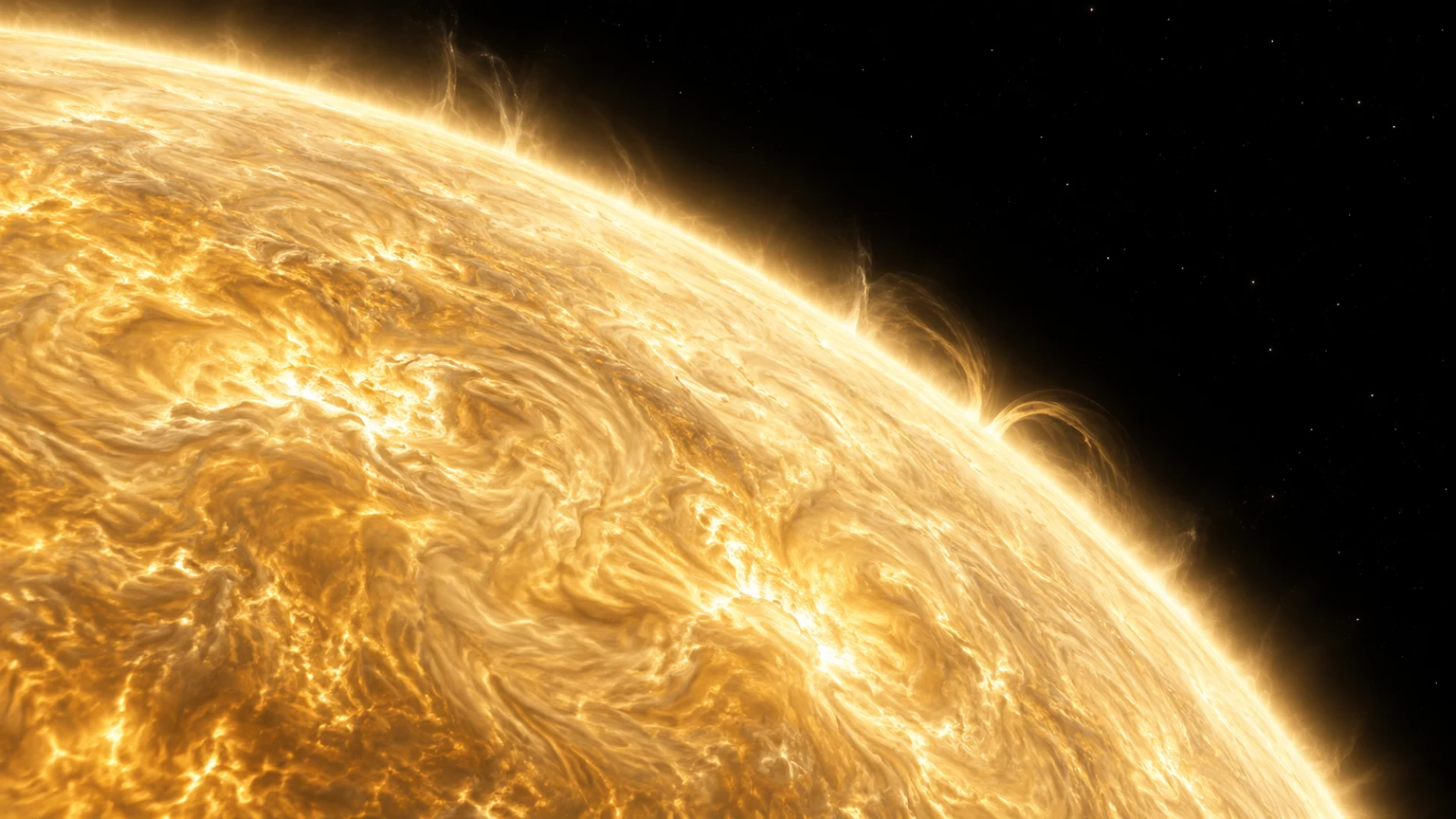
An imagined ivory-gold photosphere with fine gaseous texture. Exposure and color are illustrative.Above another sun ↗ ARTIST’S IMPRESSION · 3 VIEWS

Diameter comparison ↗

06
1.2 × Sol
HD 209458

Instrument detail

Artist’s impression of HD 209458

Artist’s impression · structure and color are illustrative.

A useful stellar yardstick.

The adopted Hubble spectrophotometric analysis gives a radius of 1.20 solar radii and an effective temperature of 6,071 K. These are the published 2016 reference values, rather than a new fit to modern distance data.

A small silhouette crosses the disk.

The planet crosses the star as viewed from Earth. The depth of the dimming measures a size ratio, so the stellar radius helps set the physical scale of the planet.

Starlight can sample planetary gas.

During a transit, a little starlight passes through the planet’s atmospheric edge. Hubble detected sodium absorption there, providing the first direct detection of an exoplanet atmosphere.

A familiar source of stellar energy.

Hydrogen fusion powers a main-sequence Sun-like star. Its visible photosphere is hot gas where light escapes; the bright texture in these scenes offers an imagined close view of that layer.

A star in perspective.

DIAMETER / SOL1.20 ×

About 20% wider than our Sun.

Circles compare diameter, not mass or luminosity. Adopted radius 1.20 ± 0.05 solar radii, del Burgo & Allende Prieto (2016), HST spectral fit plus Hipparcos distance.

EFFECTIVE TEMPERATURE

A slightly hotter kind of sunlight.

  • HD 209458≈ 6,071 K
  • Sol≈ 5,770 K

Shared scale: 0–10,000 K. Effective temperature describes total emitted energy per unit surface area; it is not the core temperature. Effective temperature 6,071 ± 20 K from the same spectral analysis.

LIFE PHASE

Main sequence.

  1. NOWHydrogen fusion
  2. LATERGiant phase
  3. REMNANTWhite dwarf

A broad evolutionary sequence, not an estimate of remaining lifetime.

Research · size and temperature ↗
LIFE & HUMAN SURVIVAL / THE STAR ITSELF
POSSIBILITY FOR LIFEIncompatible with known life

The star’s hot gaseous layers cannot provide the cool, stable environment required by life as we know it. Conditions on any orbiting worlds are a separate question.

WITHOUT PROTECTIONNot survivable

No breathable air or solid ground. Extreme heat and radiation make a close encounter lethal; a meaningful survival timer depends on where you are.

NASA · stellar structure and evolution ↗
10⁵1,000100.10.00110⁻⁵30,00010,0005,0002,500LUMINOSITY / SOL · BRIGHTER →HOTTER ← EFFECTIVE TEMPERATURE (K) → COOLERSUPERGIANTSGIANTSWHITE DWARFSMAIN SEQUENCESOLHD 209458
HD 2094586,071 K · ≈ 1.76 × Sol
Sol / reference5,770 K · 1 × Sol

Estimated from size & temperature. Both axes are logarithmic; equal steps represent equal ratios.

Small points are other worlds in this atlas. The soft band marks the main sequence; region labels are broad guides, not a path through time.

Main sequence.

  1. NOWHydrogen fusion
  2. LATERGiant phase
  3. REMNANTWhite dwarf

A broad evolutionary sequence, not an estimate of remaining lifetime.

Research ↗

Hydrogen fusion powers a main-sequence Sun-like star. Its visible photosphere is hot gas where light escapes; the bright texture in these scenes offers an imagined close view of that layer.

How much energy leaves the star?

≈ 1.76 × Sol

This compares total radiant power across all wavelengths, not just visible light or apparent brightness in our sky. The beams on the dashboard share a linear length scale.

The estimate combines this log’s diameter ratio (1.2 × Sol) and effective temperature (6,071 K): luminosity scales with radius squared and temperature to the fourth power. It is derived from rounded values, not an independent luminosity measurement.

Adopted radius 1.20 ± 0.05 solar radii, del Burgo & Allende Prieto (2016), HST spectral fit plus Hipparcos distance.

Effective temperature 6,071 ± 20 K from the same spectral analysis.

Swinburne University · Stefan–Boltzmann law ↗

A useful stellar yardstick.

The adopted Hubble spectrophotometric analysis gives a radius of 1.20 solar radii and an effective temperature of 6,071 K. These are the published 2016 reference values, rather than a new fit to modern distance data.

A small silhouette crosses the disk.

The planet crosses the star as viewed from Earth. The depth of the dimming measures a size ratio, so the stellar radius helps set the physical scale of the planet.

Starlight can sample planetary gas.

During a transit, a little starlight passes through the planet’s atmospheric edge. Hubble detected sodium absorption there, providing the first direct detection of an exoplanet atmosphere.

A familiar source of stellar energy.

Hydrogen fusion powers a main-sequence Sun-like star. Its visible photosphere is hot gas where light escapes; the bright texture in these scenes offers an imagined close view of that layer.

An imagined ivory-gold photosphere with fine gaseous texture. Exposure and color are illustrative.

Above another sun

An imagined ivory-gold photosphere with fine gaseous texture. Exposure and color are illustrative.

A schematic artist’s view of HD 209458 b crossing its host. The viewpoint and exact placement are invented; this is not a transit photograph.

A planetary silhouette

A schematic artist’s view of HD 209458 b crossing its host. The viewpoint and exact placement are invented; this is not a transit photograph.

An invented magnetic region amid luminous gas. Its appearance and location have not been mapped on HD 209458.

A small magnetic patch

An invented magnetic region amid luminous gas. Its appearance and location have not been mapped on HD 209458.

Stellar images are artistic interpretations, not resolved photographs of this star.