LHS 1140 / STELLAR DOSSIER

LHS 1140

48.80 light-years from Sol

A nearby red dwarf whose transiting planets let astronomers compare masses, sizes and possible atmospheres.
Stellar conditions ↗

02
EFFECTIVE TEMPERATURE3,096 K

Light from the outer layers.

LHS 11403,096 K
Sol5,770 K
Shared scale 0–10,000 K · effective, not core temperature

Evolution ↗

03
CURRENT PHASE

A long-lived red dwarf.

  1. NOWA long-lived red dwarf
  2. PROCESSChanging internal structure
  3. OUTLOOKModel-dependent evolution
A physical sequence, not a lifetime scale or a countdown.
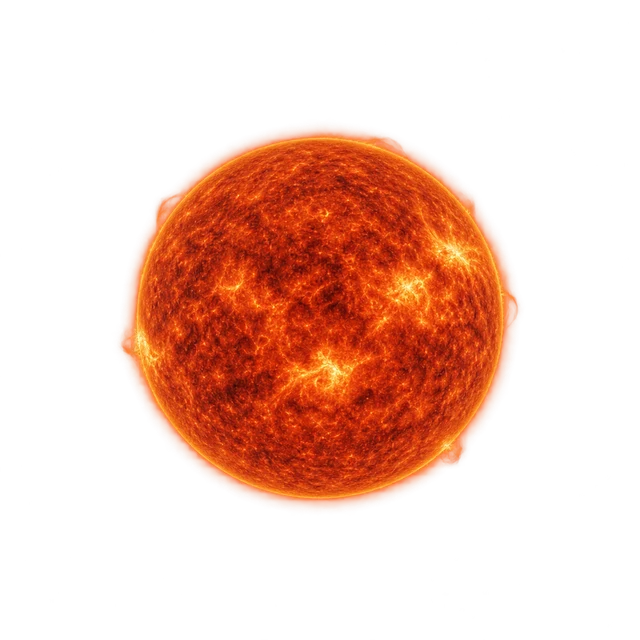
Artist’s impression. The curved luminous layers and detailed gas texture are illustrative, not a measured surface map.Across the luminous edge ↗ ARTIST’S IMPRESSION · 3 VIEWS

Diameter comparison ↗

06
0.2159 × Sol
LHS 1140

Instrument detail

Artist’s impression of LHS 1140

Artist’s impression · structure and color are illustrative.

Small stars make deeper transits.

A planet blocks a larger fraction of the light when its host star is small. Around LHS 1140, transits combine with radial velocities to constrain planetary radii and masses. Those two measurements together narrow the range of possible interiors.

A compact planetary system.

The system has the transiting planets b and c. This atlas entry links the temperate outer planet b. Its roughly 24.7-day year reflects the close-in location where a faint red dwarf can provide modest irradiation.

A slow stellar clock.

Low-mass red dwarfs consume their hydrogen slowly. Their long main-sequence lifetimes differ strongly from the short lives of massive supergiants. A long stellar lifetime alone says nothing decisive about life on an individual planet.

A star in perspective.

DIAMETER / SOL0.22 ×

About 21.6% of our Sun’s diameter.

Circles compare diameter, not mass or luminosity. Radius 0.2159 ± 0.0030 solar radii from Cadieux et al. (2024).

EFFECTIVE TEMPERATURE

Light from the outer layers.

  • LHS 1140≈ 3,096 K
  • Sol≈ 5,770 K

Shared scale: 0–10,000 K. Effective temperature describes total emitted energy per unit surface area; it is not the core temperature. Effective temperature 3,096 ± 48 K from the cited NIRPS analysis.

LIFE PHASE

A long-lived red dwarf.

  1. NOWA long-lived red dwarf
  2. PROCESSChanging internal structure
  3. OUTLOOKModel-dependent evolution

A physical sequence, not a lifetime scale or a countdown.

Research · size and temperature ↗
LIFE & HUMAN SURVIVAL / THE STAR ITSELF
POSSIBILITY FOR LIFEIncompatible with known life

The star’s hot gaseous layers cannot provide the cool, stable environment required by life as we know it. Conditions on any orbiting worlds are a separate question.

WITHOUT PROTECTIONNot survivable

No breathable air or solid ground. Extreme heat and radiation make a close encounter lethal; a meaningful survival timer depends on where you are.

NASA · stellar structure and evolution ↗

A long-lived red dwarf.

  1. NOWA long-lived red dwarf
  2. PROCESSChanging internal structure
  3. OUTLOOKModel-dependent evolution

A physical sequence, not a lifetime scale or a countdown.

Research ↗

Low-mass red dwarfs consume their hydrogen slowly. Their long main-sequence lifetimes differ strongly from the short lives of massive supergiants. A long stellar lifetime alone says nothing decisive about life on an individual planet.

How much energy leaves the star?

≈ 0.00386 × Sol

This compares total radiant power across all wavelengths, not just visible light or apparent brightness in our sky. The beams on the dashboard share a linear length scale.

The estimate combines this log’s diameter ratio (0.2159 × Sol) and effective temperature (3,096 K): luminosity scales with radius squared and temperature to the fourth power. It is derived from rounded values, not an independent luminosity measurement.

Radius 0.2159 ± 0.0030 solar radii from Cadieux et al. (2024).

Effective temperature 3,096 ± 48 K from the cited NIRPS analysis.

Swinburne University · Stefan–Boltzmann law ↗

Small stars make deeper transits.

A planet blocks a larger fraction of the light when its host star is small. Around LHS 1140, transits combine with radial velocities to constrain planetary radii and masses. Those two measurements together narrow the range of possible interiors.

A compact planetary system.

The system has the transiting planets b and c. This atlas entry links the temperate outer planet b. Its roughly 24.7-day year reflects the close-in location where a faint red dwarf can provide modest irradiation.

A slow stellar clock.

Low-mass red dwarfs consume their hydrogen slowly. Their long main-sequence lifetimes differ strongly from the short lives of massive supergiants. A long stellar lifetime alone says nothing decisive about life on an individual planet.

Artist’s impression. The curved luminous layers and detailed gas texture are illustrative, not a measured surface map.

Across the luminous edge

Artist’s impression. The curved luminous layers and detailed gas texture are illustrative, not a measured surface map.

Artist’s impression. An imagined close view; geometry, fine structure and colors are illustrative.

Structure in perspective

Artist’s impression. An imagined close view; geometry, fine structure and colors are illustrative.

Artist’s impression. The expanded field places the object in an imagined setting. Exposure and apparent scale are adjusted for clarity.

A wider view

Artist’s impression. The expanded field places the object in an imagined setting. Exposure and apparent scale are adjusted for clarity.

Stellar images are artistic interpretations, not resolved photographs of this star.