POLARIS / STELLAR DOSSIER

Polaris

446.51 light-years from Sol

Polaris Aa is a pulsating supergiant and the bright primary of a multiple-star system.

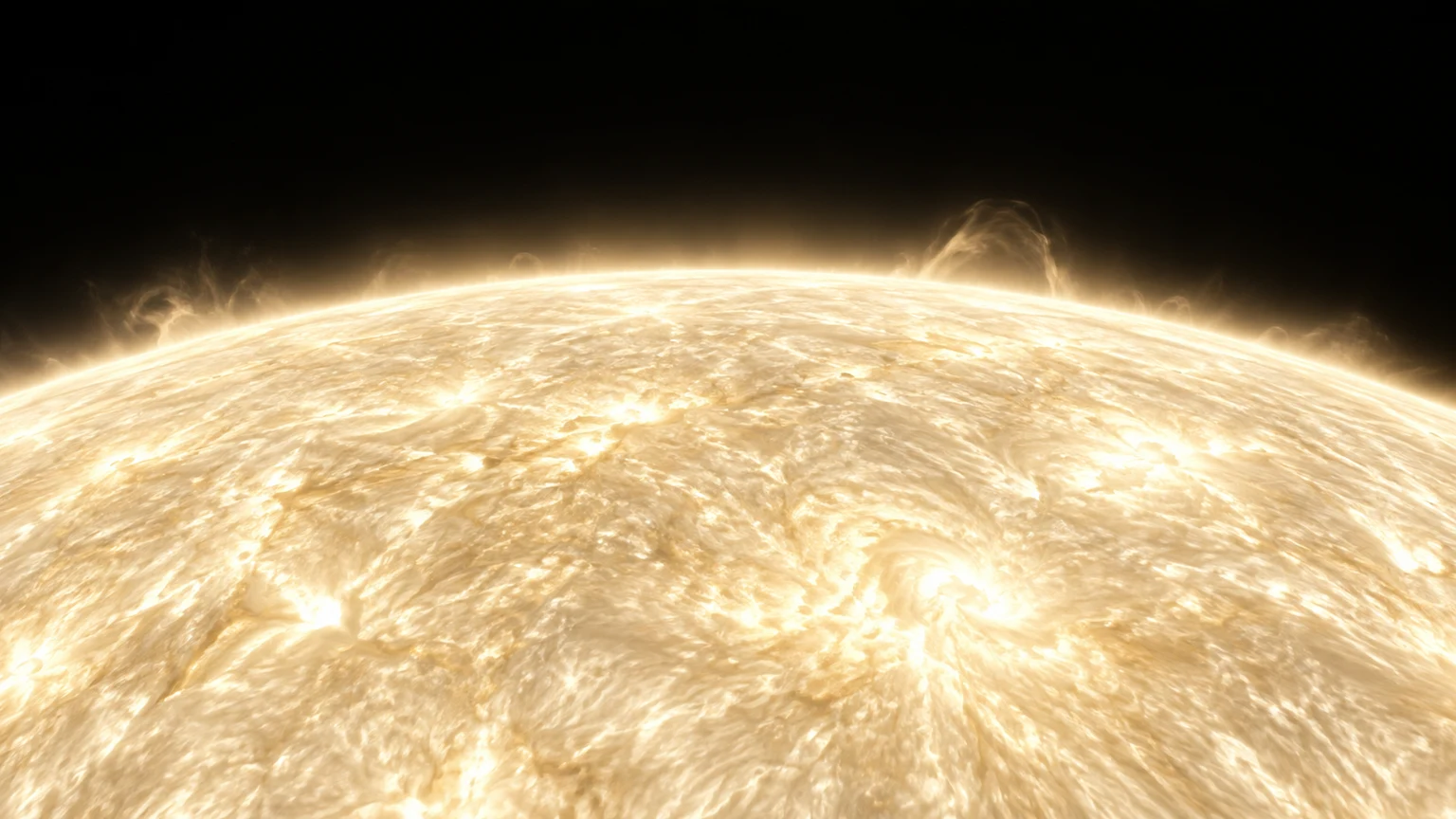
Artist’s impression of Polaris
F-type supergiant · classical Cepheid

The North Star has a changing heartbeat.

Stellar conditions ↗

02
EFFECTIVE TEMPERATURE6,015 K

Light escaping from a gaseous photosphere.

Polaris6,015 K
Sol5,770 K
Shared scale 0–10,000 K · effective, not core temperature

Evolution ↗

03
H–R MAPBRIGHTER ↑
SOLHEREHOTTERCOOLER →
CURRENT PHASE

Pulsating supergiant.

  1. NOWCepheid pulsations
  2. EVOLUTIONInstability-strip crossing
  3. QUESTIONMass–luminosity models
The precise evolutionary history remains debated. This is not a countdown.
An imagined close view of luminous gas. Texture, exposure and small arcs are illustrative.Above the pale limb ↗ ARTIST’S IMPRESSION · 3 VIEWS

Diameter comparison ↗

06
46.27 × Sol
POLARIS

Instrument detail

Artist’s impression of Polaris

Artist’s impression · structure and color are illustrative.

The bright member is Polaris Aa.

This dossier describes the Cepheid Aa. Its close companion Ab and more distant companion B belong to the same system; they are not separate entries here.

A rhythm of roughly four days.

Polaris pulsates in the first overtone. Its small brightness variations and changing pulsation history make it an unusual nearby laboratory for Cepheid physics.

Size and mass from resolved observations.

CHARA interferometry gives a mean radius of 46.27 solar radii. The combined orbit analysis yields a dynamical mass of 5.13 ± 0.28 solar masses. The distance is adopted from the wide companion Polaris B.

A representative temperature, not a fixed thermostat.

Spectroscopy from 2001–2004 gives a mean effective temperature of 6,015 K with variations of about 170 K. This historical reference is used for the comparison; a pulsating star does not have a single constant temperature.

A star in perspective.

DIAMETER / SOL46.27 ×

About 4527% wider than our Sun.

Circles compare diameter, not mass or luminosity. Mean radius 46.27 ± 0.42 solar radii, Evans et al. (2024), using the Gaia-based distance of Polaris B.

EFFECTIVE TEMPERATURE

Light escaping from a gaseous photosphere.

  • Polaris≈ 6,015 K
  • Sol≈ 5,770 K

Shared scale: 0–10,000 K. Effective temperature describes total emitted energy per unit surface area; it is not the core temperature. 6,015 K is the 2001–2004 spectroscopic mean; reported variation about 170 K, Usenko et al. (2005).

LIFE PHASE

Pulsating supergiant.

  1. NOWCepheid pulsations
  2. EVOLUTIONInstability-strip crossing
  3. QUESTIONMass–luminosity models

The precise evolutionary history remains debated. This is not a countdown.

Research · size and temperature ↗
LIFE & HUMAN SURVIVAL / THE STAR ITSELF
POSSIBILITY FOR LIFEIncompatible with known life

The star’s hot gaseous layers cannot provide the cool, stable environment required by life as we know it. Conditions on any orbiting worlds are a separate question.

WITHOUT PROTECTIONNot survivable

No breathable air or solid ground. Extreme heat and radiation make a close encounter lethal; a meaningful survival timer depends on where you are.

NASA · stellar structure and evolution ↗
10⁵1,000100.10.00110⁻⁵30,00010,0005,0002,500LUMINOSITY / SOL · BRIGHTER →HOTTER ← EFFECTIVE TEMPERATURE (K) → COOLERSUPERGIANTSGIANTSWHITE DWARFSMAIN SEQUENCESOLPolaris
Polaris6,015 K · ≈ 2,530 × Sol
Sol / reference5,770 K · 1 × Sol

Estimated from size & temperature. Both axes are logarithmic; equal steps represent equal ratios.

Small points are other worlds in this atlas. The soft band marks the main sequence; region labels are broad guides, not a path through time.

Pulsating supergiant.

  1. NOWCepheid pulsations
  2. EVOLUTIONInstability-strip crossing
  3. QUESTIONMass–luminosity models

The precise evolutionary history remains debated. This is not a countdown.

Research ↗

How much energy leaves the star?

≈ 2,530 × Sol

This compares total radiant power across all wavelengths, not just visible light or apparent brightness in our sky. The beams on the dashboard share a linear length scale.

The estimate combines this log’s diameter ratio (46.27 × Sol) and effective temperature (6,015 K): luminosity scales with radius squared and temperature to the fourth power. It is derived from rounded values, not an independent luminosity measurement.

Mean radius 46.27 ± 0.42 solar radii, Evans et al. (2024), using the Gaia-based distance of Polaris B.

6,015 K is the 2001–2004 spectroscopic mean; reported variation about 170 K, Usenko et al. (2005).

Swinburne University · Stefan–Boltzmann law ↗

The bright member is Polaris Aa.

This dossier describes the Cepheid Aa. Its close companion Ab and more distant companion B belong to the same system; they are not separate entries here.

A rhythm of roughly four days.

Polaris pulsates in the first overtone. Its small brightness variations and changing pulsation history make it an unusual nearby laboratory for Cepheid physics.

Size and mass from resolved observations.

CHARA interferometry gives a mean radius of 46.27 solar radii. The combined orbit analysis yields a dynamical mass of 5.13 ± 0.28 solar masses. The distance is adopted from the wide companion Polaris B.

A representative temperature, not a fixed thermostat.

Spectroscopy from 2001–2004 gives a mean effective temperature of 6,015 K with variations of about 170 K. This historical reference is used for the comparison; a pulsating star does not have a single constant temperature.

An imagined close view of luminous gas. Texture, exposure and small arcs are illustrative.

Above the pale limb

An imagined close view of luminous gas. Texture, exposure and small arcs are illustrative.

Invented brightness patches evoke a nonuniform photosphere; they do not reproduce a CHARA image or measured spot map.

Uneven light

Invented brightness patches evoke a nonuniform photosphere; they do not reproduce a CHARA image or measured spot map.

A conceptual view of Polaris Aa with a faint companion. Angular separation and brightness contrast are artistic choices; the whole triple system is not shown.

A companion in the distance

A conceptual view of Polaris Aa with a faint companion. Angular separation and brightness contrast are artistic choices; the whole triple system is not shown.

Stellar images are artistic interpretations, not resolved photographs of this star.