PROCYON / STELLAR DOSSIER

Procyon B

11.46 light-years from Sol

A compact stellar remnant, slightly wider than Earth and hotter than its bright companion.

Artist’s impression of Procyon B
DQZ · white dwarf

A quiet glow after the giant years.

Stellar conditions ↗

02
EFFECTIVE TEMPERATURE7,740 K

Small, faint, and still hot.

Procyon B7,740 K
Sol5,770 K
Shared scale 0–10,000 K · effective, not core temperature

Evolution ↗

03
H–R MAPBRIGHTER ↑
SOLHEREHOTTERCOOLER →
CURRENT PHASE

The cooling remnant.

  1. NOWWhite dwarf
  2. ENERGYStored heat
  3. OUTLOOKGradual cooling
Core hydrogen fusion has ended. Cooling age and total stellar age are different quantities.

Stellar family

04
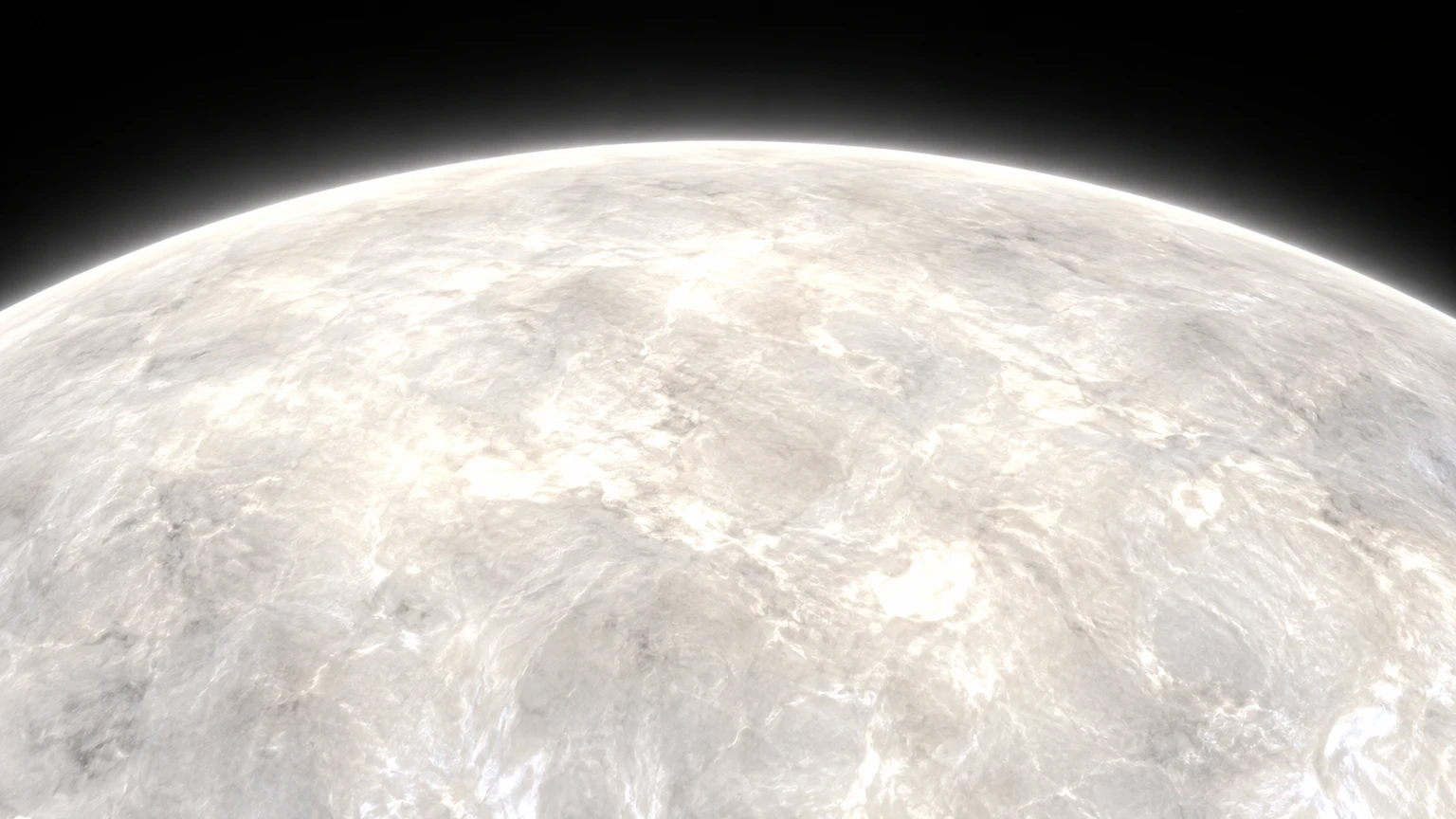
An imagined close view of Procyon B’s helium-rich photosphere. Subtle mottling and apparent brightness are artistic choices, not mapped features. The white glow is hot gas, not ice or solid rock.Above the remnant’s glow ↗ ARTIST’S IMPRESSION · 3 VIEWS

Diameter comparison ↗

06
1.345 × Earth
PROCYON B

Instrument detail

Artist’s impression of Procyon B

Artist’s impression · structure and color are illustrative.

What survives a star’s transformation.

A white dwarf remains after a star sheds its outer layers. Its compact body retains heat from the earlier stages and radiates that energy away. Procyon B is in this cooling chapter. The clean white horizon in our scene is a way to approach that idea visually, not an Earth-like surface waiting beneath a thin atmosphere.

A planet-sized body with stellar weight.

White dwarfs place an enormous amount of matter into a small volume. Their familiar-looking scale is misleading: a body comparable in size to Earth can still contain a substantial fraction of a star’s mass. The diameter graphic and mass readout describe different properties. Together they explain why a small illustration must never be mistaken for a mild destination.

A different atmosphere from Sirius B.

Procyon B has a helium-dominated atmosphere, with carbon and heavier elements visible in its spectrum. That differs from the hydrogen-rich outer gas of Sirius B. The source of its heavier elements remains uncertain. The atmospheric profile therefore reports spectral clues without inventing a detailed chemical recipe.

Cooling is only part of its age.

A white dwarf’s cooling age counts the time since it entered its remnant phase. Its earlier life as a fusion-powered star must be added to estimate a total age. Models depend on interior composition and the layers that regulate escaping heat. Procyon’s two stars offer complementary clues to that history, but not a single clock whose reading is independent of assumptions.

A star in perspective.

DIAMETER / EARTH1.35 ×

About 135% of Earth’s diameter.

Circles compare diameter, not mass or luminosity. Radius: 0.01232 ± 0.00032 solar radii, Bond et al. (2015). Earth comparison uses mean radii of 6,371 km and 695,700 km for Sol.

MASS / SOL
0.592 ×
WHAT THAT MEANS
About 59% of Sol’s mass in a body only about 1.35 times Earth’s diameter.
EFFECTIVE TEMPERATURE

Small, faint, and still hot.

  • Procyon B≈ 7,740 K
  • Sol≈ 5,770 K

Shared scale: 0–10,000 K. Effective temperature describes total emitted energy per unit surface area; it is not the core temperature. Effective temperature: 7,740 ± 50 K. Faintness does not imply a lower temperature than Procyon A.

LIFE PHASE

The cooling remnant.

  1. NOWWhite dwarf
  2. ENERGYStored heat
  3. OUTLOOKGradual cooling

Core hydrogen fusion has ended. Cooling age and total stellar age are different quantities.

Research · size and temperature ↗
ATMOSPHERE / SPECTRAL EVIDENCE

Helium with spectral traces.

ATMOSPHERE
Helium-dominated
SPECTRAL FEATURES
Carbon and heavier elements

DQZ describes spectral evidence, not percentages. A carbon–oxygen core is an interior model, distinct from the visible gas.

Research · atmospheric spectrum ↗
LIFE & HUMAN SURVIVAL / THE STAR ITSELF
POSSIBILITY FOR LIFEIncompatible with known life

The star’s hot gaseous layers cannot provide the cool, stable environment required by life as we know it. Conditions on any orbiting worlds are a separate question.

WITHOUT PROTECTIONNot survivable

No breathable air or solid ground. Extreme heat and radiation make a close encounter lethal; a meaningful survival timer depends on where you are.

NASA · stellar structure and evolution ↗
10⁵1,000100.10.00110⁻⁵30,00010,0005,0002,500LUMINOSITY / SOL · BRIGHTER →HOTTER ← EFFECTIVE TEMPERATURE (K) → COOLERSUPERGIANTSGIANTSWHITE DWARFSMAIN SEQUENCESOLProcyon B
Procyon B7,740 K · ≈ 0.000491 × Sol
Sol / reference5,770 K · 1 × Sol

Estimated from size & temperature. Both axes are logarithmic; equal steps represent equal ratios.

Small points are other worlds in this atlas. The soft band marks the main sequence; region labels are broad guides, not a path through time.

The cooling remnant.

  1. NOWWhite dwarf
  2. ENERGYStored heat
  3. OUTLOOKGradual cooling

Core hydrogen fusion has ended. Cooling age and total stellar age are different quantities.

Research ↗

A white dwarf remains after a star sheds its outer layers. Its compact body retains heat from the earlier stages and radiates that energy away. Procyon B is in this cooling chapter. The clean white horizon in our scene is a way to approach that idea visually, not an Earth-like surface waiting beneath a thin atmosphere.

How much energy leaves the star?

≈ 0.000491 × Sol

This compares total radiant power across all wavelengths, not just visible light or apparent brightness in our sky. The beams on the dashboard share a linear length scale.

The estimate combines this log’s diameter ratio (0.01232 × Sol) and effective temperature (7,740 K): luminosity scales with radius squared and temperature to the fourth power. It is derived from rounded values, not an independent luminosity measurement.

Radius: 0.01232 ± 0.00032 solar radii, Bond et al. (2015). Earth comparison uses mean radii of 6,371 km and 695,700 km for Sol.

Effective temperature: 7,740 ± 50 K. Faintness does not imply a lower temperature than Procyon A.

Swinburne University · Stefan–Boltzmann law ↗

What survives a star’s transformation.

A white dwarf remains after a star sheds its outer layers. Its compact body retains heat from the earlier stages and radiates that energy away. Procyon B is in this cooling chapter. The clean white horizon in our scene is a way to approach that idea visually, not an Earth-like surface waiting beneath a thin atmosphere.

A planet-sized body with stellar weight.

White dwarfs place an enormous amount of matter into a small volume. Their familiar-looking scale is misleading: a body comparable in size to Earth can still contain a substantial fraction of a star’s mass. The diameter graphic and mass readout describe different properties. Together they explain why a small illustration must never be mistaken for a mild destination.

A different atmosphere from Sirius B.

Procyon B has a helium-dominated atmosphere, with carbon and heavier elements visible in its spectrum. That differs from the hydrogen-rich outer gas of Sirius B. The source of its heavier elements remains uncertain. The atmospheric profile therefore reports spectral clues without inventing a detailed chemical recipe.

Cooling is only part of its age.

A white dwarf’s cooling age counts the time since it entered its remnant phase. Its earlier life as a fusion-powered star must be added to estimate a total age. Models depend on interior composition and the layers that regulate escaping heat. Procyon’s two stars offer complementary clues to that history, but not a single clock whose reading is independent of assumptions.

An imagined close view of Procyon B’s helium-rich photosphere. Subtle mottling and apparent brightness are artistic choices, not mapped features. The white glow is hot gas, not ice or solid rock.

Above the remnant’s glow

An imagined close view of Procyon B’s helium-rich photosphere. Subtle mottling and apparent brightness are artistic choices, not mapped features. The white glow is hot gas, not ice or solid rock.

A hypothetical view along the white dwarf’s curved limb. Exposure is compressed to show delicate structure. No surface geography or exposed carbon–oxygen core is represented.

A compact edge in the dark

A hypothetical view along the white dwarf’s curved limb. Exposure is compressed to show delicate structure. No surface geography or exposed carbon–oxygen core is represented.

An artistic view of Procyon B against space. The luminous disk and fine gaseous texture are illustrative; color and exposure are adjusted for visibility, not a resolved stellar photograph.

The star against space

An artistic view of Procyon B against space. The luminous disk and fine gaseous texture are illustrative; color and exposure are adjusted for visibility, not a resolved stellar photograph.

Stellar images are artistic interpretations, not resolved photographs of this star.