SOL SYSTEM / STELLAR DOSSIER

Sol

Our Solar System

A changing sea of plasma, powering the worlds around it.

Stellar conditions ↗

02
EFFECTIVE TEMPERATURE5,770 K

Our stellar reference.

Sol5,770 K
Shared scale 0–10,000 K · effective, not core temperature

Evolution ↗

03
H–R MAPBRIGHTER ↑
SOLHOTTERCOOLER →
CURRENT PHASE

Main sequence.

  1. NOWHydrogen fusion
  2. LATERRed giant
  3. REMNANTWhite dwarf
A broad evolutionary sequence, not a time scale or a countdown.
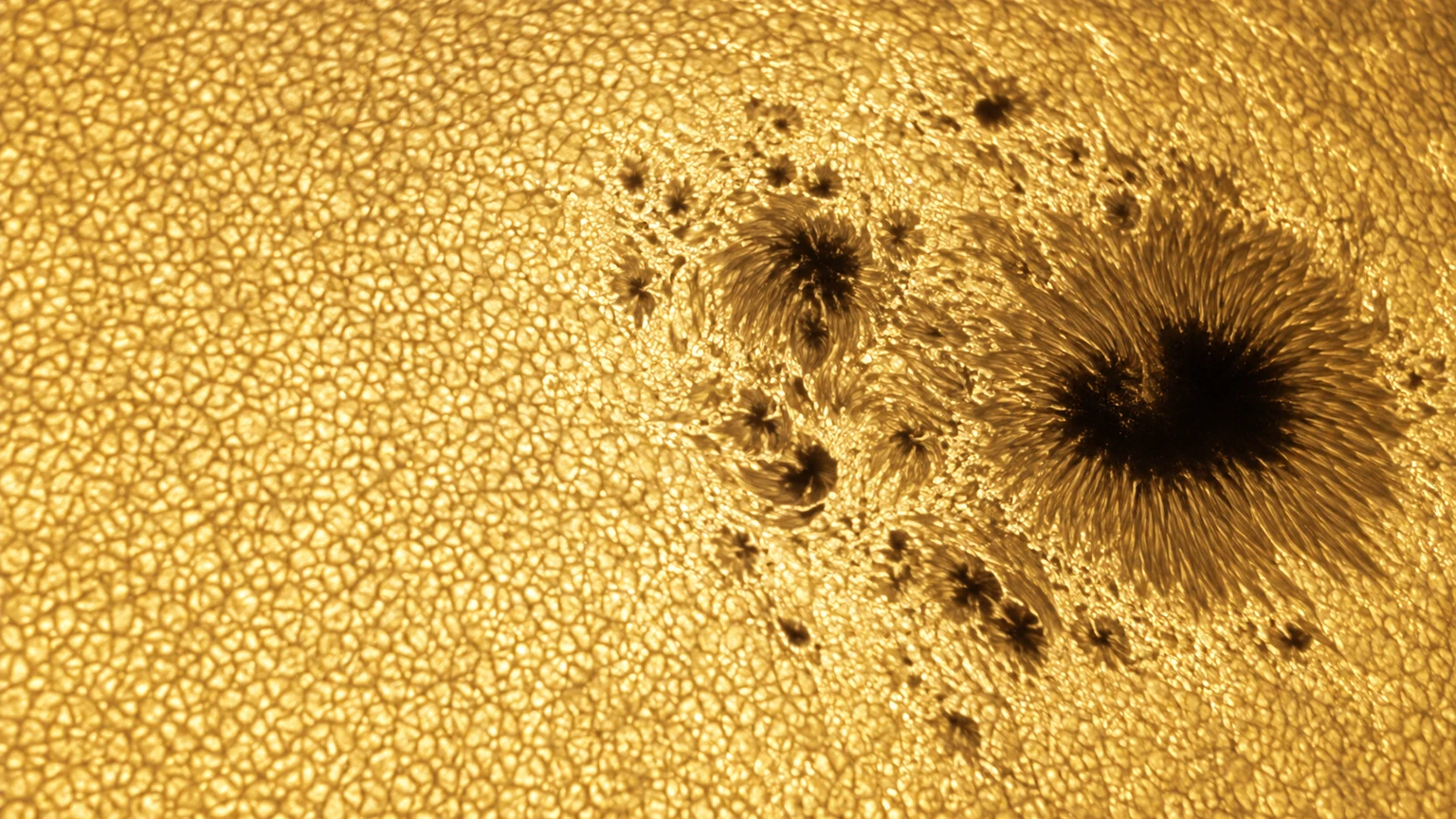
Artist’s reconstruction of photospheric granulation and sunspots. Warm tones are illustrative; this is neither bare-eye appearance nor a solid landscape.The visible furnace ↗ ARTIST’S IMPRESSION · 3 VIEWS

Diameter comparison ↗

06
109.3 × Earth
SOL

Instrument detail

Artist’s impression of Sol

Artist’s impression · structure and color are illustrative.

Light begins deep inside.

Fusion in the core converts hydrogen into helium and releases energy. That energy works its way outward before escaping as sunlight. The bright disk is the visible end of a process taking place far below it.

A surface you cannot stand on.

The photosphere is the layer from which most visible sunlight escapes. Granules trace rising and sinking material; darker sunspots mark cooler magnetic regions. It looks like a surface, but there is no solid ground beneath your feet.

Arches written by magnetic fields.

Above the photosphere, magnetic fields shape prominences and other plasma structures. The corona can reach temperatures far above those of the visible disk. Brightness, density and temperature do not simply rise together as you move inward.

Our system moves with its star.

The solar wind carries particles outward into the heliosphere. Meanwhile, Sol and its family orbit the Milky Way. Our local center is itself a traveler, moving through a much larger galactic neighborhood.

Our star in perspective.

DIAMETER / EARTH109.30 ×

Sol is about 109.30 times Earth’s width.

Circles show relative diameter, not mass or volume. mean diameters; Earth reference 12,742 km. Rings excluded.

PHOTOSPHERE / ELEMENTS BY MASS

Hydrogen, helium and plasma

  • H Hydrogen≈ 73.46%
  • He Helium≈ 24.85%

Approximate photospheric elemental abundances by mass, not atmospheric volume fractions. Small heavier-element contributions are omitted. Ionization changes with depth and temperature.

NASA · physical data and atmospheric constraints ↗
POSSIBILITY FOR LIFE

Could anything call this home?

Assessment for life as we know it. These labels describe evidence and conditions, not a probability score.

NATURAL CONDITIONSHostile to known life

No known organism could inhabit the Sun. Its energy supports life on Earth at a very different distance and temperature.

HUMANS / WITHOUT PROTECTIONNo

Intense heat and radiation make unprotected survival impossible. There is no solid surface or breathable air.

TEMPERATURE
≈ 5,500°C photosphere
PRESSURE
Strongly depth-dependent
WATER
No liquid-water habitat
TERRAIN
Plasma · no solid ground
NASA · background for this assessment ↗
10⁵1,000100.10.00110⁻⁵30,00010,0005,0002,500LUMINOSITY / SOL · BRIGHTER →HOTTER ← EFFECTIVE TEMPERATURE (K) → COOLERSUPERGIANTSGIANTSWHITE DWARFSMAIN SEQUENCESol
Sol5,770 K · ≈ 1 × Sol

Estimated from size & temperature. Both axes are logarithmic; equal steps represent equal ratios.

Small points are other worlds in this atlas. The soft band marks the main sequence; region labels are broad guides, not a path through time.

Main sequence.

  1. NOWHydrogen fusion
  2. LATERRed giant
  3. REMNANTWhite dwarf

A broad evolutionary sequence, not a time scale or a countdown.

Research ↗

How much energy leaves the star?

≈ 1 × Sol

This compares total radiant power across all wavelengths, not just visible light or apparent brightness in our sky. The beams on the dashboard share a linear length scale.

The estimate combines this log’s diameter ratio (1 × Sol) and effective temperature (5,770 K): luminosity scales with radius squared and temperature to the fourth power. It is derived from rounded values, not an independent luminosity measurement.

Sol defines one solar diameter in this comparison.

Rounded effective temperature used as the reference throughout these stellar comparisons.

Swinburne University · Stefan–Boltzmann law ↗

Light begins deep inside.

Fusion in the core converts hydrogen into helium and releases energy. That energy works its way outward before escaping as sunlight. The bright disk is the visible end of a process taking place far below it.

A surface you cannot stand on.

The photosphere is the layer from which most visible sunlight escapes. Granules trace rising and sinking material; darker sunspots mark cooler magnetic regions. It looks like a surface, but there is no solid ground beneath your feet.

Arches written by magnetic fields.

Above the photosphere, magnetic fields shape prominences and other plasma structures. The corona can reach temperatures far above those of the visible disk. Brightness, density and temperature do not simply rise together as you move inward.

Our system moves with its star.

The solar wind carries particles outward into the heliosphere. Meanwhile, Sol and its family orbit the Milky Way. Our local center is itself a traveler, moving through a much larger galactic neighborhood.

Artist’s reconstruction of photospheric granulation and sunspots. Warm tones are illustrative; this is neither bare-eye appearance nor a solid landscape.

The visible furnace

Artist’s reconstruction of photospheric granulation and sunspots. Warm tones are illustrative; this is neither bare-eye appearance nor a solid landscape.

An imagined solar prominence seen beyond the limb. Red-orange tones evoke narrowband solar imagery; structure and viewpoint are illustrative.

Above the limb

An imagined solar prominence seen beyond the limb. Red-orange tones evoke narrowband solar imagery; structure and viewpoint are illustrative.

An artistic view of Sol against space. The luminous disk and fine gaseous texture are illustrative; color and exposure are adjusted for visibility, not a resolved stellar photograph.

A whole star in view

An artistic view of Sol against space. The luminous disk and fine gaseous texture are illustrative; color and exposure are adjusted for visibility, not a resolved stellar photograph.

Stellar images are artistic interpretations, not resolved photographs of this star.