TAU CETI / STELLAR DOSSIER

Tau Ceti

11.91 light-years from Sol

A smaller, cooler sun seen almost pole-on, surrounded by a broad belt of cold debris.

Artist’s impression of Tau Ceti
G8 V · main sequence

A familiar glow with a different perspective.

Stellar conditions ↗

02
EFFECTIVE TEMPERATURE5,320 K

A slightly cooler kind of sunlight.

Tau Ceti5,320 K
Sol5,770 K
Shared scale 0–10,000 K · effective, not core temperature

Evolution ↗

03
CURRENT PHASE

The long hydrogen-fusing chapter.

  1. NOWHydrogen fusion
  2. LATERGiant phase
  3. REMNANTWhite dwarf
An evolutionary sequence, not a time scale or an estimate of remaining lifetime.
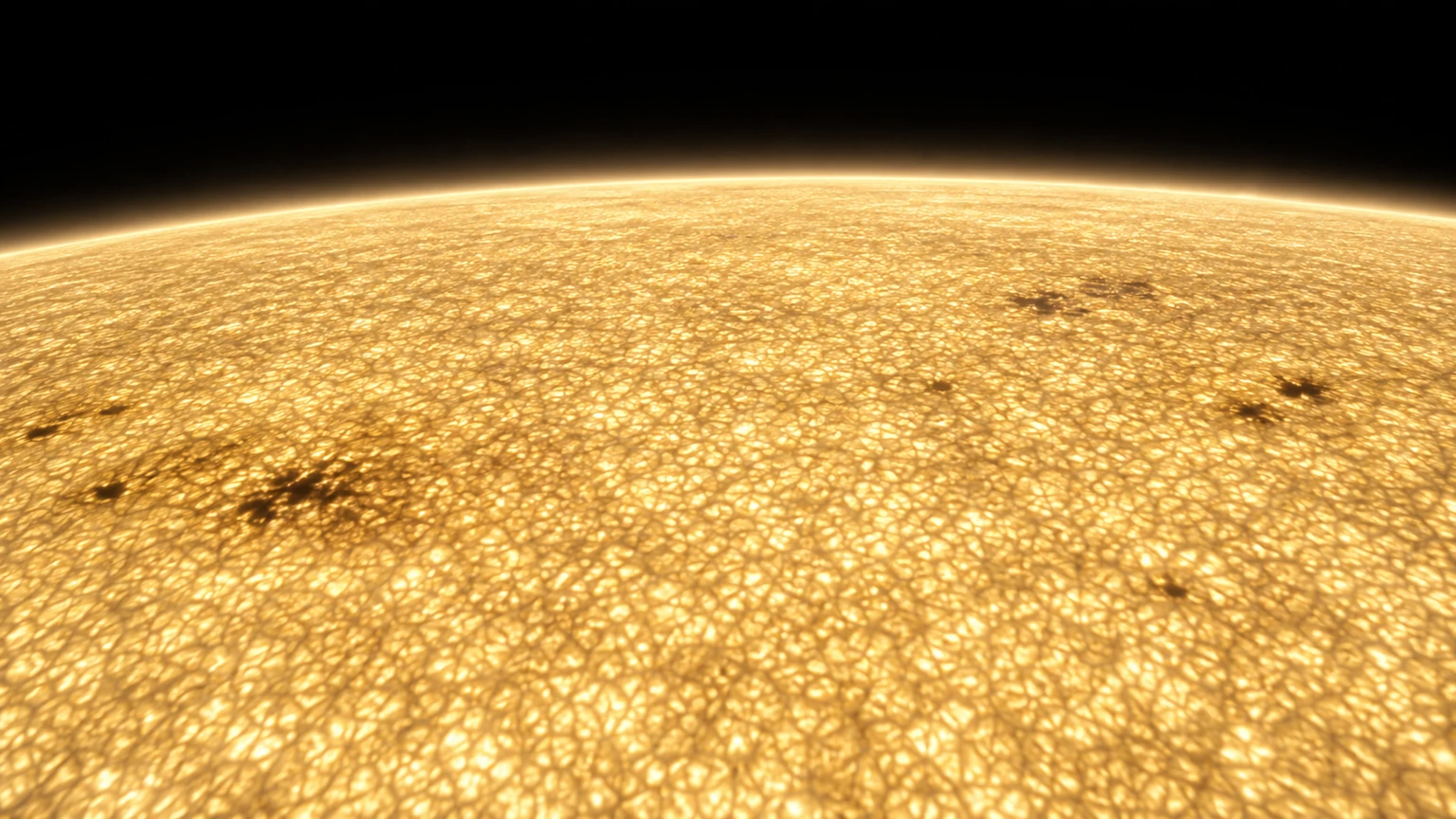
An imagined approach to Tau Ceti’s photosphere. Fine granules and darker magnetic patches borrow from solar observations, not a resolved map of this star. Warm filtered color and reduced exposure reveal the luminous gas.Across a quieter golden horizon ↗ ARTIST’S IMPRESSION · 3 VIEWS

Diameter comparison ↗

06
0.793 × Sol
TAU CETI

Instrument detail

Artist’s impression of Tau Ceti

Artist’s impression · structure and color are illustrative.

Familiar, but not a solar copy.

Tau Ceti spans about four fifths of Sol’s diameter and has a lower effective temperature. Astronomers measured its tiny apparent disk using interferometry, then combined that angle with distance to determine its size. The comparison above reflects those measurements. The granular panorama supplies an imagined viewpoint that present observations cannot resolve.

Light escaping from moving gas.

Hydrogen fusion powers a main-sequence star from deep within. Energy works its way outward until light can escape through the photosphere. The bright cells in our reconstruction represent convection: hotter material rising and cooler material sinking. They may resemble a textured landscape, but there is no crust beneath them, no breathable air and nowhere to land.

Looking almost down the spin axis.

A 2023 study inferred that we view Tau Ceti nearly pole-on. The researchers combined its radius, an estimated rotation period of about 46 days and the rotational broadening of its spectral lines. The inferred angle has substantial uncertainty. It describes our viewing geometry, not a photographed pole or a map of magnetic features.

Cold dust beyond the stellar glare.

ALMA detected millimeter emission from a broad, nearly face-on belt of cold dust around Tau Ceti. Its observations favor an extended belt rather than a narrow ring, although the edges remain uncertain. This faint material tells a different story from the brilliant photosphere: the system extends well beyond the luminous object that first catches our eye.

A star in perspective.

DIAMETER / SOL0.79 ×

About 79.3% of our Sun’s diameter.

Circles compare diameter, not mass or luminosity. Interferometric radius: 0.793 ± 0.004 solar radii, Korolik et al. (2023). Diameter has the same relative ratio.

EFFECTIVE TEMPERATURE

A slightly cooler kind of sunlight.

  • Tau Ceti≈ 5,320 K
  • Sol≈ 5,770 K

Shared scale: 0–10,000 K. Effective temperature describes total emitted energy per unit surface area; it is not the core temperature. Spectroscopic effective temperature: 5,320 ± 40 K from the same study.

LIFE PHASE

The long hydrogen-fusing chapter.

  1. NOWHydrogen fusion
  2. LATERGiant phase
  3. REMNANTWhite dwarf

An evolutionary sequence, not a time scale or an estimate of remaining lifetime.

Research · size and temperature ↗
LIFE & HUMAN SURVIVAL / THE STAR ITSELF
POSSIBILITY FOR LIFEIncompatible with known life

The star’s hot gaseous layers cannot provide the cool, stable environment required by life as we know it. Conditions on any orbiting worlds are a separate question.

WITHOUT PROTECTIONNot survivable

No breathable air or solid ground. Extreme heat and radiation make a close encounter lethal; a meaningful survival timer depends on where you are.

NASA · stellar structure and evolution ↗

The long hydrogen-fusing chapter.

  1. NOWHydrogen fusion
  2. LATERGiant phase
  3. REMNANTWhite dwarf

An evolutionary sequence, not a time scale or an estimate of remaining lifetime.

Research ↗

How much energy leaves the star?

≈ 0.454 × Sol

This compares total radiant power across all wavelengths, not just visible light or apparent brightness in our sky. The beams on the dashboard share a linear length scale.

The estimate combines this log’s diameter ratio (0.793 × Sol) and effective temperature (5,320 K): luminosity scales with radius squared and temperature to the fourth power. It is derived from rounded values, not an independent luminosity measurement.

Interferometric radius: 0.793 ± 0.004 solar radii, Korolik et al. (2023). Diameter has the same relative ratio.

Spectroscopic effective temperature: 5,320 ± 40 K from the same study.

Swinburne University · Stefan–Boltzmann law ↗

Familiar, but not a solar copy.

Tau Ceti spans about four fifths of Sol’s diameter and has a lower effective temperature. Astronomers measured its tiny apparent disk using interferometry, then combined that angle with distance to determine its size. The comparison above reflects those measurements. The granular panorama supplies an imagined viewpoint that present observations cannot resolve.

Light escaping from moving gas.

Hydrogen fusion powers a main-sequence star from deep within. Energy works its way outward until light can escape through the photosphere. The bright cells in our reconstruction represent convection: hotter material rising and cooler material sinking. They may resemble a textured landscape, but there is no crust beneath them, no breathable air and nowhere to land.

Looking almost down the spin axis.

A 2023 study inferred that we view Tau Ceti nearly pole-on. The researchers combined its radius, an estimated rotation period of about 46 days and the rotational broadening of its spectral lines. The inferred angle has substantial uncertainty. It describes our viewing geometry, not a photographed pole or a map of magnetic features.

Cold dust beyond the stellar glare.

ALMA detected millimeter emission from a broad, nearly face-on belt of cold dust around Tau Ceti. Its observations favor an extended belt rather than a narrow ring, although the edges remain uncertain. This faint material tells a different story from the brilliant photosphere: the system extends well beyond the luminous object that first catches our eye.

An imagined approach to Tau Ceti’s photosphere. Fine granules and darker magnetic patches borrow from solar observations, not a resolved map of this star. Warm filtered color and reduced exposure reveal the luminous gas.

Across a quieter golden horizon

An imagined approach to Tau Ceti’s photosphere. Fine granules and darker magnetic patches borrow from solar observations, not a resolved map of this star. Warm filtered color and reduced exposure reveal the luminous gas.

A hypothetical close view of the stellar limb. Small plasma structures and their locations are artistic interpretations, not a recorded event. The bright edge marks gaseous layers, not solid terrain.

Along the edge of another sun

A hypothetical close view of the stellar limb. Small plasma structures and their locations are artistic interpretations, not a recorded event. The bright edge marks gaseous layers, not solid terrain.

An artistic view of Tau Ceti against space. The luminous disk and fine gaseous texture are illustrative; color and exposure are adjusted for visibility, not a resolved stellar photograph. The surrounding debris belt is schematic; distances and particle sizes are not to scale.

The star against space

An artistic view of Tau Ceti against space. The luminous disk and fine gaseous texture are illustrative; color and exposure are adjusted for visibility, not a resolved stellar photograph. The surrounding debris belt is schematic; distances and particle sizes are not to scale.

Stellar images are artistic interpretations, not resolved photographs of this star.