TEEGARDEN’S STAR / STELLAR DOSSIER

Teegarden’s Star

12.50 light-years from Sol

A faint red dwarf with close companions and a planetary rhythm measured in days.

Artist’s impression of Teegarden’s Star
M7 V · red dwarf

A tiny sun, almost hidden next door.

Stellar conditions ↗

02
EFFECTIVE TEMPERATURE3,034 K

Cooler than Sol, still incandescent.

Teegarden’s Star3,034 K
Sol5,770 K
Shared scale 0–10,000 K · effective, not core temperature

Evolution ↗

03
CURRENT PHASE

A long-lived main sequence.

  1. NOWHydrogen fusion
  2. INTERIORDeep convection
  3. OUTLOOKSlow fuel consumption
A broad low-mass stellar evolution sequence, not an age estimate or a countdown.
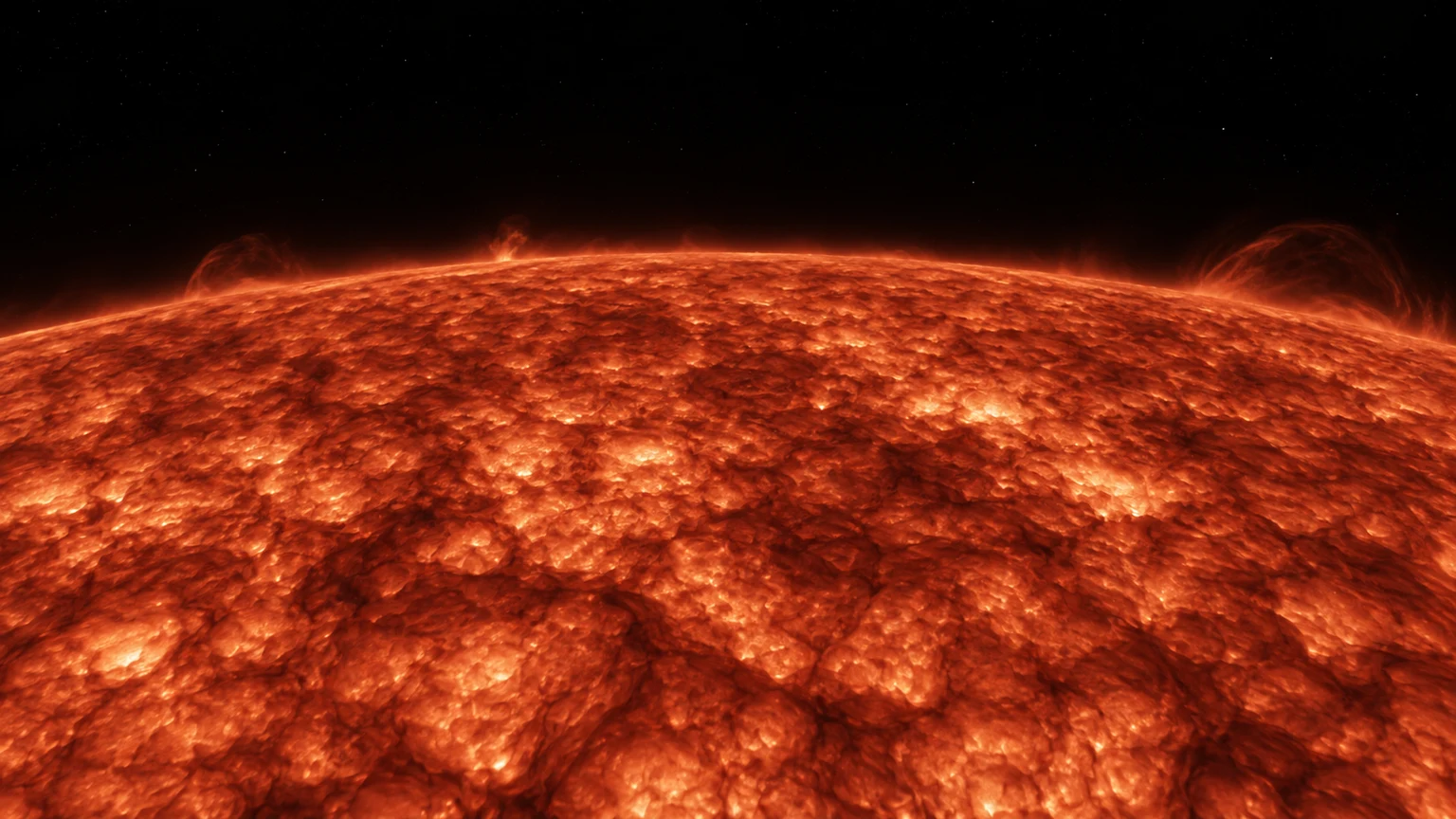
An imagined oblique view of the gaseous photosphere. Granulation, color and exposure are illustrative, not a resolved map of this star.Above the glowing horizon ↗ ARTIST’S IMPRESSION · 3 VIEWS

Diameter comparison ↗

06
0.12 × Sol
TEEGARDEN’S STAR

Instrument detail

Artist’s impression of Teegarden’s Star

Artist’s impression · structure and color are illustrative.

Near does not mean bright.

Teegarden’s Star is only about twelve and a half light-years away, yet its small size and low temperature make it faint. The adopted radius is about twelve percent of Sol’s. These warm-toned images compress the enormous brightness range of glowing gas; their color is a visual interpretation rather than a naked-eye view.

A family found in shifting starlight.

The updated study describes three planets: b, c and d, with periods of about 4.9, 11.4 and 26.1 days. Repeated changes in the star’s radial velocity reveal their pull. This console links to b, the innermost of the known trio; the link list is a selection of featured worlds, not a claim that the star has only one planet.

A small star gives a measurable response.

A planet and star both move around their shared center of mass. Spectrographs look for the accompanying changes in wavelength. The recurring pattern can reveal an orbit even when the planet itself is lost in stellar glare. An illustrated stellar disk therefore serves a different purpose from the observations that establish its companions.

A patient source of light.

Hydrogen fusion sustains this main-sequence red dwarf. Low-mass stars consume fuel slowly and can keep shining for exceptionally long spans. The evolution tile describes that general behavior. It should not be read as a precise prediction of the star’s remaining lifetime, and the three plasma scenes are not successive stages of its evolution.

A star in perspective.

DIAMETER / SOL0.120 ×

About 12.0% of our Sun’s diameter.

Circles compare diameter, not mass or luminosity. Adopted radius 0.120 ± 0.012 solar radii, Dreizler et al. (2024). Radius and diameter share the same ratio.

EFFECTIVE TEMPERATURE

Cooler than Sol, still incandescent.

  • Teegarden’s Star≈ 3,034 K
  • Sol≈ 5,770 K

Shared scale: 0–10,000 K. Effective temperature describes total emitted energy per unit surface area; it is not the core temperature. Effective temperature 3,034 ± 45 K, Dreizler et al. (2024); not a core temperature.

LIFE PHASE

A long-lived main sequence.

  1. NOWHydrogen fusion
  2. INTERIORDeep convection
  3. OUTLOOKSlow fuel consumption

A broad low-mass stellar evolution sequence, not an age estimate or a countdown.

Research · size and temperature ↗
LIFE & HUMAN SURVIVAL / THE STAR ITSELF
POSSIBILITY FOR LIFEIncompatible with known life

The star’s hot gaseous layers cannot provide the cool, stable environment required by life as we know it. Conditions on any orbiting worlds are a separate question.

WITHOUT PROTECTIONNot survivable

No breathable air or solid ground. Extreme heat and radiation make a close encounter lethal; a meaningful survival timer depends on where you are.

NASA · stellar structure and evolution ↗

A long-lived main sequence.

  1. NOWHydrogen fusion
  2. INTERIORDeep convection
  3. OUTLOOKSlow fuel consumption

A broad low-mass stellar evolution sequence, not an age estimate or a countdown.

Research ↗

Hydrogen fusion sustains this main-sequence red dwarf. Low-mass stars consume fuel slowly and can keep shining for exceptionally long spans. The evolution tile describes that general behavior. It should not be read as a precise prediction of the star’s remaining lifetime, and the three plasma scenes are not successive stages of its evolution.

How much energy leaves the star?

≈ 0.0011 × Sol

This compares total radiant power across all wavelengths, not just visible light or apparent brightness in our sky. The beams on the dashboard share a linear length scale.

The estimate combines this log’s diameter ratio (0.12 × Sol) and effective temperature (3,034 K): luminosity scales with radius squared and temperature to the fourth power. It is derived from rounded values, not an independent luminosity measurement.

Adopted radius 0.120 ± 0.012 solar radii, Dreizler et al. (2024). Radius and diameter share the same ratio.

Effective temperature 3,034 ± 45 K, Dreizler et al. (2024); not a core temperature.

Swinburne University · Stefan–Boltzmann law ↗

Near does not mean bright.

Teegarden’s Star is only about twelve and a half light-years away, yet its small size and low temperature make it faint. The adopted radius is about twelve percent of Sol’s. These warm-toned images compress the enormous brightness range of glowing gas; their color is a visual interpretation rather than a naked-eye view.

A family found in shifting starlight.

The updated study describes three planets: b, c and d, with periods of about 4.9, 11.4 and 26.1 days. Repeated changes in the star’s radial velocity reveal their pull. This console links to b, the innermost of the known trio; the link list is a selection of featured worlds, not a claim that the star has only one planet.

A small star gives a measurable response.

A planet and star both move around their shared center of mass. Spectrographs look for the accompanying changes in wavelength. The recurring pattern can reveal an orbit even when the planet itself is lost in stellar glare. An illustrated stellar disk therefore serves a different purpose from the observations that establish its companions.

A patient source of light.

Hydrogen fusion sustains this main-sequence red dwarf. Low-mass stars consume fuel slowly and can keep shining for exceptionally long spans. The evolution tile describes that general behavior. It should not be read as a precise prediction of the star’s remaining lifetime, and the three plasma scenes are not successive stages of its evolution.

An imagined oblique view of the gaseous photosphere. Granulation, color and exposure are illustrative, not a resolved map of this star.

Above the glowing horizon

An imagined oblique view of the gaseous photosphere. Granulation, color and exposure are illustrative, not a resolved map of this star.

A hypothetical cooler magnetic patch surrounded by luminous convection. The pattern is invented; dark regions are plasma, not solid ground.

Inside a magnetic region

A hypothetical cooler magnetic patch surrounded by luminous convection. The pattern is invented; dark regions are plasma, not solid ground.

An imagined prominence above the stellar limb. Its shape and brightness do not reconstruct an observed flare; filtered colors reveal a possible plasma structure.

An arch beyond the limb

An imagined prominence above the stellar limb. Its shape and brightness do not reconstruct an observed flare; filtered colors reveal a possible plasma structure.

Stellar images are artistic interpretations, not resolved photographs of this star.