TRAPPIST-1 / STELLAR DOSSIER

TRAPPIST-1

40.54 light-years from Sol

An ultracool red dwarf with a compact family of seven Earth-sized planets.
Stellar conditions ↗

02
EFFECTIVE TEMPERATURE2,566 K

A faint, very cool stellar photosphere.

TRAPPIST-12,566 K
Sol5,770 K
Shared scale 0–10,000 K · effective, not core temperature

Evolution ↗

03
H–R MAPBRIGHTER ↑
SOLHEREHOTTERCOOLER →
CURRENT PHASE

A slow-burning main sequence.

  1. NOWHydrogen fusion
  2. INTERIORDeep convection
  3. OUTLOOKLong fuel lifetime
A qualitative red-dwarf outlook, not a countdown or the Sun’s giant-stage sequence.
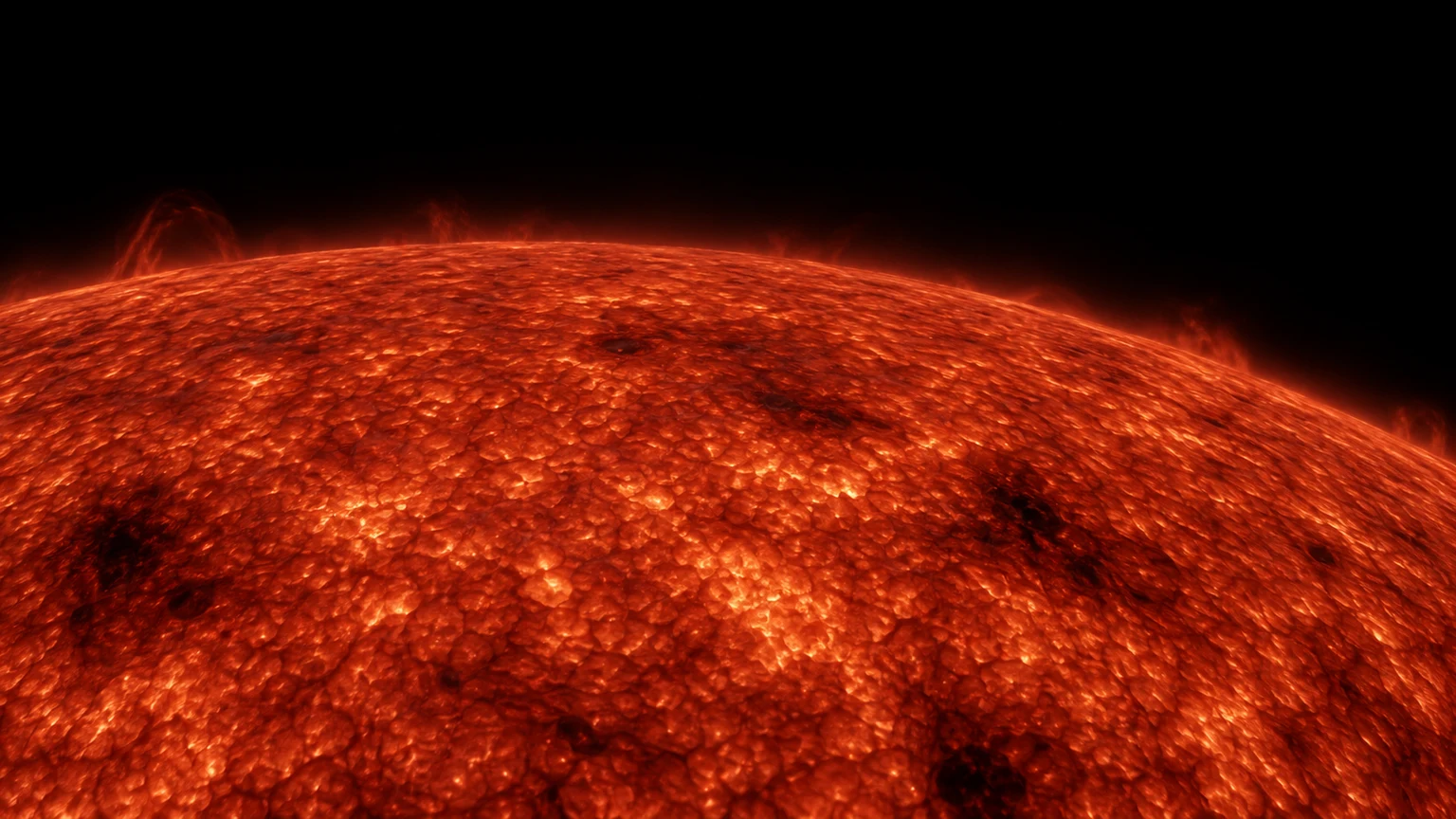
An imagined photospheric panorama. Granular gas and warm filtered colors are illustrative, not an observed surface map.Above the copper horizon ↗ ARTIST’S IMPRESSION · 3 VIEWS

Diameter comparison ↗

06
0.1192 × Sol
TRAPPIST-1

Instrument detail

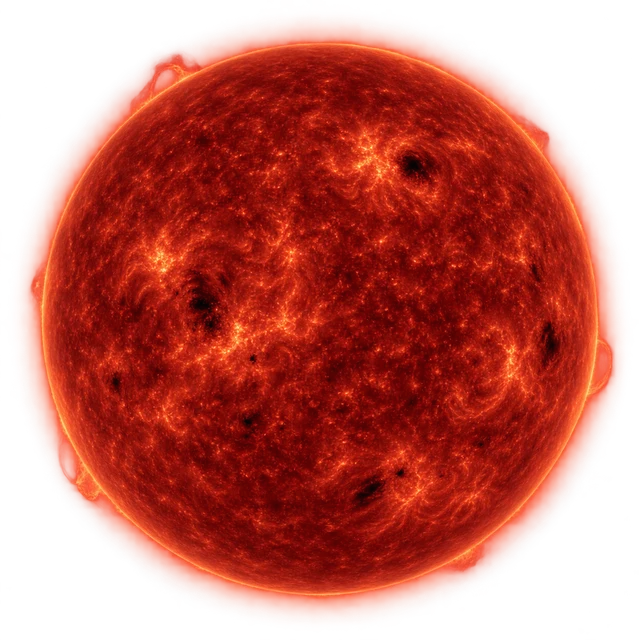
Artist’s impression of TRAPPIST-1

Artist’s impression · structure and color are illustrative.

Seven worlds inside a tiny orbit.

Every known planet in this family circles closer to its star than Mercury does to Sol. The star’s low luminosity changes what those distances mean for heating. The console links to all seven planets, from the fast-moving b to the outer h, so their sizes, masses and orbital settings can be compared directly.

The planets help weigh one another.

The worlds repeatedly cross the stellar disk. Their silhouettes constrain radius, while shifts in the timing of those crossings reveal gravitational interactions. This combination gives the system something many nearby exoplanets lack: both mass and size measurements. No instrument has turned those measurements into a resolved map of mountains or seas.

The star is part of the measurement.

Magnetic regions and flares change the light leaving this faint star. That variability can mingle with the subtle signatures being sought in planetary atmospheres. Atmospheric studies must account for the host’s contribution before a spectral feature can be attributed to a planet. The quiet-looking copper disk is an illustration, not a promise of a calm radiation environment.

Small stars use their fuel slowly.

TRAPPIST-1 belongs to the low-mass end of the main sequence. Hydrogen fusion sustains its light, and deep mixing helps make fuel available over very long spans. Its small size should not be mistaken for a cooling white dwarf or a planet: those objects have different structures and energy sources.

A star in perspective.

DIAMETER / SOL0.119 ×

About 11.9% of our Sun’s diameter.

Circles compare diameter, not mass or luminosity. Adopted radius 0.1192 ± 0.0013 solar radii; Agol et al. (2021), Table 7. Radius and diameter ratios are equal.

EFFECTIVE TEMPERATURE

A faint, very cool stellar photosphere.

  • TRAPPIST-1≈ 2,566 K
  • Sol≈ 5,770 K

Shared scale: 0–10,000 K. Effective temperature describes total emitted energy per unit surface area; it is not the core temperature. Effective temperature 2,566 ± 26 K in the adopted 2021 solution.

LIFE PHASE

A slow-burning main sequence.

  1. NOWHydrogen fusion
  2. INTERIORDeep convection
  3. OUTLOOKLong fuel lifetime

A qualitative red-dwarf outlook, not a countdown or the Sun’s giant-stage sequence.

Research · size and temperature ↗
LIFE & HUMAN SURVIVAL / THE STAR ITSELF
POSSIBILITY FOR LIFEIncompatible with known life

The star’s hot gaseous layers cannot provide the cool, stable environment required by life as we know it. Conditions on any orbiting worlds are a separate question.

WITHOUT PROTECTIONNot survivable

No breathable air or solid ground. Extreme heat and radiation make a close encounter lethal; a meaningful survival timer depends on where you are.

NASA · stellar structure and evolution ↗
10⁵1,000100.10.00110⁻⁵30,00010,0005,0002,500LUMINOSITY / SOL · BRIGHTER →HOTTER ← EFFECTIVE TEMPERATURE (K) → COOLERSUPERGIANTSGIANTSWHITE DWARFSMAIN SEQUENCESOLTRAPPIST-1
TRAPPIST-12,566 K · ≈ 0.000556 × Sol
Sol / reference5,770 K · 1 × Sol

Estimated from size & temperature. Both axes are logarithmic; equal steps represent equal ratios.

Small points are other worlds in this atlas. The soft band marks the main sequence; region labels are broad guides, not a path through time.

A slow-burning main sequence.

  1. NOWHydrogen fusion
  2. INTERIORDeep convection
  3. OUTLOOKLong fuel lifetime

A qualitative red-dwarf outlook, not a countdown or the Sun’s giant-stage sequence.

Research ↗

TRAPPIST-1 belongs to the low-mass end of the main sequence. Hydrogen fusion sustains its light, and deep mixing helps make fuel available over very long spans. Its small size should not be mistaken for a cooling white dwarf or a planet: those objects have different structures and energy sources.

How much energy leaves the star?

≈ 0.000556 × Sol

This compares total radiant power across all wavelengths, not just visible light or apparent brightness in our sky. The beams on the dashboard share a linear length scale.

The estimate combines this log’s diameter ratio (0.1192 × Sol) and effective temperature (2,566 K): luminosity scales with radius squared and temperature to the fourth power. It is derived from rounded values, not an independent luminosity measurement.

Adopted radius 0.1192 ± 0.0013 solar radii; Agol et al. (2021), Table 7. Radius and diameter ratios are equal.

Effective temperature 2,566 ± 26 K in the adopted 2021 solution.

Swinburne University · Stefan–Boltzmann law ↗

Seven worlds inside a tiny orbit.

Every known planet in this family circles closer to its star than Mercury does to Sol. The star’s low luminosity changes what those distances mean for heating. The console links to all seven planets, from the fast-moving b to the outer h, so their sizes, masses and orbital settings can be compared directly.

The planets help weigh one another.

The worlds repeatedly cross the stellar disk. Their silhouettes constrain radius, while shifts in the timing of those crossings reveal gravitational interactions. This combination gives the system something many nearby exoplanets lack: both mass and size measurements. No instrument has turned those measurements into a resolved map of mountains or seas.

The star is part of the measurement.

Magnetic regions and flares change the light leaving this faint star. That variability can mingle with the subtle signatures being sought in planetary atmospheres. Atmospheric studies must account for the host’s contribution before a spectral feature can be attributed to a planet. The quiet-looking copper disk is an illustration, not a promise of a calm radiation environment.

Small stars use their fuel slowly.

TRAPPIST-1 belongs to the low-mass end of the main sequence. Hydrogen fusion sustains its light, and deep mixing helps make fuel available over very long spans. Its small size should not be mistaken for a cooling white dwarf or a planet: those objects have different structures and energy sources.

An imagined photospheric panorama. Granular gas and warm filtered colors are illustrative, not an observed surface map.

Above the copper horizon

An imagined photospheric panorama. Granular gas and warm filtered colors are illustrative, not an observed surface map.

A hypothetical dark magnetic region surrounded by glowing convection. Its shape is invented and does not depict a solid crust.

Inside a magnetic patch

A hypothetical dark magnetic region surrounded by glowing convection. Its shape is invented and does not depict a solid crust.

An imagined plasma arch beyond the stellar limb. This is not a reconstruction of a measured flare; exposure and color reveal the proposed structure.

A loop against the dark

An imagined plasma arch beyond the stellar limb. This is not a reconstruction of a measured flare; exposure and color reveal the proposed structure.

Stellar images are artistic interpretations, not resolved photographs of this star.