LYRA / STELLAR DOSSIER

Vega

25.04 light-years from Sol

A blue-white beacon whose rapid rotation hides behind a nearly pole-on view.

Artist’s impression of Vega
A0 V · main sequence

A bright pole turned almost toward us.

Stellar conditions ↗

02
EFFECTIVE TEMPERATURE9,360 K

A hotter pole and a cooler equator.

Vega9,360 K
Sol5,770 K
Shared scale 0–10,000 K · effective, not core temperature

Evolution ↗

03
CURRENT PHASE

Main sequence.

  1. NOWHydrogen fusion
  2. LATERGiant phase
  3. REMNANTWhite dwarf
A broad evolutionary sequence, not a timescale or a prediction of remaining lifetime.
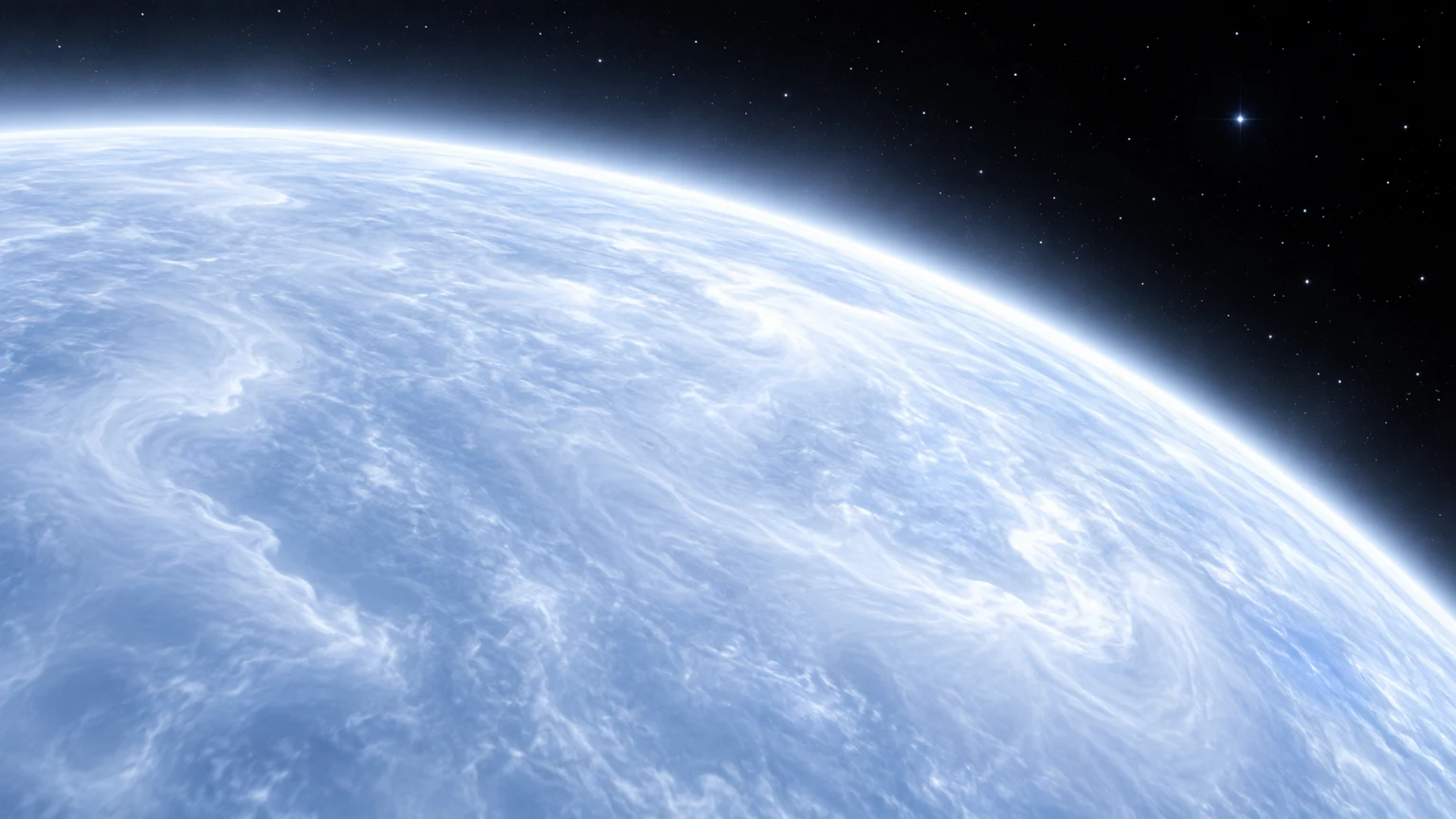
An imagined close view of Vega’s gaseous photosphere. Color and exposure are compressed; the subtle texture is not a resolved close-up.Above the blue-white limb ↗ ARTIST’S IMPRESSION · 3 VIEWS

Diameter comparison ↗

06
2.726 × Sol
VEGA

Instrument detail

Artist’s impression of Vega

Artist’s impression · structure and color are illustrative.

The viewing angle hides the spin.

Vega’s rotation axis points almost toward Earth. Interferometry reveals a wider equator and brighter poles, even though the projected disk looks nearly round. The adopted rotating-star model has a period of roughly 0.71 days.

Brightness depends on the direction of view.

Gravity darkening makes the equatorial regions cooler than the poles. Looking toward a bright pole changes the luminosity one would infer by assuming equal emission in every direction. The value here is the model’s total output, integrated over the star.

A wide field of fine debris.

Hubble and Webb observed a broad, unusually smooth disk of dust around Vega. The observations constrain massive planets that would strongly disturb it. They do not prove that every possible small planet is absent; no planet is added here on the basis of dust alone.

A brilliant but finite main sequence.

Vega is an A-type main-sequence star. It radiates much more power than Sol while drawing on its nuclear fuel. Its broad future path leads through evolved giant stages to a white dwarf; neither the images nor the phase display predicts a precise date.

A star in perspective.

DIAMETER / SOL2.73 ×

About 173% wider than our Sun.

Circles compare diameter, not mass or luminosity. Equatorial radius 2.726 ± 0.006 solar radii; polar radius 2.418 ± 0.012. Monnier et al. (2012), concordance model. The diameter comparison uses the equator; Vega is oblate, not spherical.

EFFECTIVE TEMPERATURE

A hotter pole and a cooler equator.

  • Vega≈ 9,360 K
  • Sol≈ 5,770 K

Shared scale: 0–10,000 K. Effective temperature describes total emitted energy per unit surface area; it is not the core temperature. Surface-averaged effective temperature 9,360 ± 90 K in the same model. The pole is about 10,070 K and the equator about 8,910 K; one temperature does not describe every latitude.

LIFE PHASE

Main sequence.

  1. NOWHydrogen fusion
  2. LATERGiant phase
  3. REMNANTWhite dwarf

A broad evolutionary sequence, not a timescale or a prediction of remaining lifetime.

Research · size and temperature ↗
LIFE & HUMAN SURVIVAL / THE STAR ITSELF
POSSIBILITY FOR LIFEIncompatible with known life

The star’s hot gaseous layers cannot provide the cool, stable environment required by life as we know it. Conditions on any orbiting worlds are a separate question.

WITHOUT PROTECTIONNot survivable

No breathable air or solid ground. Extreme heat and radiation make a close encounter lethal; a meaningful survival timer depends on where you are.

NASA · stellar structure and evolution ↗

Main sequence.

  1. NOWHydrogen fusion
  2. LATERGiant phase
  3. REMNANTWhite dwarf

A broad evolutionary sequence, not a timescale or a prediction of remaining lifetime.

Research ↗

Vega is an A-type main-sequence star. It radiates much more power than Sol while drawing on its nuclear fuel. Its broad future path leads through evolved giant stages to a white dwarf; neither the images nor the phase display predicts a precise date.

How much energy leaves the star?

≈ 47.2 × Sol

This compares total radiant power across all wavelengths, not just visible light or apparent brightness in our sky. The beams on the dashboard share a linear length scale.

Adopted bolometric luminosity 47.2 ± 2.0 solar luminosities from the rotating-star concordance model of Monnier et al. (2012). This integrates the varying temperature over the oblate star; applying a spherical formula to its equatorial radius would overestimate the result.

Equatorial radius 2.726 ± 0.006 solar radii; polar radius 2.418 ± 0.012. Monnier et al. (2012), concordance model. The diameter comparison uses the equator; Vega is oblate, not spherical.

Surface-averaged effective temperature 9,360 ± 90 K in the same model. The pole is about 10,070 K and the equator about 8,910 K; one temperature does not describe every latitude.

Research · bolometric luminosity model ↗

The viewing angle hides the spin.

Vega’s rotation axis points almost toward Earth. Interferometry reveals a wider equator and brighter poles, even though the projected disk looks nearly round. The adopted rotating-star model has a period of roughly 0.71 days.

Brightness depends on the direction of view.

Gravity darkening makes the equatorial regions cooler than the poles. Looking toward a bright pole changes the luminosity one would infer by assuming equal emission in every direction. The value here is the model’s total output, integrated over the star.

A wide field of fine debris.

Hubble and Webb observed a broad, unusually smooth disk of dust around Vega. The observations constrain massive planets that would strongly disturb it. They do not prove that every possible small planet is absent; no planet is added here on the basis of dust alone.

A brilliant but finite main sequence.

Vega is an A-type main-sequence star. It radiates much more power than Sol while drawing on its nuclear fuel. Its broad future path leads through evolved giant stages to a white dwarf; neither the images nor the phase display predicts a precise date.

An imagined close view of Vega’s gaseous photosphere. Color and exposure are compressed; the subtle texture is not a resolved close-up.

Above the blue-white limb

An imagined close view of Vega’s gaseous photosphere. Color and exposure are compressed; the subtle texture is not a resolved close-up.

An illustrative equatorial viewpoint showing oblateness and gravity darkening. We normally see Vega nearly pole-on; this side view is reconstructed, with contrast enhanced to show the effect.

A star stretched by rotation

An illustrative equatorial viewpoint showing oblateness and gravity darkening. We normally see Vega nearly pole-on; this side view is reconstructed, with contrast enhanced to show the effect.

An artist’s interpretation of Vega’s broad debris disk. Dust brightness and the central star’s apparent size are adjusted for visibility; the scene shows no claimed planets.

Dust around a bright center

An artist’s interpretation of Vega’s broad debris disk. Dust brightness and the central star’s apparent size are adjusted for visibility; the scene shows no claimed planets.

Stellar images are artistic interpretations, not resolved photographs of this star.