EPSILON ERIDANI SYSTEM / PLANETARY DOSSIER

Epsilon Eridani b

A Jupiter-mass companion whose stellar tug reveals more than its imagined clouds.
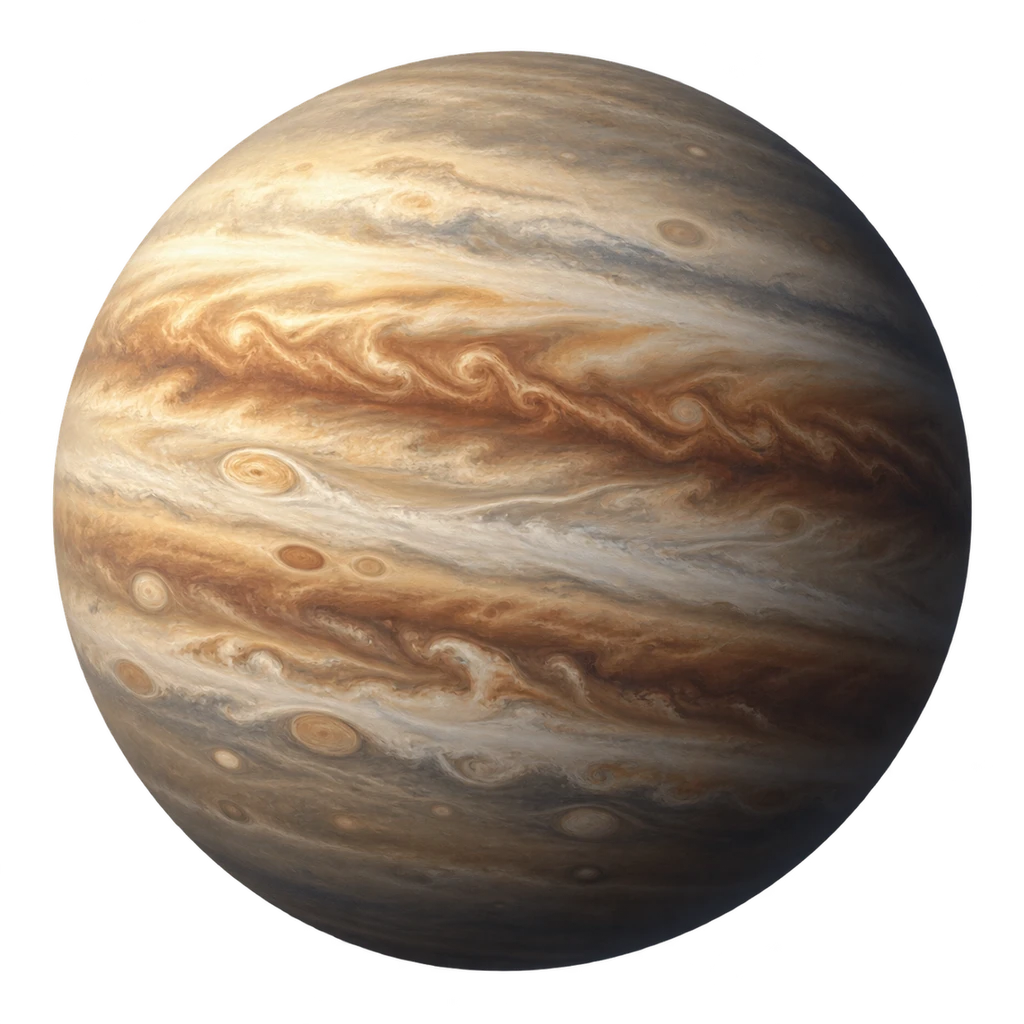
Artist’s impression of Epsilon Eridani b; appearance and diameter are unconfirmed
Gas giant

A long year above an unseen cloud sea.

Environment ↗

02
ATMOSPHERE

A giant’s envelope, still unresolved.

DIAMETER
Not measured
POSSIBILITY FOR LIFE
Unknown · no established habitat
WITHOUT PROTECTION
Not survivable without protection

Mass comparison ↗

04
DYNAMICAL MASS1 × Jupiter

± 0.1 Jupiter masses

Orbit inclination constrained by astrometry and radial velocities.
EPSILON ERIDANI B

Instrument detail

Artist’s impression of Epsilon Eridani b

Artist’s impression · appearance and diameter are unconfirmed.

Seven Earth years for one circuit.

The adopted joint orbital fit puts b about 3.53 astronomical units from its star, with a period of 7.33 Earth years. Its orbit is close to circular. This is a wide-orbit giant, moving slowly enough that its rhythm takes years of observations to follow. Those measurements trace a gravitational path, not the changing shapes of individual clouds.

More than a minimum.

Radial velocities measure the star’s motion toward and away from us. Astrometry adds its movement across the sky. Together, they constrain the orbital inclination and give a dynamical mass of about one Jupiter in the adopted model. That is why the comparison above uses Jupiter and does not carry the minimum-mass qualifier used for some other worlds in this atlas.

A world without a shoreline.

Gas giants carry enormous envelopes rather than an accessible rocky surface. For this world, pale bands and billowing clouds provide one possible visual language. They do not establish ammonia, water or any other cloud ingredient. Looking farther down would not uncover a convenient landing site: the atmospheric setting continues into increasingly extreme conditions.

The next clues come from light.

Measuring a planet’s own light can add information that stellar motion cannot provide. Spectroscopy separates that light into wavelengths to investigate atmospheric properties, while an orbit supplies a different set of constraints. These scenes imagine the view from within the system. The profile keeps the unknown radius, composition and detailed weather visible as open questions.

Size, mass and atmosphere

DIAMETER / EARTH

Not measured.

The radius has not been measured; the illustration does not establish its size.

SIZE UNKNOWN
DYNAMICAL MASS / JUPITER
  • Epsilon Eridani b1.00 ± 0.10 M♃
  • Jupiter · reference mass1.00 M♃

Shared scale: 0–1.5 Jupiter masses. Radial velocities and astrometry constrain the orbital inclination and true mass together; this is not just a minimum mass. Thompson et al. (2025), full joint model, Table 3: 1.00 ± 0.10 Jupiter masses. Radius and density are not measured by this fit.

ATMOSPHERE / COMPOSITION

A giant’s envelope, still unresolved.

A substantial gaseous envelope is expected for this Jupiter-mass planet. Specific gas fractions, cloud materials and weather patterns have not been established here. The pale cloud layers are a visual interpretation, not a measured atmospheric map.

Habitability

NATURAL CONDITIONSUnknown · no established habitat

No life or liquid-water habitat has been established. A gas giant’s atmosphere is not an Earth-like surface, and an attractive cloud scene does not demonstrate a habitable layer.

HUMANS / WITHOUT PROTECTIONNot survivable without protection

A giant-planet atmosphere offers no breathable air or ground to stand on. Conditions change strongly with depth; no single pressure, temperature or survival timer describes the whole planet.

ATMOSPHERIC TEMPERATURE
Varies with depth · not mapped
PRESSURE
Depth-dependent · no landing surface
LIQUID WATER HABITAT
Not established
REFERENCE-LEVEL GRAVITY
Unknown · radius required

A year around Epsilon Eridani

7.33 Earth years

Semimajor axis: 3.53 AU. One astronomical unit is approximately the mean Earth–Sun distance.

The overview is a schematic: sizes, orbital shape and the planet’s position are illustrative. It does not show a measured eccentricity, the orbit’s orientation or a live position.

The adopted joint orbital fit puts b about 3.53 astronomical units from its star, with a period of 7.33 Earth years. Its orbit is close to circular. This is a wide-orbit giant, moving slowly enough that its rhythm takes years of observations to follow. Those measurements trace a gravitational path, not the changing shapes of individual clouds.

Thompson et al. (2025) · orbital measurements ↗
A hypothetical high-altitude view of Epsilon Eridani b under its host’s softer light. Cloud color, layers and weather are invented; exposure is adjusted for visibility. No solid surface is represented.

Above a possible cloud sea

A hypothetical high-altitude view of Epsilon Eridani b under its host’s softer light. Cloud color, layers and weather are invented; exposure is adjusted for visibility. No solid surface is represented.

An imagined passage within a giant-planet atmosphere. Mist and cloud structure illustrate a gaseous setting, not a measured pressure level or chemical composition. This is not a place where a visitor could stand.

Between the layers

An imagined passage within a giant-planet atmosphere. Mist and cloud structure illustrate a gaseous setting, not a measured pressure level or chemical composition. This is not a place where a visitor could stand.

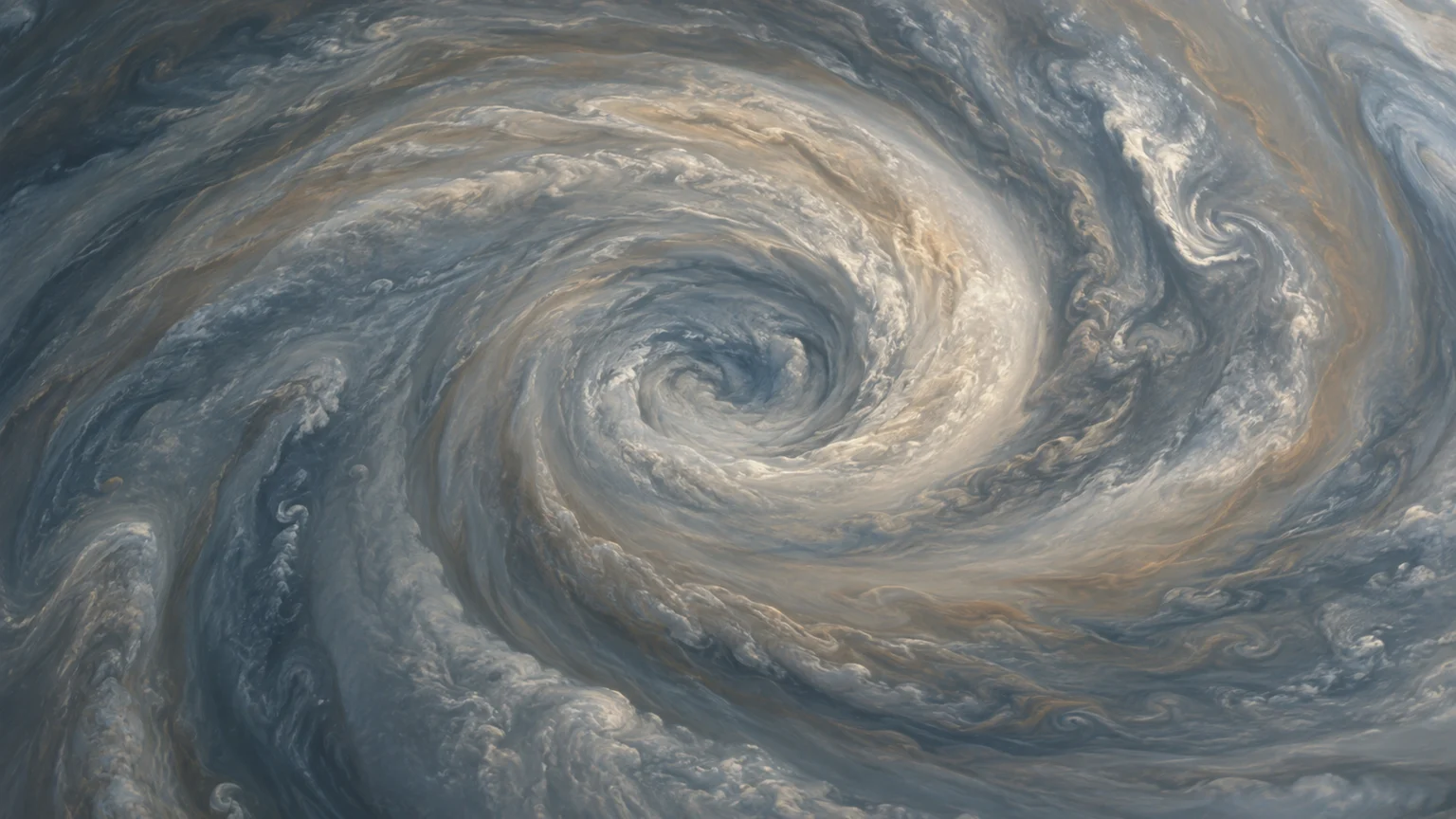
A hypothetical broad atmospheric vortex with curved cloud filaments. An artistic reconstruction of Epsilon Eridani b; local detail, lighting and viewpoint are imagined. The depicted environment is a possibility, not an observed surface or weather map.

A possible atmospheric vortex

A hypothetical broad atmospheric vortex with curved cloud filaments. An artistic reconstruction of Epsilon Eridani b; local detail, lighting and viewpoint are imagined. The depicted environment is a possibility, not an observed surface or weather map.

Planet and landscape images are hypothetical artistic interpretations.