LALANDE 21185 SYSTEM / PLANETARY DOSSIER

Lalande 21185 b

A confirmed inner planet with an orbit we can trace and a landscape we can only imagine.
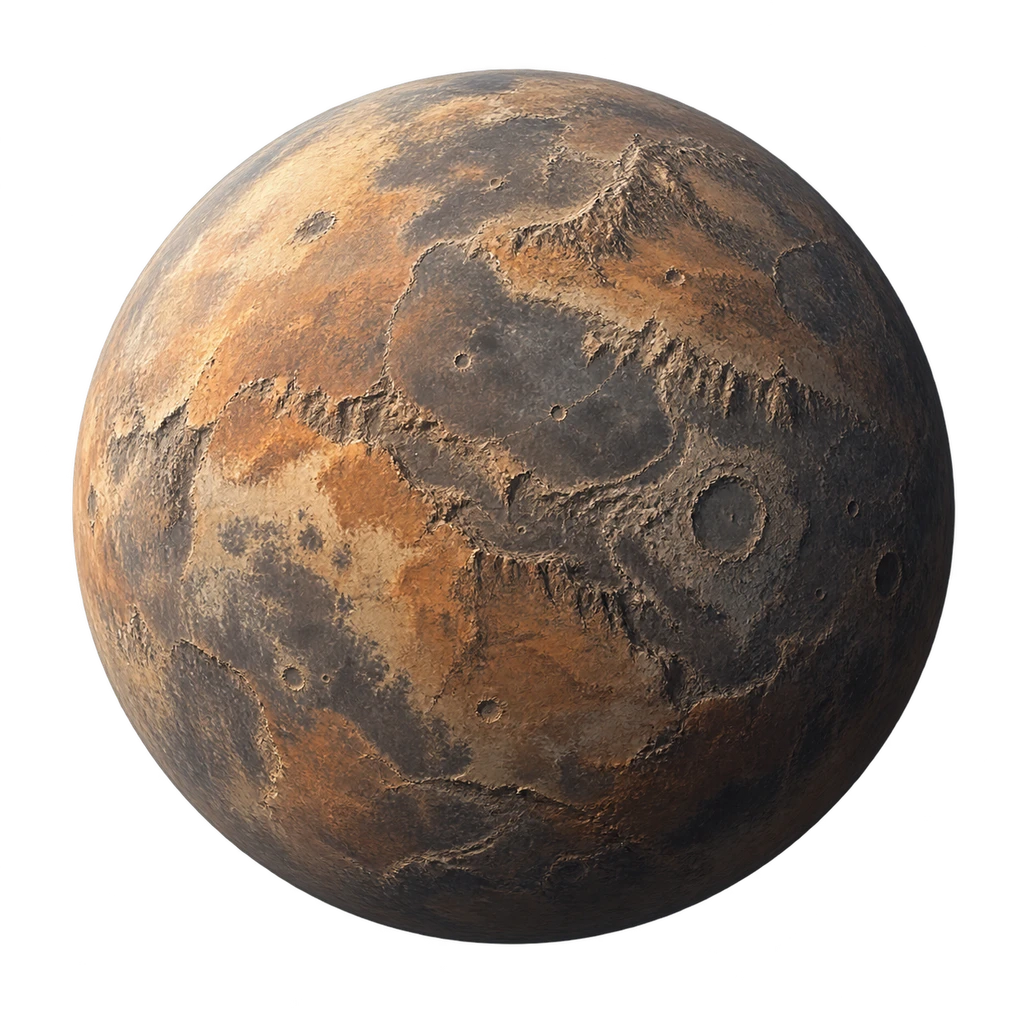
Artist’s impression of Lalande 21185 b; appearance and diameter are unconfirmed
Super-Earth-mass exoplanet

Thirteen days beneath a smaller sun.

Environment ↗

02
ATMOSPHERE

Not measured

DIAMETER
Not measured
POSSIBILITY FOR LIFE
Unknown · close to its star
WITHOUT PROTECTION
Not established as survivable

Mass comparison ↗

04
MINIMUM MASS2.69 × Earth

+0.19 / −0.18 Earth masses

Measured m sin i · true mass may be larger.
LALANDE 21185 B

Instrument detail

Artist’s impression of Lalande 21185 b

Artist’s impression · appearance and diameter are unconfirmed.

A short circuit around a faint host.

Lalande 21185 b lies much closer to its star than Earth does to Sol and completes a year in less than two weeks. Its host is a red dwarf, so the same distance does not imply the same heating as around our Sun. An orbital period is a firm starting point for understanding a world, not a complete description of its environment.

A discovery checked with another instrument.

CARMENES observations independently confirmed the short-period planet first detected with SOPHIE. Agreement across instruments makes the orbital interpretation more convincing. That does not mean a camera has revealed a rocky globe: the evidence comes from small shifts in the host star’s light as it moves under the planet’s gravitational pull.

Mass is only one part of the picture.

A radial-velocity measurement constrains the mass multiplied by the sine of the orbital inclination. If the orbit is tilted differently from our view, the true mass can be larger. A radius measurement would add another essential clue, allowing density to be estimated. Until then, the rocky setting shown here is a scenario, not an established interior model.

The missing atmosphere matters.

An atmosphere can transport heat and change how energy escapes to space. Clouds and surface reflectivity also affect temperature. Without those ingredients, a survival timer or a claim of habitability would suggest more certainty than we have. These images intentionally explore an airless possibility; they do not show that the real planet has lost its atmosphere.

Size, mass and atmosphere

DIAMETER / EARTH

Not measured.

The radius has not been measured; the illustration does not establish its size.

SIZE UNKNOWN
MINIMUM MASS / EARTH
  • Lalande 21185 b · minimum2.69 (+0.19 / −0.18) M⊕
  • Earth · reference mass1.00 M⊕

Shared scale: 0–4 Earth masses. The planetary measurement is m sin i, a minimum mass with measurement uncertainty. Unknown orbital inclination allows a larger true mass. Hurt et al. (2022), adopted joint radial-velocity fit. Asymmetric uncertainties are shown; this is not a radius or density measurement.

ATMOSPHERE / COMPOSITION

Not measured

We cannot assign atmospheric percentages or surface pressure. An atmosphere has not been established here; that is different from proving the planet is airless.

Habitability

NATURAL CONDITIONSUnknown · close to its star

The close orbit receives substantial starlight, but its actual climate depends on an atmosphere and reflectivity that have not been measured. No liquid water or life has been established.

HUMANS / WITHOUT PROTECTIONNot established as survivable

Breathable air, safe pressure and tolerable temperatures are not known. A survival time would be speculation.

SURFACE TEMPERATURE
Unknown · no measured climate
SURFACE PRESSURE
Unknown
LIQUID WATER
Not established
SURFACE GRAVITY
Unknown · radius required

A year around Lalande 21185

12.94 Earth days

Semimajor axis: 0.07879 AU. One astronomical unit is approximately the mean Earth–Sun distance.

The overview is a schematic: sizes, orbital shape and the planet’s position are illustrative. It does not show a measured eccentricity, the orbit’s orientation or a live position.

Lalande 21185 b lies much closer to its star than Earth does to Sol and completes a year in less than two weeks. Its host is a red dwarf, so the same distance does not imply the same heating as around our Sun. An orbital period is a firm starting point for understanding a world, not a complete description of its environment.

Hurt et al. (2022) · orbital measurements ↗
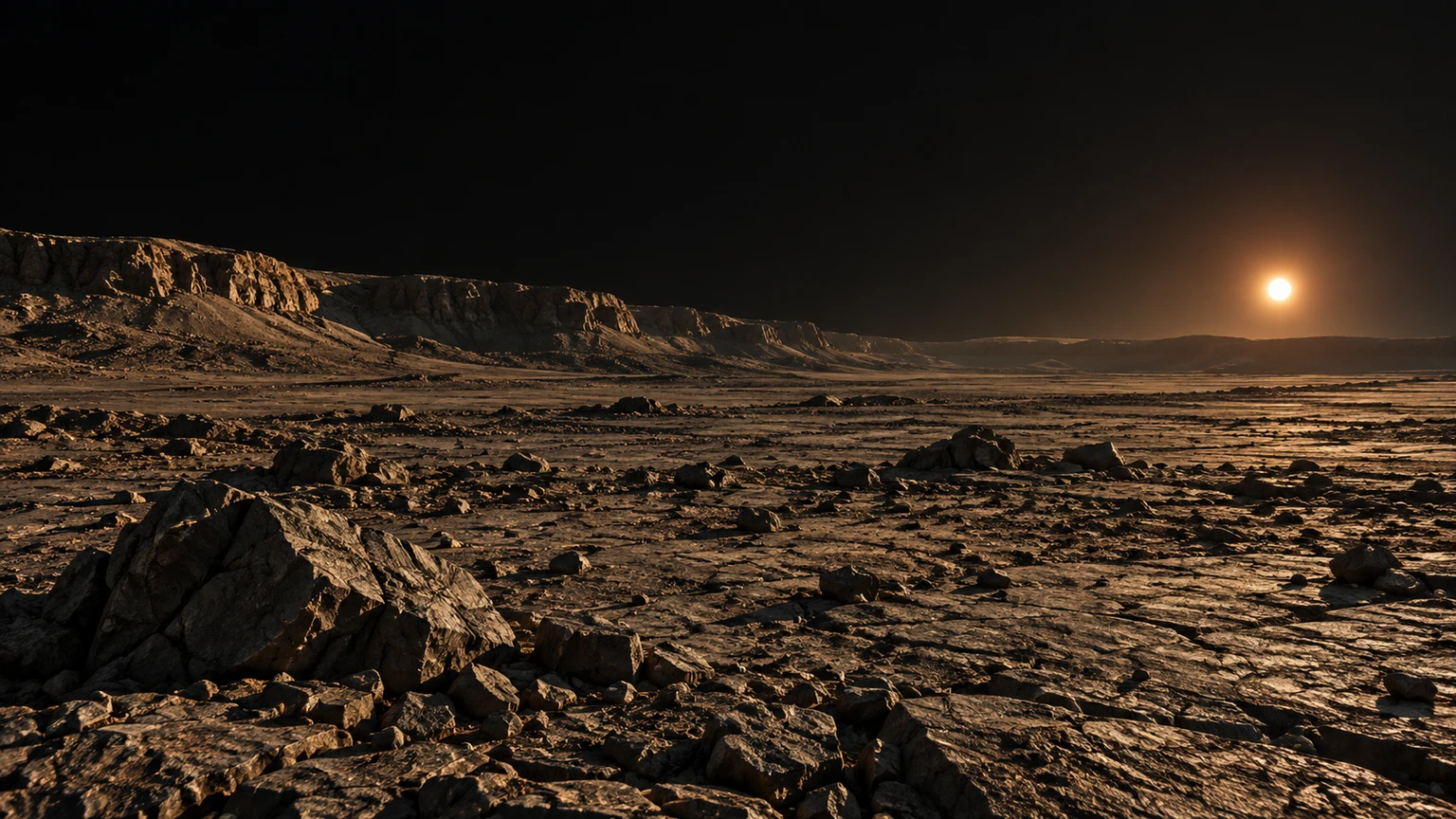
A hypothetical dry, airless rocky plain beneath Lalande 21185. The terrain, minerals and absence of air are artistic assumptions. Warm light and camera glare are illustrative; this is not a resolved view of the planet.

Light across an imagined plain

A hypothetical dry, airless rocky plain beneath Lalande 21185. The terrain, minerals and absence of air are artistic assumptions. Warm light and camera glare are illustrative; this is not a resolved view of the planet.

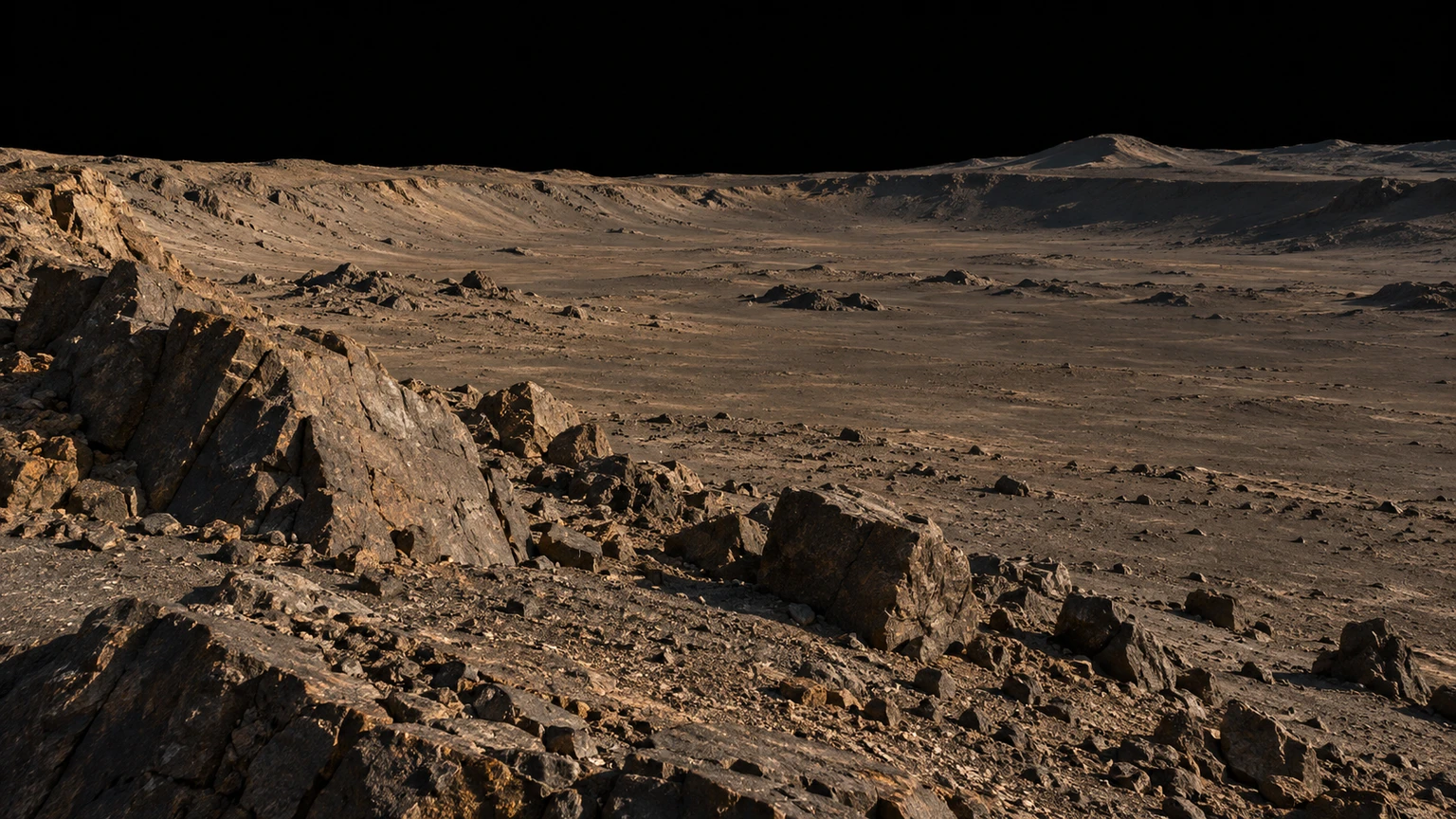
An imagined impact basin with broken rock and regolith. No basin or landing site has been mapped on this planet. The scene continues one possible rocky scenario rather than establishing its geology.

At the basin edge

An imagined impact basin with broken rock and regolith. No basin or landing site has been mapped on this planet. The scene continues one possible rocky scenario rather than establishing its geology.

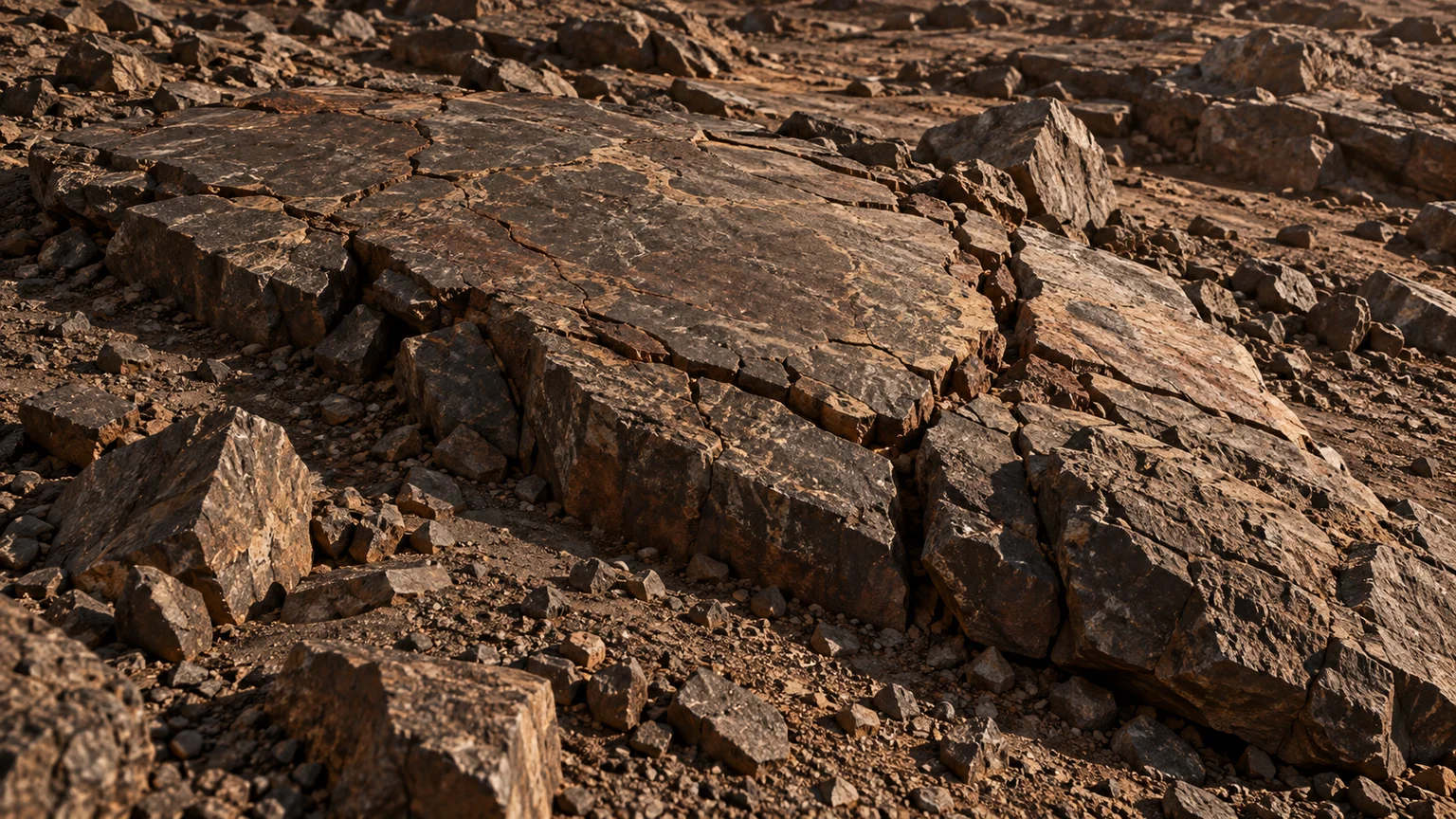
A large fractured rocky slab and smaller angular fragments under subdued warm starlight, crisp shadows. An artistic reconstruction of Lalande 21185 b; local detail, lighting and viewpoint are imagined. The depicted environment is a possibility, not an observed surface or weather map.

Rock textures under distant light

A large fractured rocky slab and smaller angular fragments under subdued warm starlight, crisp shadows. An artistic reconstruction of Lalande 21185 b; local detail, lighting and viewpoint are imagined. The depicted environment is a possibility, not an observed surface or weather map.

Planet and landscape images are hypothetical artistic interpretations.