GJ 1061 SYSTEM / PLANETARY DOSSIER

GJ 1061 b

The innermost planet of a compact red-dwarf system, with a mass constrained by its neighbors.

Artist’s impression of GJ 1061 b; appearance and diameter are unconfirmed
Terrestrial-mass exoplanet

A brief year on an unseen world.

Environment ↗

02
ATMOSPHERE

Not measured

DIAMETER
Not measured
POSSIBILITY FOR LIFE
Unknown · close-in orbit
WITHOUT PROTECTION
Not established as survivable

Mass comparison ↗

04
DYNAMICAL MASS1.11 × Earth

+0.11 / −0.09 Earth masses

Planet–planet interactions in radial-velocity data constrain inclination and dynamical mass.
GJ 1061 B

Instrument detail

Artist’s impression of GJ 1061 b

Artist’s impression · appearance and diameter are unconfirmed.

Three days and another year begins.

At about 0.021 astronomical units from its star, b completes an orbit in just over three Earth days. The star is much fainter than Sol, but this remains the innermost of its known planets. The orbit diagram is a schematic: its spacing and the displayed planetary position are not a live view of the system.

The neighbors help weigh the planet.

The 2025 study includes mutual gravitational interactions rather than treating the planets as independent Keplerian signals. This constrains the orbital inclination and gives a dynamical mass near 1.11 Earth masses for b. The result depends on the adopted interacting model; it is not a transit radius or an atmospheric measurement.

An Earth-scale mass leaves room for surprises.

Mass alone does not determine radius, density or surface gravity. The charcoal rocks shown here select a possible rocky, airless world for illustration. Neither an impact basin nor a cliff has been mapped on the real planet. A different interior or atmospheric history could produce a view unlike any of these scenes.

A landscape is not a weather report.

Starlight supplies energy while atmospheric composition, clouds and reflectivity affect how a planet absorbs and releases it. The black sky in these images is an artistic assumption. It cannot establish atmospheric loss, a measured temperature or the presence or absence of a habitat.

Size, mass and atmosphere

DIAMETER / EARTH

Not measured.

The radius has not been measured; the illustration does not establish its size.

SIZE UNKNOWN
DYNAMICAL MASS / EARTH
  • GJ 1061 b1.11 (+0.11 / −0.09) M⊕
  • Earth · reference mass1.00 M⊕

Shared scale: 0–2 Earth masses. Planet–planet interactions in radial-velocity data constrain inclination and dynamical mass. Dreizler et al. (2025), interacting orbital model: 1.11 (+0.11 / −0.09) Earth masses. This is model-dependent and does not measure radius or density.

ATMOSPHERE / COMPOSITION

Not measured

We cannot assign atmospheric percentages or surface pressure. An atmosphere has not been established here; that is different from proving the planet is airless.

Habitability

NATURAL CONDITIONSUnknown · close-in orbit

No atmosphere, liquid water or life has been established. Orbital measurements do not provide a surface temperature, and the airless landscapes here are one invented possibility.

HUMANS / WITHOUT PROTECTIONNot established as survivable

Breathable air, safe pressure and tolerable temperatures are not known. A survival time would be speculation.

SURFACE TEMPERATURE
Unknown · no measured climate
SURFACE PRESSURE
Unknown
LIQUID WATER
Not established
SURFACE GRAVITY
Unknown · radius required

A year around GJ 1061

3.2073 Earth days

Semimajor axis: 0.021 AU. One astronomical unit is approximately the mean Earth–Sun distance.

The overview is a schematic: sizes, orbital shape and the planet’s position are illustrative. It does not show a measured eccentricity, the orbit’s orientation or a live position.

At about 0.021 astronomical units from its star, b completes an orbit in just over three Earth days. The star is much fainter than Sol, but this remains the innermost of its known planets. The orbit diagram is a schematic: its spacing and the displayed planetary position are not a live view of the system.

Dreizler et al. (2025) · orbital measurements ↗
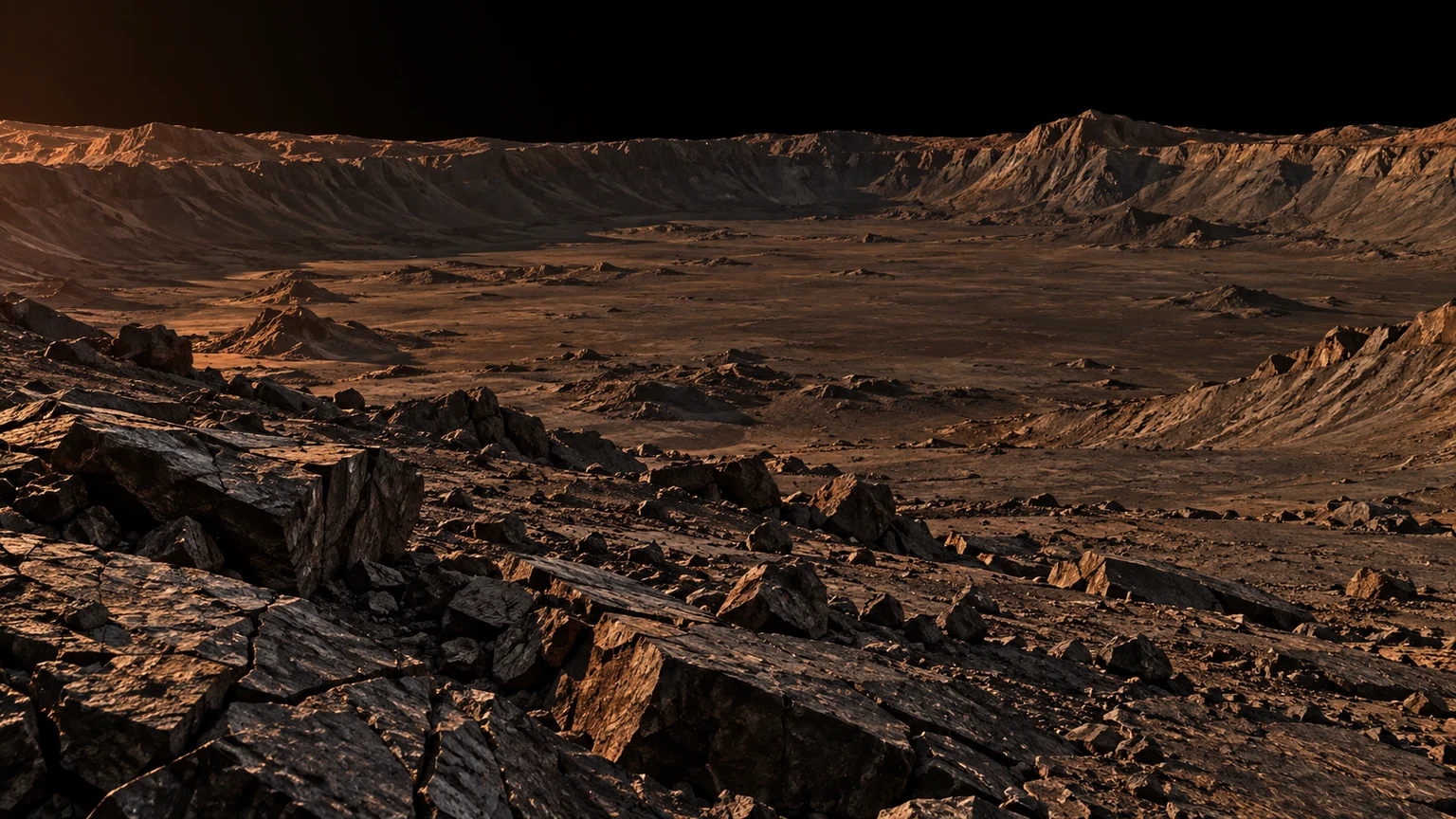
A hypothetical airless basin with regolith and distant crater walls. Terrain, mineral colors and the absence of air are artistic assumptions; no such landscape has been observed.

Across the impact basin

A hypothetical airless basin with regolith and distant crater walls. Terrain, mineral colors and the absence of air are artistic assumptions; no such landscape has been observed.

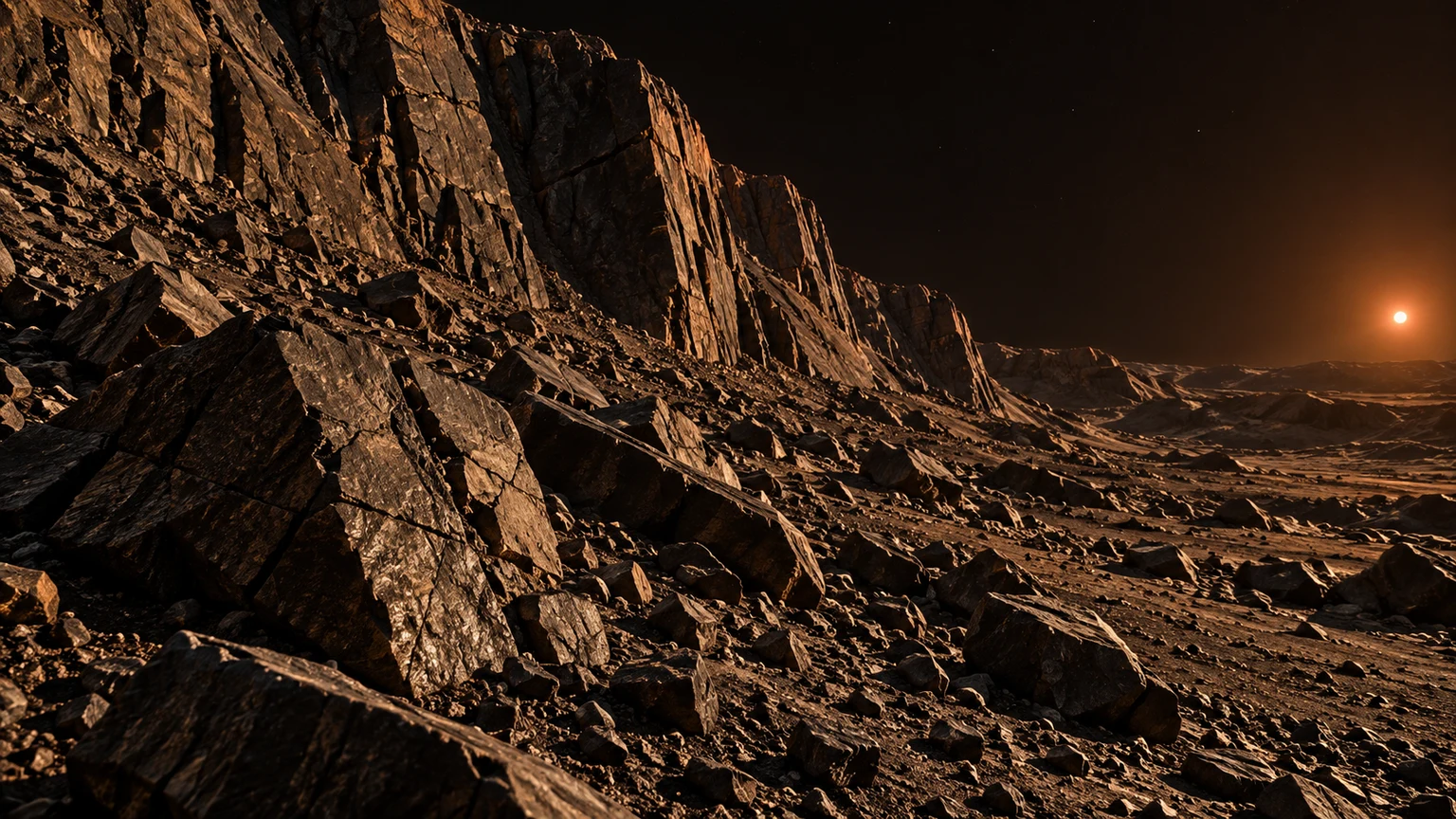
An imagined fractured cliff and fallen blocks under sharp starlight. These rocks do not establish the planet’s geology, atmosphere or surface conditions.

Beneath the escarpment

An imagined fractured cliff and fallen blocks under sharp starlight. These rocks do not establish the planet’s geology, atmosphere or surface conditions.

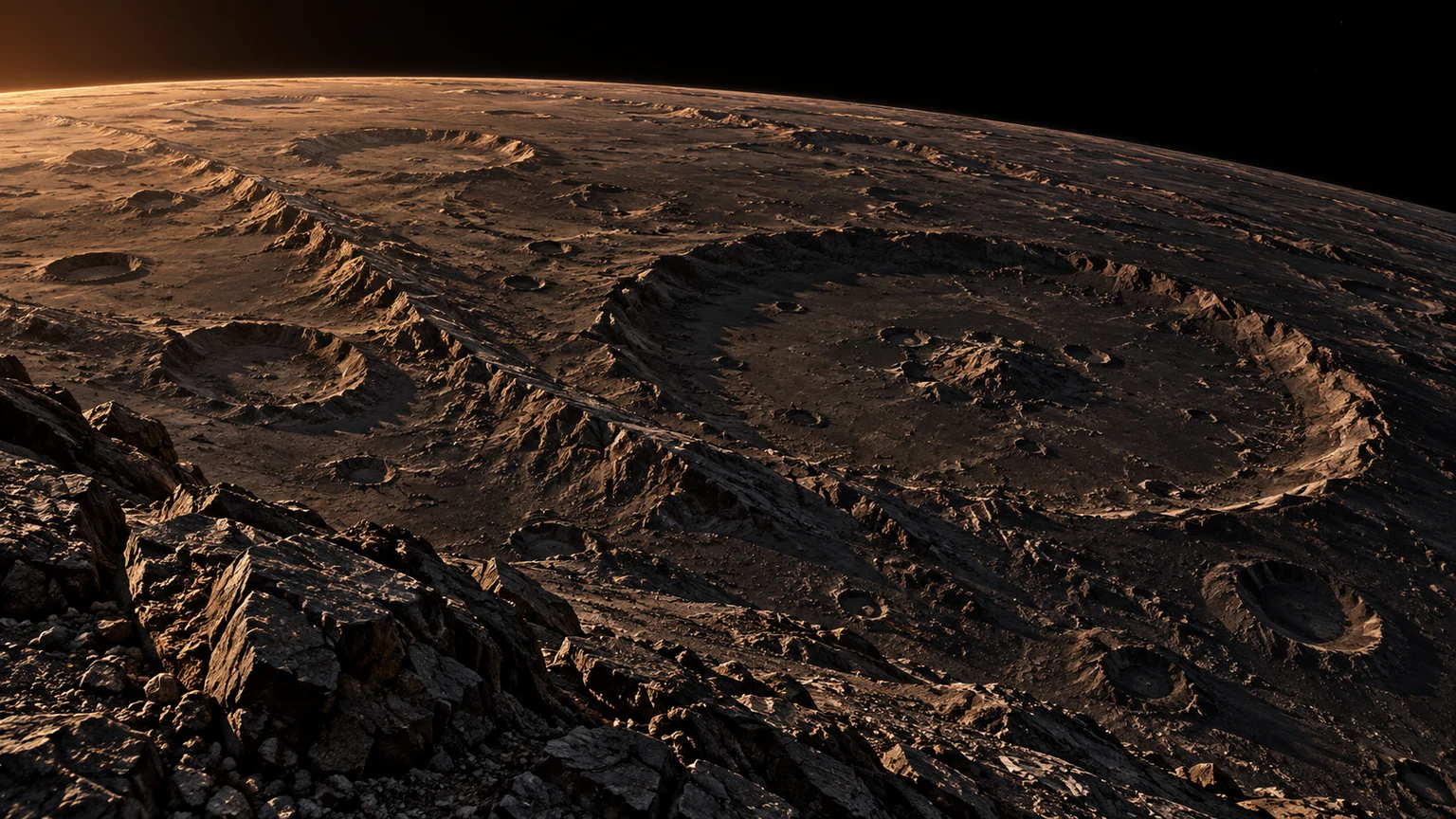
A hypothetical orbital view across overlapping craters and ridges. The curved horizon is an artist’s reconstruction, not a measured radius or terrain map.

Where the horizon curves

A hypothetical orbital view across overlapping craters and ridges. The curved horizon is an artist’s reconstruction, not a measured radius or terrain map.

Planet and landscape images are hypothetical artistic interpretations.