SOL SYSTEM / PLANETARY DOSSIER

Haumea

Haumea is an elongated icy world that rotates in about four hours. It has a narrow ring and two moons, while its detailed surface geography remains unknown.
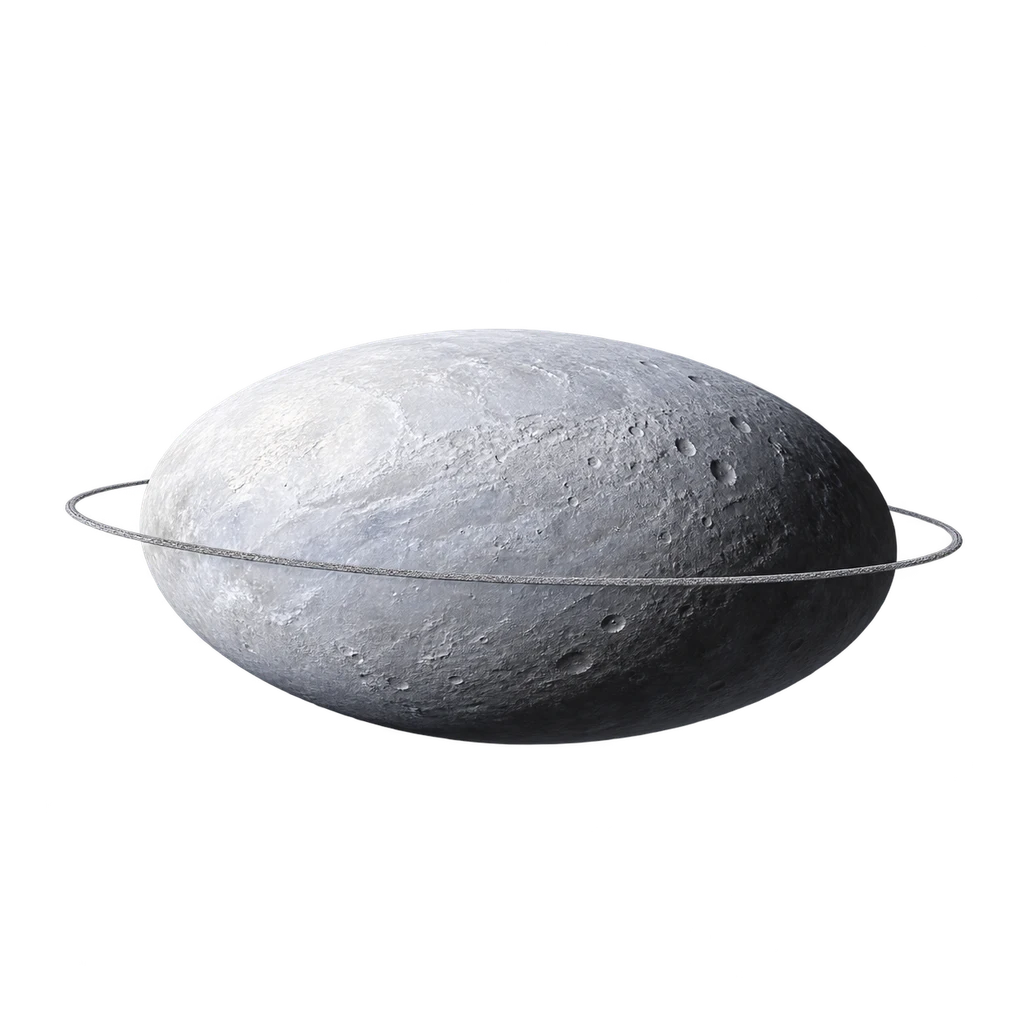
Artist’s impression of Haumea

Dwarf planetAn elongated icy body, a narrow ring and a remarkably short day.

EQUIV. DIAMETER / EARTH0.11×
EARTHHAUMEA
ATMOSPHERE
No substantial global atmosphere detectedOccultations constrain the atmosphere
SURFACE TEMPERATURE
Very cold · no local measurements
SURFACE PRESSURE
Not established at a landing site
HABITABILITYNo life detected
UNPROTECTED HUMANSNot survivable
Interior ↗

03
Haumea interiorHaumea's internal structure is unresolved.Unresolved

System ↗

04
HiʻiakaNamaka2 companionsRINGS AND MOONS · SCHEMATIC
HAUMEA

Instrument detail

Haumea orbitElliptical orbit viewed along the orbital axis, relative to Sun. Motion is accelerated, not a live position. Distances are center to center.SUNHAUMEA51.40 AU34.70 AU
ONE ORBIT≈ 285 Earth years
Closest to the Sun
34.70 AU
Farthest from the Sun
51.40 AU

The Sun sits at a focus of the orbit. Haumea moves faster near the Sun and more slowly farther away.

A simplified ellipse from rounded JPL orbital elements at epoch JD 2461200.5. The moving marker is illustrative, not a current position. Orbital inclination and perturbations are omitted.

Haumea rotation compared with EarthThe markers follow equal elapsed time on both worlds. Equal elapsed time and sidereal rotation rates. Polar schematic: sizes, axial tilt and seasons are not shown. Illumination uses a circular mean orbit, not a live sky prediction. The spin direction is illustrative, not measured.SAME ELAPSED TIME · POLAR SCHEMATICHAUMEA3.9 hoursSIDEREAL ROTATIONDirection illustrativeEARTH23.9 hoursSIDEREAL ROTATION≈ 24 h · solar day
Marked longitude · equal time on both worlds
ONE SIDEREAL ROTATION3.9 hours

Turning through space

Haumea spins in about 3.9 hours. The comparison shows its rapid spin, not its elongated shape or changing viewing geometry. Spin direction is illustrative.

0 Earth hoursShared clock

Spin comparison only; no solar day is inferred. Sizes and starting longitudes are schematic, not live positions.

Satellite atlasMoons
HiʻiakaNamaka2 companionsRINGS AND MOONS · SCHEMATIC

Haumea and its surroundings

Hi’iaka and Namaka orbit Haumea. A collision has been proposed to help explain its unusual family and rapid spin, although the full history remains a research problem.

During a stellar occultation, Haumea briefly hid a background star. Additional dips in the starlight revealed a narrow ring. The same event constrained the body’s outline: a fleeting shadow became a measuring tool.

The illustration identifies companions without assigning orbital periods, distances or present-day positions. Body sizes and spacing are schematic.

GRAVITY CONSTRAINTSMODEL-DEPENDENT
SURFACE GRAVITYModel-dependent

Mass, size and shape

Haumea’s elongated shape and rapid spin make surface gravity strongly location-dependent. Its area-equivalent diameter is not a spherical radius for a reliable jump comparison.

Haumea interiorHaumea's internal structure is unresolved.Unresolved

Beyond the surface

Remote observations constrain surface materials and bulk properties, but do not map internal layer boundaries. A precise core, shell thickness or present-day ocean is not established by this view.

    Artist’s impression of Haumea

    The globe breaks the rules.

    Haumea is distinctly elongated and rotates in about four hours. Its changing brightness helps reveal that shape even though telescopes cannot show a detailed landscape. The stretched portrait is essential to understanding this unusual world.

    A star blinked, and a ring appeared.

    During a stellar occultation, Haumea briefly hid a background star. Additional dips in the starlight revealed a narrow ring. The same event constrained the body’s outline: a fleeting shadow became a measuring tool.

    Two companions, one busy system.

    Hi’iaka and Namaka orbit Haumea. A collision has been proposed to help explain its unusual family and rapid spin, although the full history remains a research problem.

    An outline before a landscape.

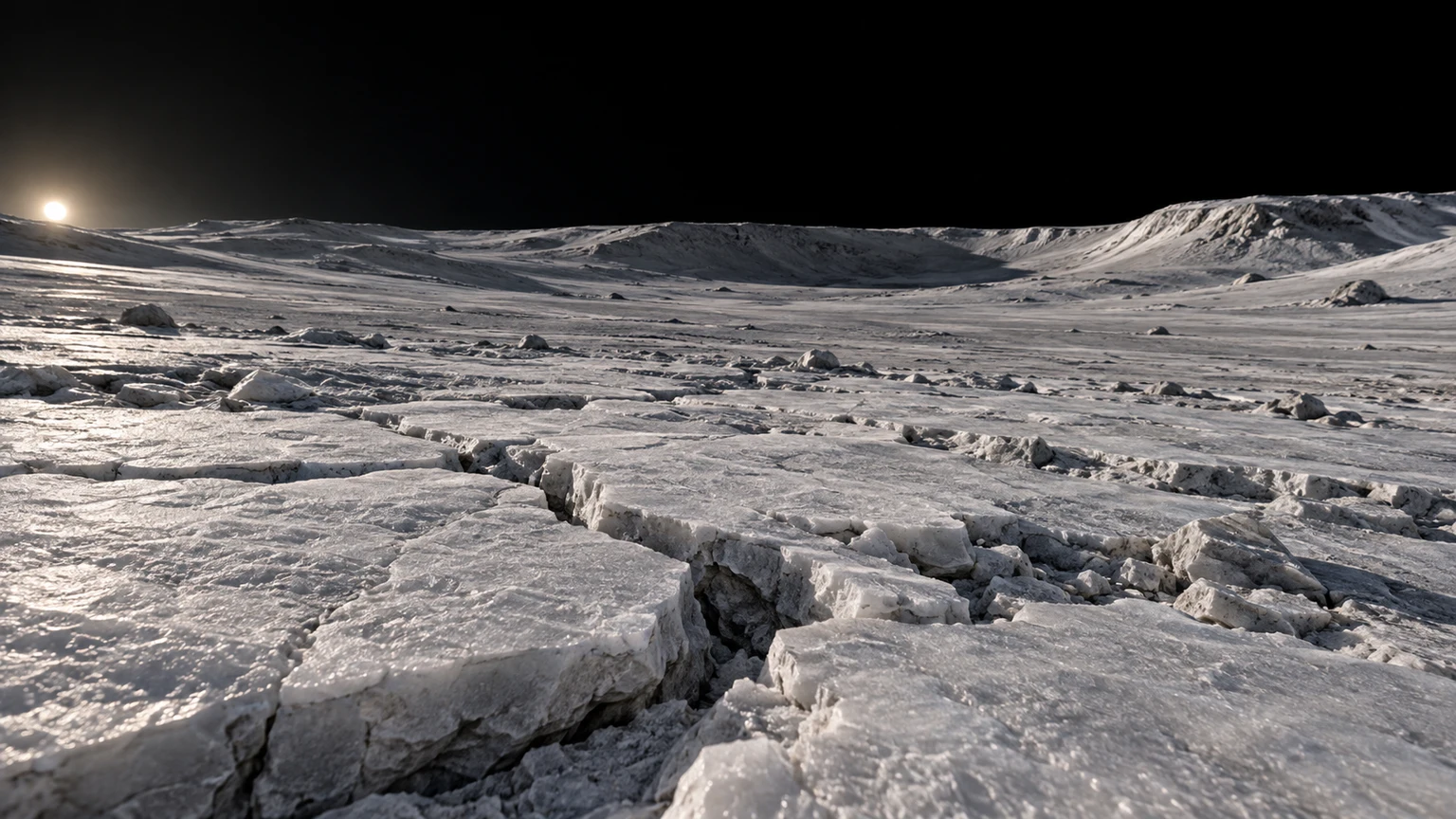
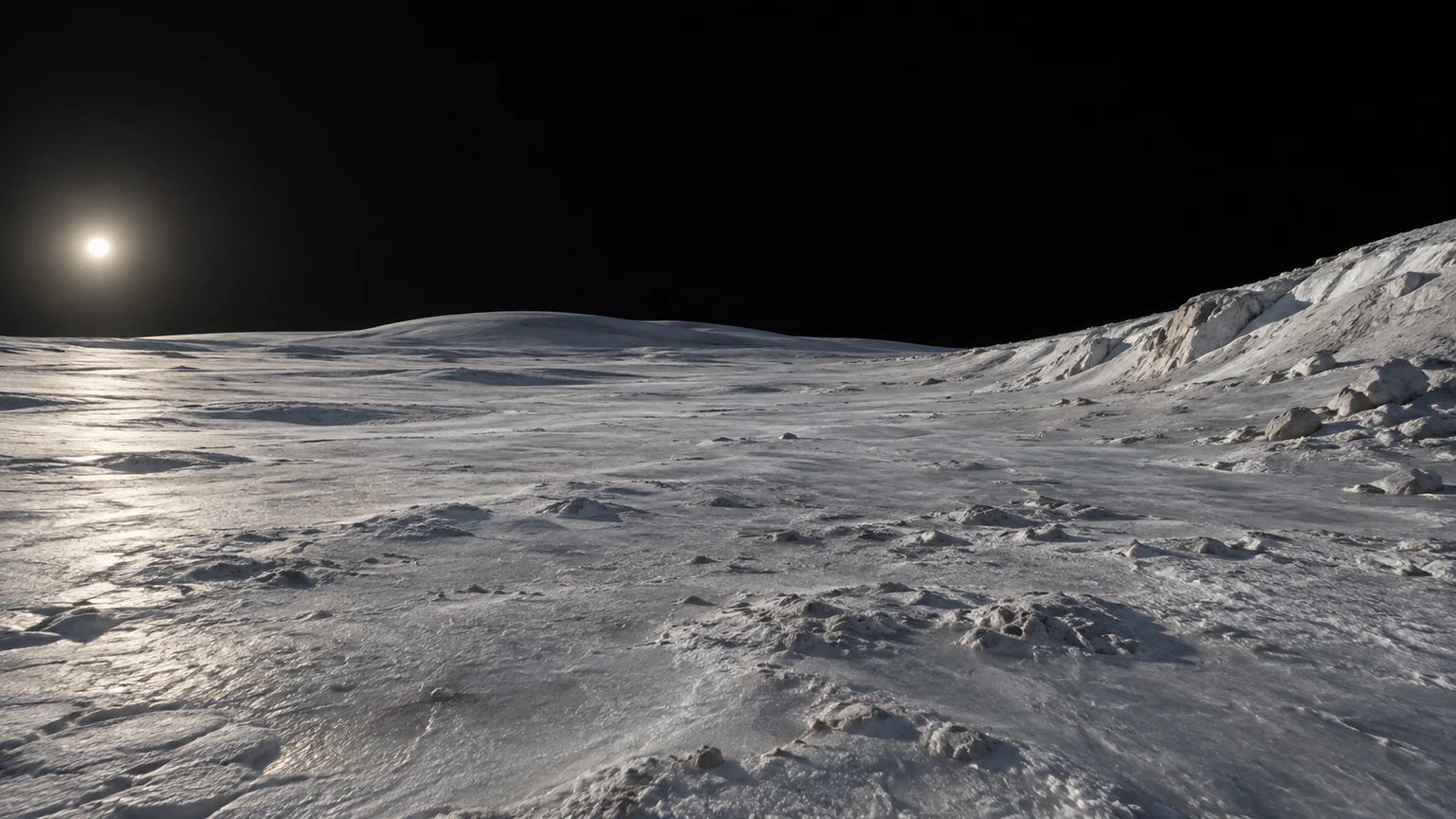
    We know much more about Haumea’s shape than about individual features on its surface. The icy terrain shown here is a possible scene, not a mapped location.

    EQUIV. DIAMETER / EARTH0.11×
    EARTHHAUMEA
    EARTH
    12,756 km
    HAUMEA
    1,393 km
    area-equivalent planet diameter / equatorial Earth diameter · rings excluded

    Haumea is elongated. The circle uses a 1,393 km area-equivalent diameter calculated from the 1,704 × 1,138 km projected outline measured in the 2017 occultation. Its actual outline changes with viewing angle; this is not its longest axis.

    ATMOSPHERE
    No substantial global atmosphere detectedOccultations constrain the atmosphere

    A 2017 occultation set upper limits on global nitrogen and methane atmospheres. Upper limits are not measured gas percentages.

    SURFACE TEMPERATURE
    Very cold · no local measurements
    SURFACE PRESSURE
    Not established at a landing site
    HABITABILITYNo life detected

    There is no evidence of life here. Remote measurements do not establish a liquid-water habitat; the interior remains poorly constrained.

    UNPROTECTED HUMANSNot survivable

    The distant, cold environment offers no known breathable air or protective surface pressure. Human exploration would require a sealed, thermally controlled habitat.

    Planet and landscape images are artistic interpretations.

    • NASA ↗
      • Classification and orbital data
      • Natural conditions and human survival
      • Shape
      • Family
      • Exploration
    • NASA / JPL ↗
      • Rounded heliocentric orbital elements
      • Rotation measurements and uncertainty
    • Research ↗
      • Size, physical data and atmospheric constraints
      • Rings
    Hypothetical ground-level landscape of Haumea. Color and broad material choices follow remote observations; terrain, lighting and local details are artistic interpretation, not a mapped or photographed site.

    Across a pale ice plain

    Hypothetical ground-level landscape of Haumea. Color and broad material choices follow remote observations; terrain, lighting and local details are artistic interpretation, not a mapped or photographed site.

    Hypothetical ground-level landscape of Haumea. Color and broad material choices follow remote observations; terrain, lighting and local details are artistic interpretation, not a mapped or photographed site.

    Fractures in the foreground

    Hypothetical ground-level landscape of Haumea. Color and broad material choices follow remote observations; terrain, lighting and local details are artistic interpretation, not a mapped or photographed site.

    Fractured pale water-ice-rich slabs and granular debris in a shallow pocket, black shadows. An artistic reconstruction of Haumea; local detail, lighting and viewpoint are imagined. The depicted environment is a possibility, not an observed surface or weather map.

    Ice fragments in close view

    Fractured pale water-ice-rich slabs and granular debris in a shallow pocket, black shadows. An artistic reconstruction of Haumea; local detail, lighting and viewpoint are imagined. The depicted environment is a possibility, not an observed surface or weather map.